Telangana Chief Secretary Sanjay Jaju has asked district administrations to enrol more hospitals under PM-RAHAT, the state's health assurance scheme, as reported by Indian Masterminds. For a 100-bed hospital in a district town, a circular like this is not a policy headline, it is a question about whether the billing counter, the pre-authorisation file and the bed board can absorb one more payer line without slowing the ward down. The enrolment form takes an afternoon; the operating consequences last for years.
What a district enrolment drive puts on the hospital's desk
The directive, as reported, is administrative rather than clinical: districts have been told to widen the list of empanelled providers so that scheme beneficiaries find covered care closer to home. Drives of this kind move fastest where a private hospital already runs the specialities the scheme packages cover, general surgery, obstetrics, orthopaedics, dialysis, paediatrics, and has enough bed strength to hold a few scheme admissions at a time without displacing cash and corporate patients.
The arithmetic is simple and rarely written down. A new scheme line brings volume at a fixed package rate, settled on a claim cycle the hospital does not control. That makes empanelment a working-capital decision wearing the costume of a growth opportunity. Hospitals that treat it as the latter end up with higher occupancy, lower realisation per bed-day and a receivables ledger nobody reconciles weekly.
The hospitals that handle it well do three things before signing. They measure current cost per bed-day by ward, including nursing hours and consumables. They count how much of their existing receivable is already parked with TPAs and state schemes, and how old it is. And they decide which specialities will be offered under the scheme instead of opening the whole service list on day one.
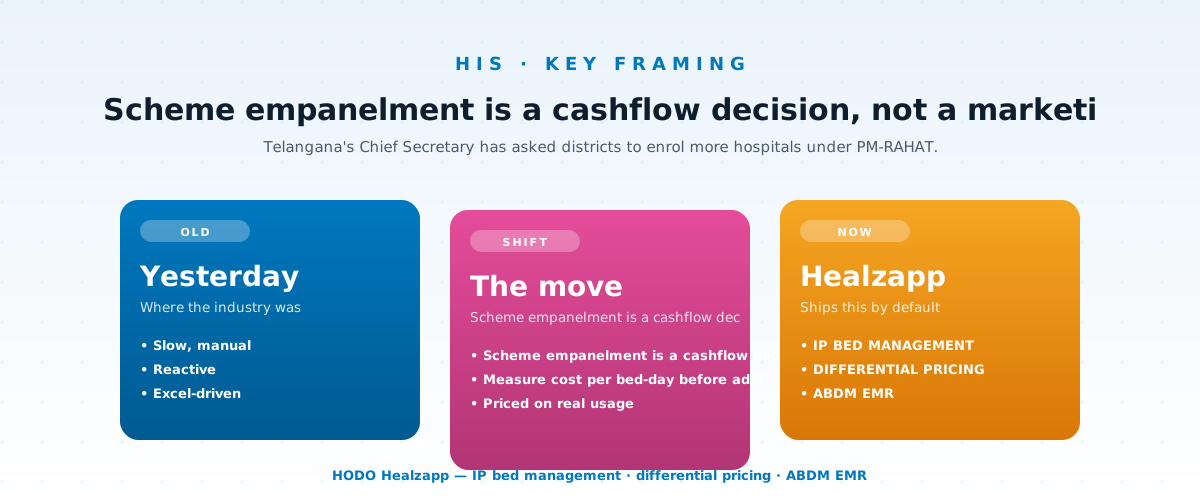
Scheme empanelment is a cashflow decision, not a marketing one.
Pre-authorisation needs an owner, not goodwill
Scheme revenue is lost at the documentation stage far more often than at the clinical one. Every package admission carries a sequence, beneficiary identification, pre-authorisation request with supporting investigations, approval, treatment, discharge summary, claim upload, and each step has a format the payer will reject if it is incomplete. In most 100-bed hospitals this work is distributed informally: the front office verifies the card, a staff nurse hunts for the scan report, a consultant signs the summary three days after discharge, and the claim goes out late with a weak note.
The fix is organisational before it is technical. One named payer desk should own every scheme case from registration to settlement, with a checklist per package rather than a general one. Query response time should be tracked as a number, because scheme portals close windows quickly and a query answered on day nine is often a claim written off. Case papers should live in one record, not in a mix of paper files and photographs on a coordinator's phone.
This is where an EMR earns its cost. When the admitting consultant, the pre-auth coordinator and the claims clerk are reading the same chart, the pre-auth note matches the discharge summary, and the discharge summary matches the bill. When they are not, the payer notices first.
Package rates make payer-wise pricing non-negotiable
A scheme package is a ceiling, not a price list. Inside it sit the bed charge, consultant fee, investigations, consumables and pharmacy, items the hospital usually prices for cash and insurance patients at entirely different rates. If the billing system carries only one tariff, staff will either apply cash rates to a scheme patient and inflate the claim, or apply scheme rates to a cash patient and lose the difference quietly. Both happen in the same month in hospitals running a single rate card.
Payer-wise rate configuration solves the discipline problem at the point of entry rather than at audit. Each payer, PM-RAHAT, a TPA panel, a corporate contract, a walk-in cash patient, carries its own tariff, and the bill is assembled from the correct one the moment the patient's category is selected at registration. Pharmacy and consumables deserve particular attention, because package admissions tend to leak there: items issued to the ward, never charged, never returned to stock.
Alongside pricing, hospitals should know their contribution per package, not just their revenue per package. Three or four high-volume packages usually carry the whole scheme line, and two or three loss-making ones usually explain the monthly gap. Without that split, management debates the scheme in general terms, schemes don't pay, when the real answer is to keep eight packages and stop offering two.
Scheme admissions change the bed board, not just the bill
An enrolment push changes case mix, and case mix changes bed utilisation. Package patients often have a longer stay than their cash equivalents, partly clinical and partly procedural, a discharge waits for an approval, a report, a signature. If the hospital cannot see, on one screen, which beds are occupied by which payer category and which discharges are pending on paperwork rather than on medical readiness, the ward absorbs the delay and the next admission waits in casualty.
Two operational habits matter here. First, a daily discharge huddle that separates clinically ready patients from administratively stuck ones, with an owner against each stuck case. Second, a payer-wise occupancy view, so that management can cap scheme beds at a planned share of the ward instead of discovering after the fact that two-thirds of the surgical floor is on package rates and the hospital's cash cycle has shifted by sixty days.
Outpatient volume moves too. Enrolment drives usually come with screening activity and local publicity, and the OP counter sees the effect first. Queue discipline, token flow and investigation turnaround decide whether that footfall converts into planned admissions or dissipates into a crowded corridor.
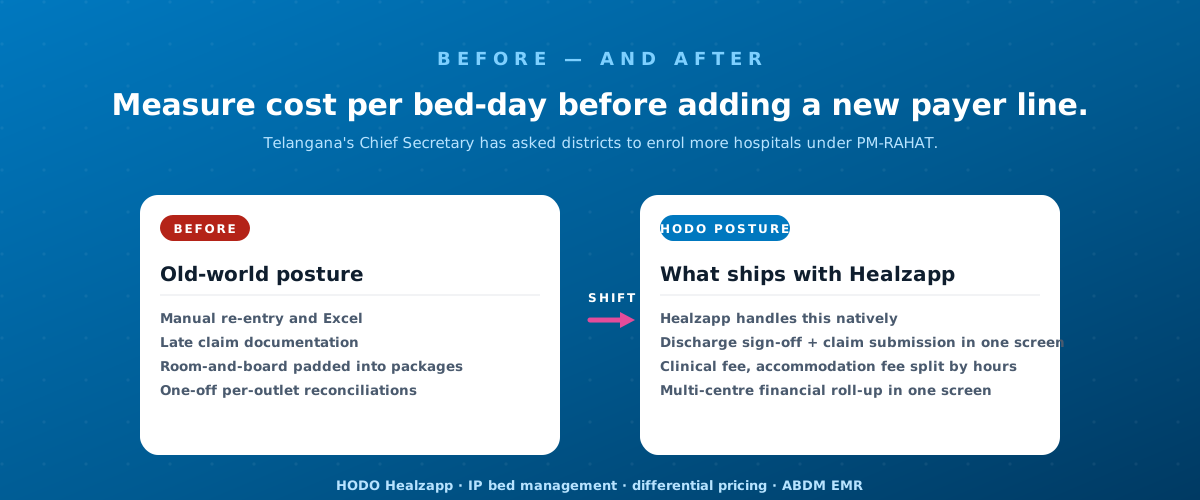
Measure cost per bed-day before adding a new payer line.
Reconciliation is where scheme revenue is won or lost
The last mile is accounting, and it is the part most often left to a spreadsheet. A scheme claim has at least four states, submitted, queried, approved, settled, and each has a date and an amount that rarely matches the hospital bill exactly. Deductions arrive without narrative. If the finance team is re-keying these into Tally from a payer portal every month, reconciliation runs weeks behind reality and ageing analysis becomes guesswork.
Three numbers should be visible to management every week: total scheme receivable by age bucket, claim rejection and deduction rate by reason, and realisation per package against cost. The first protects cash. The second is a process signal, because most rejections cluster on three or four recurring documentation faults that a checklist change can fix. The third decides which packages stay on the list.
Hospitals planning a second unit should note that this discipline does not transfer by itself. A new centre inherits the tariff logic, the payer masters and the claim workflow only if the system carries them; otherwise every branch invents its own method and the group loses comparability within a quarter.
What this means for HODO customers
Scheme enrolment is a configuration exercise as much as a commercial one. HODO Healzapp handles payer-wise tariffs through Differential pricing, so PM-RAHAT, TPA, corporate and cash patients bill from their own rate cards from the registration counter onward. IP bed management gives the payer-wise occupancy and pending-discharge view that keeps package stays from silently consuming the ward. Tally integration moves billing and settlement data into the books without re-keying, which is what makes weekly receivable ageing and deduction analysis practical rather than aspirational.