
ET HealthWorld reported this week that 1,114 hospitals have been de-empanelled and 1,504 penalised under the Ayushman Bharat PM-JAY scheme, following a fresh round of National Health Authority audits. For hospital owners and administrators running PMJAY-heavy caseloads, the message is unambiguous: the empanelment badge is now conditional, revocable, and tied directly to the quality of the documentation trail behind every claim.
The numbers matter more than the headline. 1,114 de-empanelments is not a rounding error — it is a sizeable slice of the roughly 29,000 empanelled hospitals nationwide, and the penalties collected run into crores. NHA has been tightening triangulation between claim submissions, patient records, TPA disbursement patterns, and Ayushman Bharat Health Account (ABHA) linkage. Hospitals that once treated PMJAY paperwork as a back-office chore are now discovering that a mismatch between admission notes, discharge summaries, and package codes is enough on its own to trigger a red flag.
For a 200-bed hospital where PMJAY footfall runs at 30-40% of IP volume, a suspension letter is not merely a compliance annoyance. It is a direct hit on monthly cashflow, on OT scheduling, and on the referral network of ASHAs and CSCs who route beneficiaries. Re-empanelment can take months, and reputational damage with local referrers lingers longer than the paperwork.
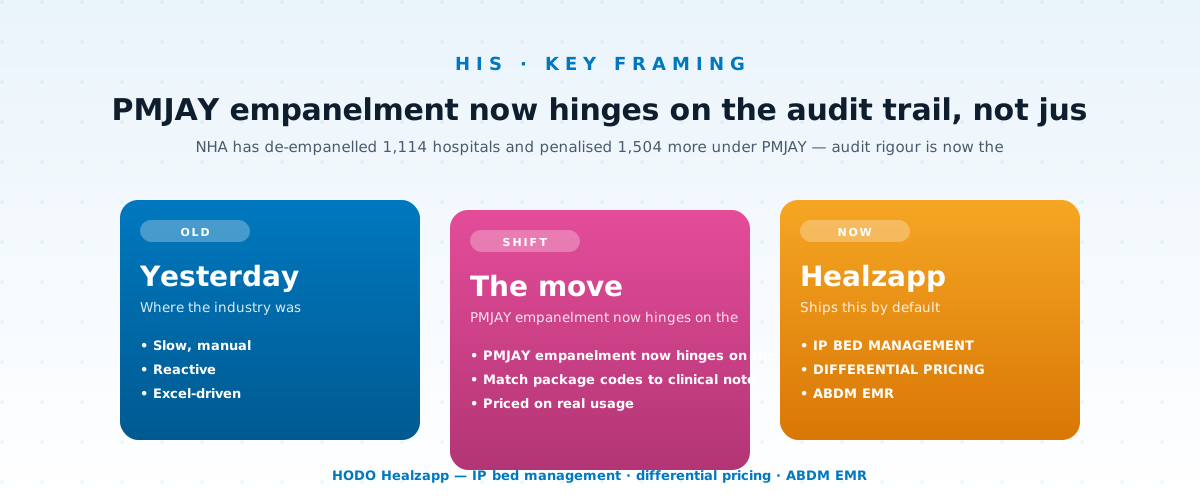
The public notices from NHA cluster failures into a handful of buckets. First, package-code mismatches — a higher-tier package billed while the case sheet supports a lower one. Second, ghost admissions where the paper trail cannot reconcile the patient's actual physical presence, ID capture, and biometric verification. Third, weak discharge documentation that fails to justify length of stay. Fourth, delays or gaps in linking treatment episodes to the beneficiary's ABHA number, breaking the longitudinal record NHA now expects to see across visits.
None of these are exotic failures. They are the routine outcome of running claims workflows in disconnected spreadsheets, paper case sheets, and a billing module that was never designed to speak to an EMR. When the auditor arrives, the hospital is asked to produce a coherent, time-stamped, cross-referenced record — and the reconciliation exercise, done manually across three or four disconnected systems, is what breaks.
Larger corporate chains have compliance teams. A 100-bed standalone hospital typically does not. The claims desk is one or two people, often overloaded, often working from PDFs and scanned copies. Discharge summaries are generated separately from the EMR and re-typed. Consumables issued from pharmacy are logged in one system, while the coded PMJAY package treats them as a fixed inclusion in another. Reconciling those at audit time is where hours turn into weeks and where genuine claims start looking suspicious on paper.
NHA's newer audits pull the digital trail directly. If the timestamp on the OT log does not align with the anaesthesia note, or if the pharmacy issue against a PMJAY IP episode looks inconsistent with the coded package, the query is automated and the response window is short. A hospital whose HIS cannot produce a single, joined view of the admission is at a structural disadvantage in every audit cycle from here on.
The de-empanelment risk is a compliance story, but the downstream story is cashflow. A hospital that runs 40% PMJAY, 30% TPA, 30% cash is exposed on both public and private insurance channels — because the same documentation weaknesses that trigger PMJAY penalties also cause TPA claim rejections. Deficiencies are not scheme-specific. If a case sheet does not justify a procedure to NHA, it will not justify it to Star Health, HDFC ERGO, or a corporate cashless desk either.
Administrators focused only on the PMJAY headline are missing the wider point. The operational discipline needed to survive an NHA audit is the same discipline that shortens TPA claim cycles from 45 days to 20, that reduces query rejection rates, and that lifts the overall collection ratio. Compliance and cashflow are the same problem, viewed from two ends of the same corridor.
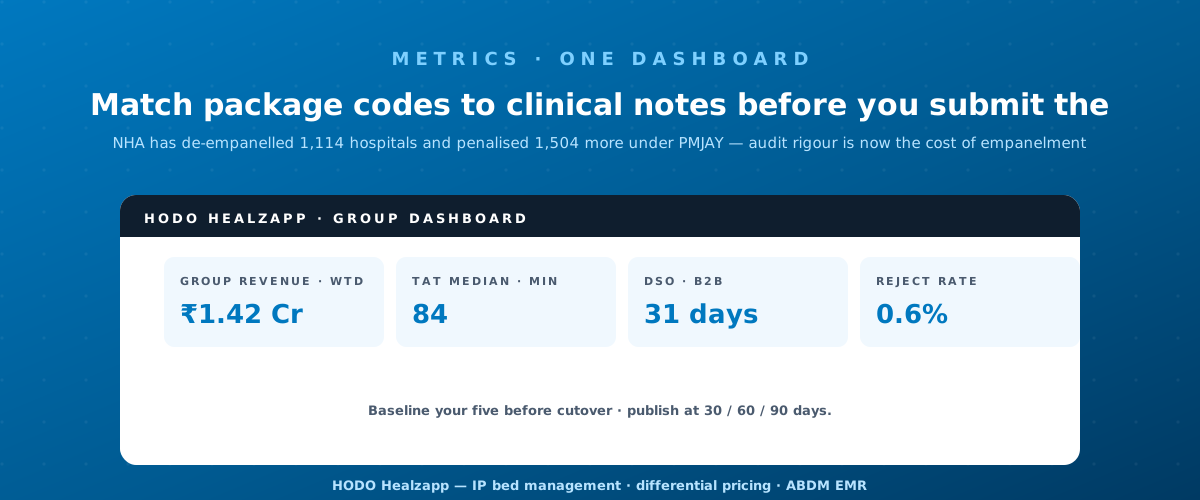
For clinic chains and hospital groups adding new outlets, PMJAY empanelment at each new centre is now a longer process — and losing empanelment at one outlet raises scrutiny at the others under the same ownership. Group-level compliance visibility, standardised documentation templates, uniform ABDM linkage practices, and centralised claim monitoring stop being nice-to-haves. They become the price of scale, and they need to be in place before the third outlet opens, not after.
Administrators expanding into Tier-2 and Tier-3 towns, where PMJAY volume can be 60-70% of IP mix, need to think about compliance infrastructure before they think about signage and equipment. A new outlet that gets de-empanelled in its first year is a strategic setback, not a routine hiccup, and it will shape the group's audit profile for years.
Hospitals running HODO Healzapp already have the plumbing to close most of the gaps NHA is now auditing against. The ABDM-compliant EMR links every episode to the patient's ABHA number at admission, closing the longitudinal-record gap that trips up many hospitals during audit. The unified EMR (AI-condensed history) keeps admission notes, OT logs, pharmacy issue, and discharge summary on a single time-stamped record — so a claim audit produces one coherent view rather than a manual reconciliation exercise across systems. And the Healzapp Billing module ties the coded package directly to the clinical documentation, so package-to-notes mismatches surface before submission, not after a de-empanelment notice arrives.
For multi-outlet groups, the same setup replicates across centres with one-click new-centre setup, giving the head office a single compliance dashboard rather than a dozen different claim desks each running their own version of the truth.
See how Healzapp handles this — book a 30-min demo.
See how Healzapp, Labzapp and EReazy fit your speciality in a free 30-minute demo.
Book a Free Demo