The National Health Authority has de-empanelled 2,359 hospitals and suspended another 1,200 from the Ayushman Bharat PMJAY scheme, per a Livemint report this week. The action targets ghost billing, upcoded procedures and identity mismatches, and it puts every empanelled hospital on notice.
What actually triseggered the crackdown
The scale of the action, nearly 3,600 facilities pulled from the network in one sweep, signals the NHA has moved past soft warnings. Auditors flagged three recurring patterns: procedures billed against patients who never showed up, tertiary-care packages claimed for day-care work, and Aadhaar mismatches between the claim record and the treated patient. Owners in Tier-2 and Tier-3 cities are hit hardest because PMJAY often anchors 30-60% of monthly IP throughput for these hospitals. Losing empanelment does not just cost future claims, it triggers clawback demands, blacklisting from state schemes, and reputational fallout that ripples into cash-pay footfall. Administrators need to stop treating PMJAY compliance as a claims-desk problem. It is now a governance issue that touches admissions, EMR, pharmacy and billing simultaneously. The MD who signs off on empanelment renewal is the person who bears the risk when a random NHA sample pull turns up a documentation gap three quarters old.
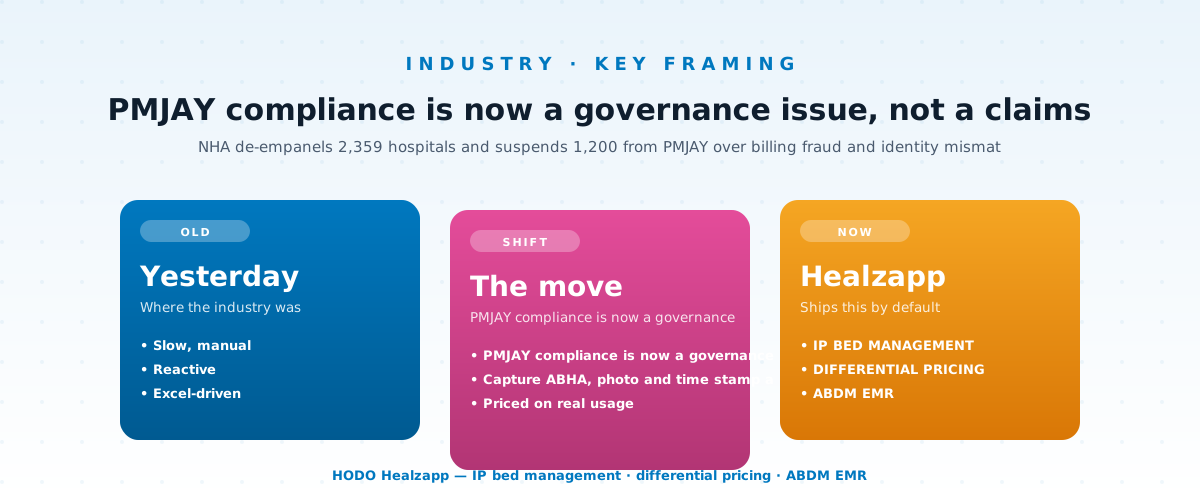
PMJAY compliance is now a governance issue, not a claims desk task.
The three audit trails NHA is checking
First, patient identity: does the Aadhaar or ABHA number on the claim match the person physically admitted, with a live photograph on file? Second, clinical documentation: is there a time-stamped record trail, investigations, notes, medication administration, that supports the package claimed? Third, financial trail: does the billing head match the discharge summary, and is the package selection consistent with the diagnosis codes? Hospitals that rely on paper case sheets and standalone billing software are structurally exposed because the three trails live in different systems and different formats. When the audit team pulls a random sample, the reconstruction takes days, and any gap gets read as intent to defraud. The fix is not more staff. It is a single record spine that ties admission, clinical and billing events to one patient episode, retrievable in minutes.
Why manual reconciliation is the failure point
Most mid-sized Indian hospitals still reconcile PMJAY claims at month-end using spreadsheets, a claims coordinator sits with the discharge register, case sheets and the TMS portal to piece together evidence. This process breaks at 40-50 claims per week. Errors compound: a wrong package selected in week one gets duplicated for the next similar case; a missing pre-authorisation reference gets papered over; a discharged patient's photograph gets uploaded from a stock folder because the original was never captured. Auditors specifically look for these patterns. Meanwhile, the hospital's own cashflow is squeezed because rejected claims sit in a resubmission queue with no ageing dashboard. Owners see a receivables number in the monthly MIS but no line of sight into which claims will actually convert to cash. By the time the CFO asks the question, the query window has often closed.
What a hardened workflow looks like
The compliance-ready workflow starts at registration: ABHA capture, biometric or photo verification, and auto-linking to the PMJAY beneficiary database before the patient is admitted. During the stay, every clinical event, investigation ordered, medication administered, procedure performed, is logged with a user stamp and time stamp. At discharge, the package is auto-suggested from the ICD codes on the summary, and the claim file is generated with all supporting documents bundled. Pharmacy issue notes and OT logs are pulled in automatically. Nothing is re-keyed. The claims coordinator's job shifts from evidence-hunting to exception-handling. When the auditor asks for a random pull, the entire episode reconstructs in minutes, not days. This is not a compliance nice-to-have, it is the difference between staying empanelled and joining the next list of 2,359.
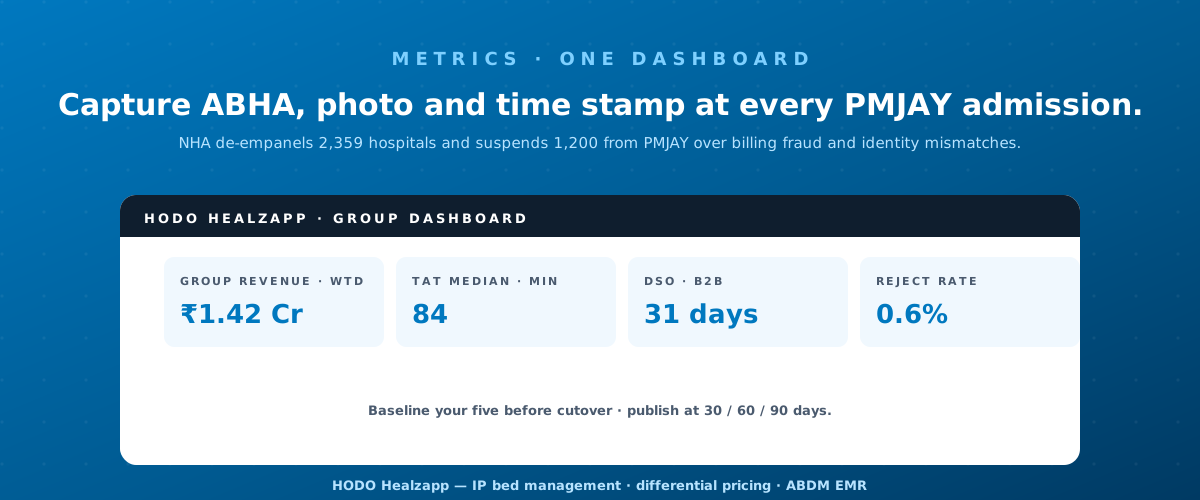
Capture ABHA, photo and time stamp at every PMJAY admission.
Cashflow, not just compliance
The other half of the story is money. Even hospitals that stay empanelled bleed on TAT. NHA data shows the median claim cycle is 45-60 days when submissions are clean; it stretches to 90-120 days when queries pile up. For a hospital doing Rs 40-60 lakh of PMJAY billing a month, a 30-day slip is Rs 40-60 lakh stuck in receivables. Administrators tracking DSO at outlet level find PMJAY-heavy outlets consistently 15-20 days worse than cash-pay outlets. A tightened workflow, pre-auth capture at admission, package validation at discharge, one-click claim submission, pulls TAT back inside 45 days and frees working capital for salaries, consumables and expansion. The compliance investment pays for itself in cashflow terms alone, before any de-empanelment risk is priced in.
What this means for HODO customers
For hospitals running HODO Healzapp, the single-spine architecture already ties admission, clinical and billing to one patient episode. Three features carry the compliance load. ABDM-compliant EMR captures ABHA IDs at registration and links every clinical event to the beneficiary record, so identity mismatches surface before the claim leaves the hospital. The Billing module reads the discharge summary and flags package-to-diagnosis mismatches at the point of claim generation, which is where NHA audits most often catch upcoding. And Patient Management logs a photograph, ID capture and admission time stamp for every episode, the exact three-item bundle NHA auditors ask for when they pull a sample. Multi-outlet groups also get one-view reconciliation across centres, so the CFO sees which outlet is running claim TAT above 45 days and where the ageing bucket is building.