CNBC TV18 reports that 112 treatment packages under Ayushman Bharat PM-JAY may be reserved for government hospitals from 1 December, which would stop empanelled private hospitals from claiming against them. For a 100-bed hospital in a tier-2 district, that is not a policy footnote — it is a change in next month's receivables mix. The operational questions are narrow and answerable: how much admitted volume sat on those packages, what fills those beds instead, and whether the billing stack can show both numbers before the month closes.
What the reported change does to a private hospital's book
PM-JAY pays on fixed package rates against a defined list. Reserving a block of that list for public facilities removes two things from a private empanelled hospital at once: the case volume, and a payment stream that is slow but predictable. The first effect is visible in the IP register within a fortnight. The second shows up a quarter later, when the receivables ageing report changes shape because the mix has moved from scheme claims to insurance, corporate and cash.
Because the report carries a 1 December date, hospitals have weeks rather than quarters to respond. The first move is arithmetic, not representation. Pull the last twelve months of PM-JAY claims, group them by package code, and look at concentration. Most ~100-bed hospitals find that scheme revenue sits in ten to fifteen package codes — typically a few surgical lines, dialysis or medical management blocks, and a long tail that barely moves. If the restricted set overlaps those top codes, the exposure is material. If it hits the tail, the headline is louder than the impact.
The practical obstacle is that this claim history is rarely in one place. It is split across TPA portal exports, the hospital's billing module, and a spreadsheet maintained by the claims desk. Hospitals that cannot produce a package-code-wise revenue and deduction report in an afternoon will spend the available weeks assembling data instead of acting on it.
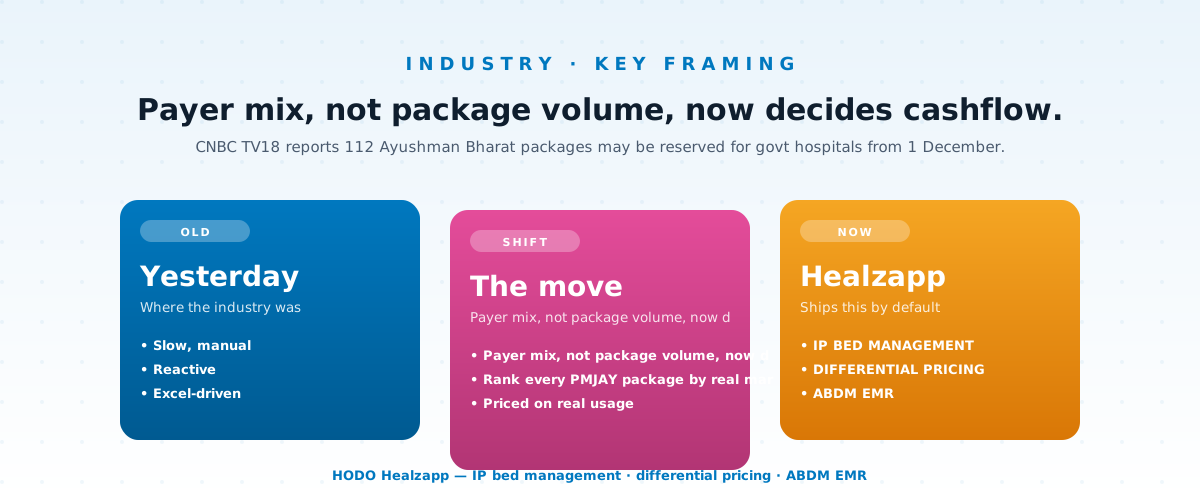
Payer mix, not package volume, now decides cashflow.
Why ~100-bed hospitals feel this before the large chains
Large corporate groups carry a payer-mix cushion: retail insurance, corporate panels, international patients, and a brand that pulls cash OP. A district 100-bed hospital often runs 30 to 50 per cent of its inpatient volume on government schemes, and that volume is doing quiet structural work. Scheme cases tend to have longer length of stay at a fixed rate, which means they act as base load — they keep the nursing roster justified, the OT list populated, and pharmacy and consumable purchase volumes at a level that holds negotiated rates.
Losing base load frees beds, but it also removes the floor under fixed cost. The choice then is between re-filling those beds with insurance and cash work — which needs demand generation, tighter discharge cycles and faster turnaround of the bed itself — or trimming the roster, which is slower and harder to reverse. Bed occupancy is the instrument to watch here, not revenue. A hospital that drops from 72 per cent to 58 per cent occupancy while holding revenue flat has still lost ground, because the next recovery has to come from a thinner operating base.
Working capital shifts as well. Scheme payments are delayed but arrive in a known pattern. TPA and insurance payments involve pre-authorisation, query cycles and deductions, with cash coming in a different rhythm per payer. A payer-mix change of twenty percentage points will move the cash curve even if the annual revenue line does not budge.
Costing each package before December, not after
A surprising number of hospitals cannot say whether a specific PM-JAY package was profitable. The package rate is known; the delivered cost usually is not, because consumables, implants, drug issue, bed-day cost, OT minutes and the TPA's historical deduction rate sit in different systems.
The exercise is mechanical. Take each package rate, subtract implants and consumables at actual issue cost, add drug and investigation cost from the case records, apply a bed-day and OT-minute rate derived from fixed cost, then discount by the average deduction percentage that payer applies to that package. Hospitals that run this honestly often find that a third of their scheme packages were loss-making at the package rate and were tolerated because they kept beds full and theatres busy.
That ranking changes the response entirely. If the restricted 112 include the loss-making lines, the exit is a margin improvement disguised as bad news, and the work is to protect occupancy cheaply. If they include the profitable lines, replacement demand has to be built deliberately — referral doctors, corporate panels, outreach diagnostics — and the hospital needs a credible target for how many cases each stream must deliver per month. Without package-level costing, both conversations run on opinion.
Rebuilding demand: referral, corporate and cash
Three replacement streams are realistic within a quarter. Referral demand from nearby clinics and consulting doctors is the fastest, but it needs a referral log that records who sent which case and what came back, otherwise follow-up collapses into memory. Corporate and TPA panels add volume at negotiated rates, which means every new panel brings its own rate card, its own exclusions and its own claim format. Retail cash OP and diagnostics is the third, and it is the one that does not consume beds — OP throughput, orderly token flow and same-day report delivery do most of the work.
Outreach and B2B lab work deserves separate mention. Processing samples for smaller labs and collection points adds contribution margin without touching inpatient capacity, and it uses equipment that is already depreciating. For hospitals with spare analyser capacity, it is often the quickest offset to a scheme revenue dip.
The caution is administrative. Each additional payer multiplies rate-card complexity, and rate cards maintained in spreadsheets are the standard source of billing leakage — wrong rate applied, concession given twice, package item billed outside the package. The cost of a payer-mix shift is usually not the lower rate; it is the quiet revenue loss in how that rate gets applied at the counter.
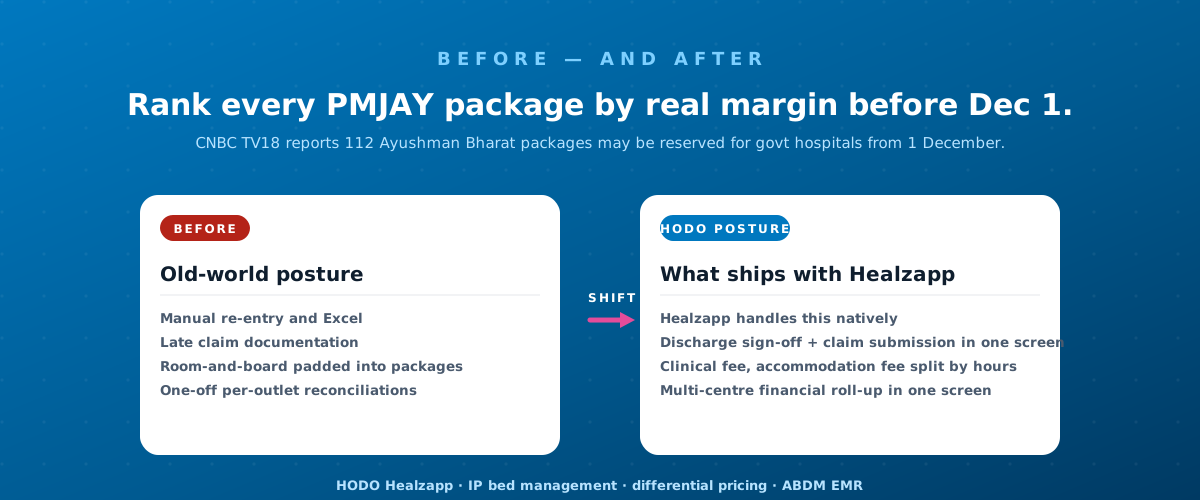
Rank every PMJAY package by real margin before Dec 1.
Claims discipline on a narrower base
Where scheme claims continue, they now matter more per claim. Deduction and rejection rates that were acceptable at high volume become expensive when the base shrinks. The controllable variables are documentation completeness, pre-authorisation timelines, discharge summary quality and investigation records that match the claimed package.
Two habits separate hospitals that recover quickly. First, rejection review moves from quarterly to weekly, grouped by reason code, so that a recurring documentation gap is fixed in days rather than discovered at audit. Second, billed-versus-received reconciliation runs per payer with ageing buckets, so that a TPA slipping from 45 days to 80 days is visible before it becomes a payroll problem. Records held in ABDM-compliant form also reduce the retrieval cost when a claim is queried months later.
What this means for HODO customers
HODO Healzapp is built for exactly this kind of payer reshuffle at ~100-bed scale. Differential pricing holds a separate rate card per scheme, TPA, corporate panel and referral partner, so a mix change does not become a counter-level billing error. Billing ties package-level revenue to the actual consumables, drugs and investigations issued on that case, which is what makes package-wise costing a report rather than a project. IP bed management shows occupancy and length-of-stay movement as the scheme mix changes, so freed capacity is visible while it can still be re-filled. Tally integration keeps billed-versus-received reconciliation and payer ageing in the accounts the finance team already uses. For hospitals adding collection points or satellite OP centres to replace lost inpatient volume, multi-outlet scale-up with one-click new-centre setup keeps the same rate cards and reporting across sites.