At the Economist's AI in Health Summit, King Faisal Specialist Hospital took the stage to talk about patient experience and nursing rather than diagnostic accuracy, according to coverage carried by Yahoo Finance. For polyclinic operators in Dubai, Abu Dhabi, Doha, Kuwait City and Manama, that choice of subject is the interesting part. The things that decide whether a clinic visit feels tolerable sit in queues, nursing documentation and insurance paperwork — not in an imaging model.
What KFSH actually brought to the summit
A tertiary referral centre with research budgets and a dedicated digital team is not a seven-doctor polyclinic on Sheikh Zayed Road. But the framing travels. When a hospital of that size chooses to present AI as a patient-experience and nursing-support story, it is signalling where the measurable return showed up: in the administrative and coordination layer, where staff time leaks in small increments all day.
That is the layer most GCC polyclinics have never instrumented. Ask a clinic manager for monthly revenue per doctor and the answer arrives in seconds. Ask for average door-to-doctor time by hour of day, or how many minutes a nurse spends re-entering vitals that already exist somewhere in the system, and the answer is an estimate. Without those numbers, any AI purchase is a guess dressed up as strategy.
The practical reading of the KFSH session, then, is a sequencing instruction. Patient experience and nursing workload are where automation pays first because they are high-frequency, low-complexity and entirely within a clinic's control. Nothing in that list requires a research partnership. It requires a clinic HIS that records the right events with the right timestamps.
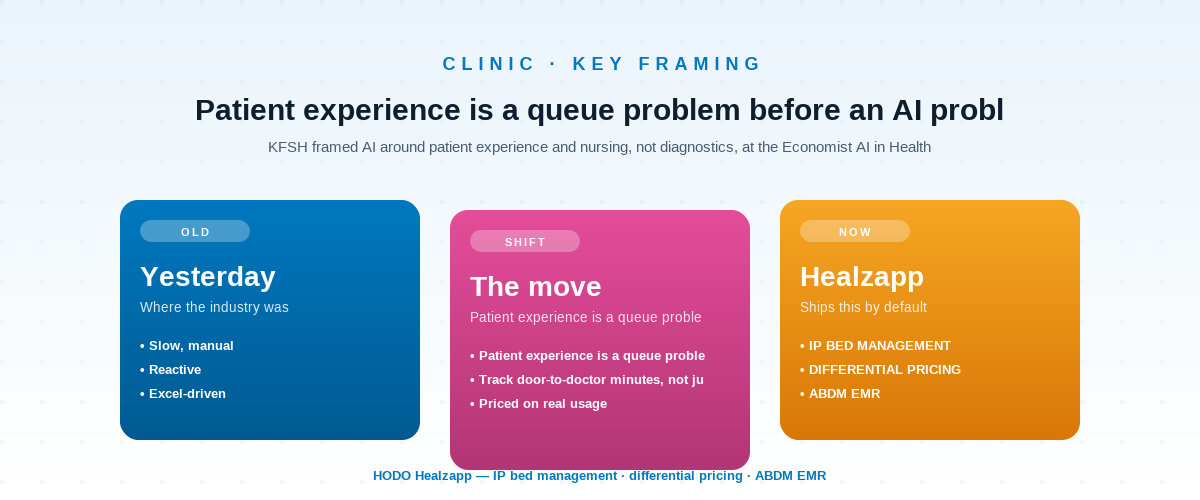
Patient experience is a queue problem before an AI problem.
Patient experience in a polyclinic is a queue problem
In a multi-doctor polyclinic, patient experience has very little to do with clinical quality as the patient perceives it in the moment. It has to do with three questions: how long until my turn, where do I stand, and did anyone tell me the truth about the wait. A clinic that answers those three well scores better on reviews than one with stronger clinicians and a chaotic waiting room.
The mechanics are unglamorous. Appointment slots have to reflect how long each doctor actually takes rather than a uniform fifteen-minute grid applied across dermatology, dentistry and internal medicine. Walk-ins — still a large share of volume in most GCC clinics — need a visible position in the same queue as booked patients, otherwise the booked patient watches a walk-in go in first and loses trust in the booking system entirely. Reception needs one screen showing which rooms are occupied, which doctor is running late and by how much.
Display matters too. A waiting area where token numbers and room assignments are on a screen removes a large fraction of the questions reception answers verbally, in two or three languages, over and over. Each of those interruptions costs a receptionist attention that should be going to registration, insurance eligibility and payment. The cheapest patient-experience intervention in most clinics is not an AI assistant; it is accurate information displayed where patients are already looking.
Nursing time is the cost line nobody measures
Nursing workload in a polyclinic is diffuse, which is why it escapes scrutiny. There is no ward, no shift handover ritual, no obvious place where the time goes. Instead a nurse moves between vitals, injections, dressings, vaccine stock, consumable counts, chaperoning and chasing a doctor for a clarification. Most of it is undocumented, and what is documented is often typed twice — once on paper during the encounter, once into the system afterwards.
This is the workload KFSH was pointing at, and it is where structured capture beats free text. Vitals entered once, at the point of measurement, on a screen designed for a nurse rather than a doctor, do not need re-entry. Standing orders and injection records held against the visit rather than in a separate register do not need reconciliation at the end of the day. Consumable usage tied to the procedure it was used for does not need a monthly stock-take argument.
There is a second-order benefit for the doctor. When a returning patient's history arrives already condensed — last visit, active medications, recent results, allergies — the consultation starts from a summary rather than a scroll. In a clinic running twenty-five to forty consultations per doctor per day, two minutes recovered per encounter is close to an hour of clinical capacity. That is a throughput gain large enough to show up in the monthly numbers, and it comes from documentation design rather than from any clinical algorithm.
Insurance and billing decide whether the gains survive
A polyclinic in the UAE, Qatar or Kuwait can run a fast clinical floor and still have an unhappy patient at the exit. Insurance is where the visit goes wrong: an eligibility check that was not done at registration, a co-payment the patient did not expect, a package price that differs from what the corporate contract says, a claim rejected weeks later for a coding mismatch.
The fix is upstream. Eligibility and co-payment need to be established at registration, before the patient sees a doctor, so the number quoted at the counter is the number on the receipt. Corporate and insurer-specific rate cards need to live in the system rather than in a spreadsheet the senior cashier maintains. Cash, card, insurance and corporate-credit flows all need to close against the same visit record so that the day's collection reconciles without manual work.
This is also where licensing and audit requirements land. DHA, MOHAP and equivalent authorities expect records that reconcile — encounter, order, result, claim — and a clinic that cannot produce that chain quickly spends management time it does not have on inspections and queries. Clean billing is not only a cashflow matter; it is the evidence trail that keeps a licence renewal uneventful.
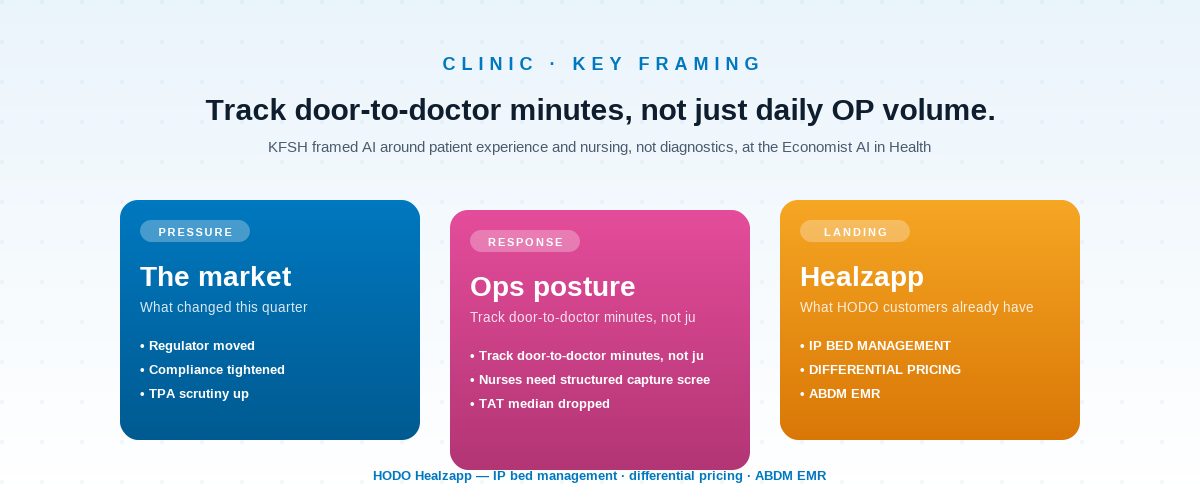
Track door-to-doctor minutes, not just daily OP volume.
Repeating the experience across branches
Most GCC polyclinic groups do not fail at the first clinic. They fail at the third, when the operating model that one strong manager held together by memory has to be reproduced by someone else in a different emirate. Doctor rosters, package pricing, insurance mappings, report templates and token-display logic all get rebuilt locally, slightly differently, and the group loses the ability to compare branches on anything except revenue.
The defence is configuration that is set once at group level and inherited by each new centre, with only genuinely local variation — licence details, doctor list, currency, payer mix — configured per site. A new branch should open with the parent group's pricing, templates and workflows already loaded, not with a three-week setup project. Reporting then compares like with like: door-to-doctor time in Al Barsha against the same metric in Doha, measured identically.
Shared capacity matters too. A teleconsultation slot lets a specialist who sits in one branch cover demand in another without relocating, and a patient app that carries reports and prescriptions across branches keeps the group looking like one organisation to the patient.
What this means for HODO customers
The KFSH framing is a useful filter for a polyclinic's technology shortlist: before evaluating any AI add-on, check whether the clinic HIS already records the operational events worth improving. In Healzapp, Nursing Station captures vitals, injections and procedure consumables at the point of care so nothing is entered twice, while EMR (AI-condensed history) presents a returning patient's relevant history as a summary rather than a chronological scroll. TV Token Display handles the waiting-room information problem that drives most of a receptionist's interruptions, and Multi-outlet scale-up with one-click new-centre setup means the second and third branch inherit the pricing, templates and workflows that already work. The sequence is deliberate: measure the queue and the nursing load first, automate second.