The Economic Times has published a comparison of how Abu Dhabi and India are each trying to convert continuous health data, wearables, remote monitors, lab analysers, pharmacy records, into health intelligence a clinician will actually act on. The piece frames it as a two-way learning exercise: population scale and cost discipline on one side, dense data governance and payer-level visibility on the other. For a polyclinic operator in Abu Dhabi, Dubai or Doha, the useful part of that argument is narrower than the policy framing suggests.
Where the Abu Dhabi-India comparison lands for clinics
Policy comparisons between the two systems usually stop at infrastructure: health information exchange coverage, consent architecture, patient identity, and who funds the analytics layer. Abu Dhabi has a mandated exchange and a largely insured, comparatively small population, so record completeness per patient is high. India has volume, hundreds of millions of encounters a year, and is building national plumbing to match it. Each side, in the Economic Times framing, is learning from the other's constraint.
None of that reaches the floor of a polyclinic in Khalifa City or Deira. There, the problem is not that data is scarce. A typical chronic patient arrives with a continuous glucose monitor export as a PDF, a home blood-pressure log photographed and sent on WhatsApp, two outside lab reports with different reference ranges, and a pharmacy history the clinic cannot see. The consulting doctor has eight to twelve minutes. Faced with four unverified sources, the rational response is to ignore all of them and re-order the tests.
That is the real loss. Trust, not volume, is the scarce input, and trust is produced by workflow rather than by a model. Health intelligence is a property of how the record was assembled, instrument, operator, timestamp, identity, long before any algorithm reads it.
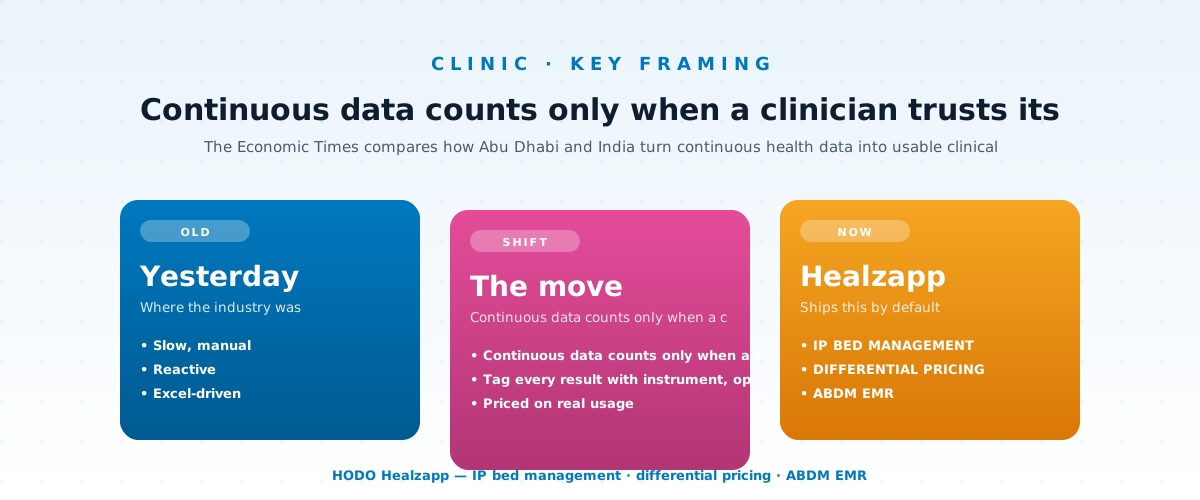
Continuous data counts only when a clinician trusts its source.
Provenance is a front-desk job, not an AI feature
Every clinically useful data point carries four attributes: which instrument produced it, which staff member handled it, when it was captured, and which patient identity it was attached to. Results that flow from an analyser or imaging modality straight into the record carry those attributes by construction. Values typed in by a technician do not, and no downstream intelligence layer can reconstruct them.
The practical rule for a polyclinic group is to close the keyboard path for anything a machine can report. Haematology, biochemistry and urine analysers, ECG and vitals monitors should post results against a barcoded order, not against a handwritten slip. Where that interfacing is missing, the cost shows up later as repeat testing and as disputes about which of two conflicting potassium values was real.
Externally sourced data needs the opposite treatment: keep it, label it, and do not merge it silently into the trend line. A patient-supplied CGM report belongs in the record as an attachment with its source named, visible to the doctor, but not plotted alongside in-house results as though the two were equivalent.
Identity is the other half. Capture of Emirates ID or the local equivalent at registration, rather than name and mobile number, decides whether five years of a patient's data land on one record or on three near-duplicates.
The consultation is where intelligence has to arrive
Polyclinic economics in the GCC are built on throughput: 25 to 40 patients per doctor per session, slots of eight to twelve minutes, a high walk-in share, and a largely expatriate population whose history is discontinuous because they change employers, insurers and emirates. A doctor in that setting will not scroll fourteen previous visits to find the last HbA1c.
So the output of all this collection has to be a short, structured brief at the top of the encounter: active problems, current medication, last values for the handful of markers relevant to the presenting complaint, and anything flagged as unverified. Anything longer is decoration. Condensing history to a single screen is a throughput argument before it is a clinical one, it shows up as fewer repeat investigations and shorter consultation overruns.
The second lever is moving routine chronic review off the physical slot. A diabetic patient whose numbers are stable does not need a room, a nurse and a parking space for a five-minute conversation about dose. Teleconsultation, paired with a patient-facing app that carries the report and the next appointment, is a cheaper unit of contact, and it keeps the data stream continuous between in-person visits instead of resetting it each time.
Payer rules decide which data is worth capturing
In Abu Dhabi, Dubai, Doha and Kuwait, the insurer decides what gets done. Prior approvals, co-pay tiers, network-specific tariffs and claim rejection on eligibility or coding errors shape clinic margin far more than list price does. Continuous monitoring and remote follow-up only survive the budget conversation if they map to a billable service line or measurably reduce rejections.
That makes a payer-by-payer view of the data question unavoidable. Which monitoring activity is reimbursable under which network. Which chronic-care protocol needs approval before the first reading is taken. Which corporate contract pays a package rate, where the marginal test is a cost rather than revenue. Differential pricing per payer and per corporate partner is not a billing nicety in this market, it is the rule set that decides whether a protocol is viable at a given branch.
The same logic applies to corporate and referral traffic. A group running occupational health screening for employers is generating structured, repeatable data at a known price per head. Giving those employers their own login to raise requests and pull results turns the data relationship into a retention mechanism rather than a monthly email exchange.
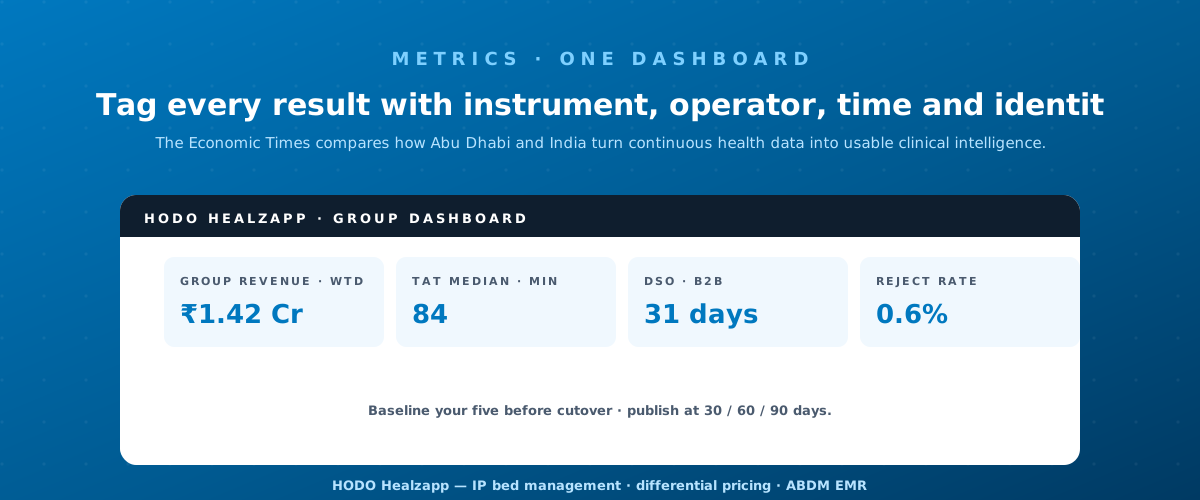
Tag every result with instrument, operator, time and identity.
One patient, three branches, three records
Most polyclinic operators in the region run three to twelve locations, often across more than one emirate or country, and the record fragments branch by branch. The same patient is registered twice because the second receptionist spelled the name differently; one branch cannot see the prescription written at another; the lab result stays with whichever centre ordered it.
Fragmentation of this kind is not fixed by exhortation. It needs a single patient master shared across locations, deduplication at the point of registration, and one order-and-billing identity per episode regardless of which site performed which part of it. It also needs a new centre to inherit the existing service master, tariff structures, payer configuration and user roles, otherwise every expansion adds another dialect of the same data.
That is also the honest test of readiness for any form of clinical intelligence. If the answer to where a patient's last creatinine sits depends on which branch is asked, the problem to solve is not analytics. It is the record.
What this means for HODO customers
The Abu Dhabi-India comparison is most useful as a reminder that the intelligence layer sits downstream of record quality, and that record quality is an operations decision. For a polyclinic group, three capabilities carry most of that load. Machine Interfacing removes the transcription step so analyser and modality results arrive against a barcoded order with their source intact. EMR (AI-condensed history) turns an accumulated record into the one screen a doctor can read inside a ten-minute slot. Multi-outlet scale-up with one-click new-centre setup keeps masters, tariffs and payer rules identical as locations are added, so the patient master does not fracture with growth. Around them, Appointments, Billing configured for GCC patterns, Teleconsultation, the Patient Health App and WhatsApp/SMS report delivery close the loop between visits.