
Aster DM Quality Care is putting more than Rs 600 crore into technology, as reported by Multibagg AI and carried on Google News. A number that size is a strategy statement rather than a budget line, and it arrives while polyclinic groups in Dubai, Abu Dhabi, Doha and Manama are being asked by their own boards what their digital plan looks like. For a four-doctor polyclinic the useful question is not how to match that spend, but which part of it actually buys throughput.
At group scale, a technology programme is mostly coordination. The money goes into replacing legacy systems across dozens of sites, moving records to cloud or co-located infrastructure, rolling out clinical documentation to thousands of users, wiring up devices and payer channels, and building a reporting warehouse the board can trust. Licences and hardware are usually the smaller share. The larger share is people: trainers, integration engineers, data migration specialists and a long period of parallel running where the old and the new system both stay alive.
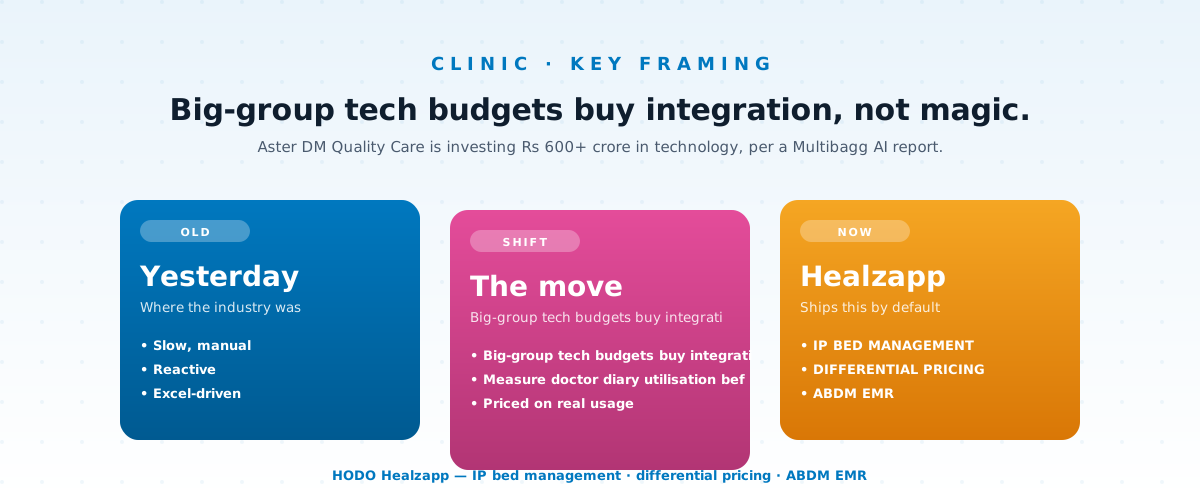
That is the part a single polyclinic does not have to pay for. Thirty users across two locations do not need a change-management workstream. The inverse is also true, and it is the harder constraint: a polyclinic has no integration team, no migration team and nobody whose full-time job is chasing a vendor. Anything that arrives as a project rather than a configured feature will sit half-finished. So the lesson from a Rs 600 crore programme is not a shopping list. It is a filter — buy capability that is already built, already tested against the equipment and payers that exist in the local market, and that a practice manager can switch on without an implementation partner on site.
A 100-bed hospital earns from occupancy. A polyclinic earns from consultations, pharmacy, diagnostics and minor procedures packed into licensed clinical rooms that are expensive by the square foot. Rent and licensed staff dominate the cost base, so every unsold consultation slot is rent already spent. Revenue quality depends on the insurance mix — self-pay, government and employer schemes, and international payers for medical visitors — and a rejected claim is not an accounting problem, it is cash that does not arrive.
The regulatory shape is different too. DHA, MOHAP and MOPH-style licensing is organised around practitioner privileges, facility scope and record-keeping rather than a national health-ID exchange. Documentation has to tie each consultation to a licensed doctor working inside an approved scope, and it has to survive inspection. A system designed only around Indian compliance will be bent out of shape for a year, and one designed only around a 500-bed hospital will assume a back office that a 25-person clinic does not have. Headcount is the real constraint: the receptionist is also the claims desk, the token system and the follow-up caller.
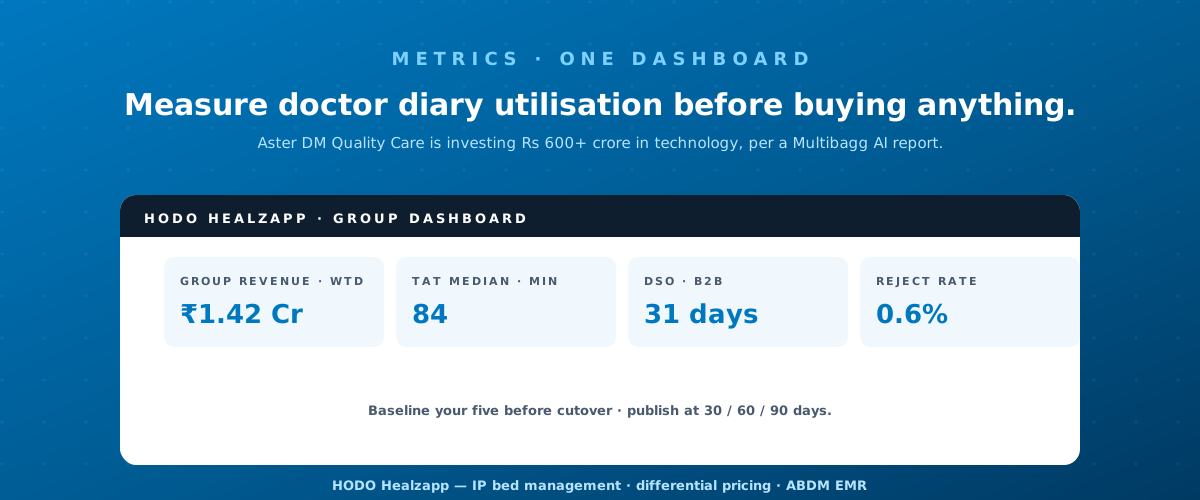
Doctor diary utilisation comes first, because it is the cheapest revenue in the building. Fill rate should be visible by doctor, by hour and by day of week, with rules for walk-in insertion, overbooking tolerance and visiting specialists who run alternate-day sessions. Most polyclinics find that two doctors are oversubscribed while three sit at half capacity, and that the fix is scheduling and signage rather than more marketing spend.
Second is billing correctness at the counter, not in the back office. Eligibility, co-pay, package rates and the correct tariff for each payer have to be applied while the patient is still standing there. Corrections made afterwards cost a phone call, a resubmission and often the entire margin on the visit. Multi-currency handling matters for walk-in medical visitors, and differential pricing matters the moment the first corporate contract is signed.
Third is turnaround to the patient. A result waiting for collection produces a second trip, a phone enquiry and a slot that could have been sold to someone else. Automated report delivery over WhatsApp or SMS removes all three at once. Diary, counter, delivery — that is where a modest clinic budget converts directly into visits per day. Clinical analytics can wait a year.
Large programmes quietly spend much of their budget on interfaces. Haematology and biochemistry analysers, radiology modalities, pharmacy stock, accounting ledgers and payer channels all have to talk to one another, and each bespoke interface is scoped, built, tested and then maintained forever. A polyclinic cannot carry that pattern. The alternative is to treat integration as a product question before signing: does the system already support the specific analyser models standing on the floor, and can the vendor demonstrate results flowing in from one of them during evaluation?
The same applies downstream. Pharmacy and inventory should reflect what was dispensed without a second data entry. Accounting should receive the day's collections without a manual export — Tally integration exists for exactly that reason. Machine Interfacing deserves testing against real equipment during the trial, because a demonstration on sample data proves nothing about a fifteen-year-old analyser in the corner of the lab. Every interface left unbuilt becomes a daily re-typing tax, paid by staff who were hired to see patients. Across a year, that tax is usually larger than the difference between two vendor quotes.
Polyclinic groups rarely grow in one large step. They grow by opening a second site in a different emirate or city, then a third beside a labour accommodation or a mall, each with its own licence, its own payer mix and often its own price list. The failure mode is predictable: every new branch becomes an island with its own patient numbering, its own spreadsheet of corporate rates and its own month-end reconciliation.
What prevents it is deciding, before branch two opens, that patient identity, tariffs and reporting are group-level concerns. One patient index means a visitor seen in Sharjah does not reappear as a fresh record in Abu Dhabi. One tariff structure with per-partner pricing means a corporate contract is configured once rather than three times. One consolidated financial view means the group can read cost per patient by site instead of waiting for three unrelated P&Ls. Setting up a new centre should take hours of configuration, not another implementation. That is the operational case for choosing a multi-outlet platform at the two-site stage rather than at the five-site stage, when migration costs are real and the spreadsheets have already become load-bearing.
The spending gap between a hospital group and a polyclinic is real, but the bottlenecks are not so different — diary, counter and delivery. Healzapp is built for that shape of problem. Appointments handles multi-doctor scheduling with per-doctor session patterns and visible utilisation, so the front desk can see which diaries are selling and which are idle. Billing (incl. multi-currency / GCC patterns) applies payer tariffs, co-pay and differential pricing at the counter, which is where claim quality is actually decided. Multi-outlet scale-up with one-click new-centre setup keeps the second and third sites inside one patient index and one tariff structure instead of spawning parallel administrations. WhatsApp/SMS report delivery and Machine Interfacing close the loop between the lab bench and the patient's phone. None of this needs a Rs 600 crore programme — it needs a decision about which three numbers the clinic intends to move this quarter.
See how Healzapp handles this — book a 30-min demo.
See how Healzapp, Labzapp and EReazy fit your speciality in a free 30-minute demo.
Book a Free Demo