GDNOnline reports that Global Health Exhibition (GHE) 2026 in Riyadh has announced its global speaker line-up, bringing health system leaders, clinicians and technology executives to talk about AI and health system transformation across the region. For polyclinic groups in Saudi Arabia, the UAE, Qatar, Kuwait and Bahrain, that speaker list is a fair preview of what the exhibition floor will be selling a few metres away. The value of the trip is not decided in Riyadh, it is decided two months later, by how disciplined the buying process was after the badge came off.
An exhibition produces a shortlist, not a decision
Most clinic groups come back from a regional health exhibition with fifteen to twenty vendor cards, four brochures worth keeping and one or two systems that felt impressive on a 12-minute booth demo. Booth demos are optimised for exactly that window: clean demo data, one specialty, no insurance rejections, no network lag, no receptionist handling three walk-ins and a phone call at the same time. Polish at the booth correlates poorly with performance at go-live.
The practical fix is to decide the scoring sheet before travelling, not after. A workable sheet has three columns, must-have, must-integrate-with, and nice-to-have, and no more than fifteen rows in total. Must-haves are the workflows that stop revenue if they break: registration, appointment booking, insurance eligibility and pre-approval, billing, pharmacy dispensing, lab ordering and report release. Must-integrate-with is the existing estate: analysers, PACS, the accounting system, the payer gateway, the WhatsApp business number. Nice-to-have is everything a conference makes exciting.
Score each vendor on the sheet the same evening, while the memory is accurate, and record what was promised, by whom, and whether it was described as shipped, on the roadmap, or "customisable". Those three words carry very different delivery risk, and by the third quarter of an implementation nobody remembers which one was used at the booth.
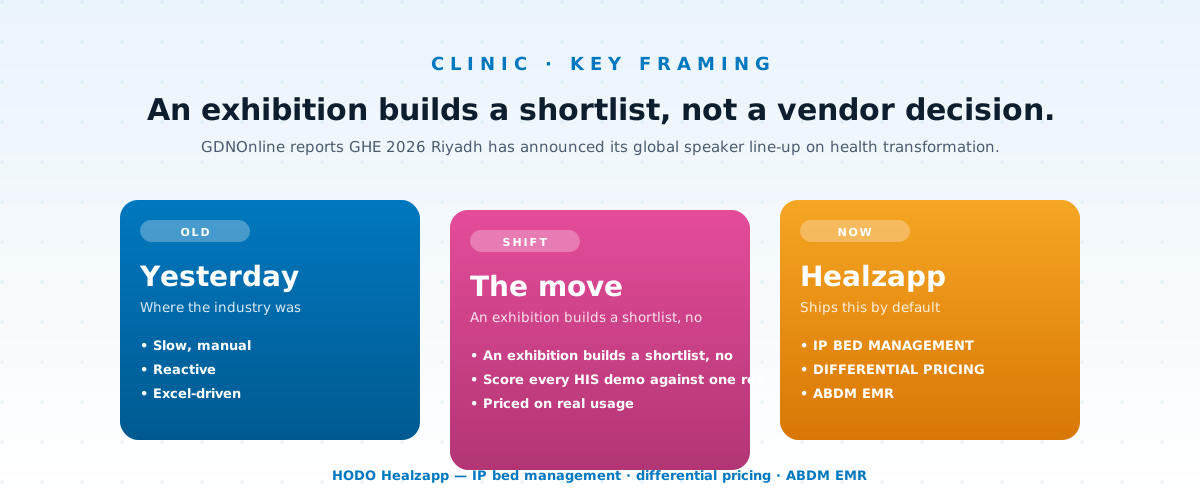
An exhibition builds a shortlist, not a vendor decision.
Score vendors against one real clinic day
The single most useful preparation for an exhibition is a written description of a normal day at the busiest branch. A six-doctor polyclinic running 180 to 220 outpatient visits a day, with peaks between 9am and 11am and again from 5pm to 8pm, is a very specific operational problem. Bring that description to the booth and ask the vendor to run it.
Three tests separate systems quickly. First, the insured walk-in: from patient arrival to a printed or digital bill, counting screens and clicks, with a co-pay applied and an eligibility check in the middle. Anything above roughly ten to twelve interactions at the counter will show up as a queue at 6pm. Second, the returning patient: someone with four years of visits across three specialties, where the doctor needs the relevant history inside fifteen seconds rather than a chronological scroll. Third, multi-doctor scheduling with constraints, a shared procedure room, one ultrasound machine, a visiting consultant who works Tuesday and Thursday evenings, and a no-show rate near 15 per cent that has to be absorbed with overbooking rules rather than guesswork.
Vendors who have deployed in comparable clinics will answer these in operational language, slot templates, queue tokens, room blocking, cancellation windows. Vendors who have not will steer the conversation back to dashboards.
Integration questions that separate a demo from a deployment
Integration is where GCC polyclinic implementations usually slip, and it is almost never discussed at a booth unless the buyer raises it. The questions are unglamorous and worth asking anyway.
Which analyser models are already interfaced, by name and by protocol, and is the link unidirectional or bidirectional? A bidirectional link that pushes the order down to the analyser removes manual entry at the bench; a unidirectional one only pulls results back. Which modality worklist standard does the radiology side use, and has it been done with the same PACS vendor already in the building? How does pharmacy stock reconcile against dispensing, and what happens at batch and expiry level? Which accounting system does the finance team use, and is the export a live integration or a monthly CSV that somebody re-keys?
Then the questions about ownership. Who holds the WhatsApp business account used for report delivery, the clinic or the vendor? Where is the data hosted, in which region, and what is the documented export format if the contract ends? Is there API access to the clinic's own data without a change request? Ask for a reference site in the same country, at similar scale, and call that site without the vendor on the line. Ten minutes with another operations manager is worth more than any case study.
Billing, insurance and licensing decide the GCC deployment
A system that handles clinical workflows well and payer workflows badly will still fail in this region, because the money is where the complexity sits. Polyclinics in the GCC typically run a dozen or more payer contracts at once, each with its own tariff, co-pay structure, deductible rules, pre-approval thresholds and e-claim format. Add corporate contracts at negotiated rates, cash patients on published rates, package pricing for health checks, VAT treatment, and multiple currencies once a group operates across two or more countries.
A good booth test is to ask the vendor to price a live scenario on screen: an insured patient with a 20 per cent co-pay on consultation, a health check package at a discounted corporate rate, one investigation requiring pre-approval, and a pharmacy item not covered by the plan. Watch how many manual overrides the receptionist has to make. Every override is a future rejection.
Licensing matters as well. DHA, MOHAP, Qatar and Saudi regimes each expect provider records tied to valid licences, traceable clinical documentation, and audit trails that can be produced during inspection. Ask how doctor licence expiry is tracked, whether expired licences block billing, and what the audit log actually records, user, timestamp, before-value and after-value, or only the fact that something changed.
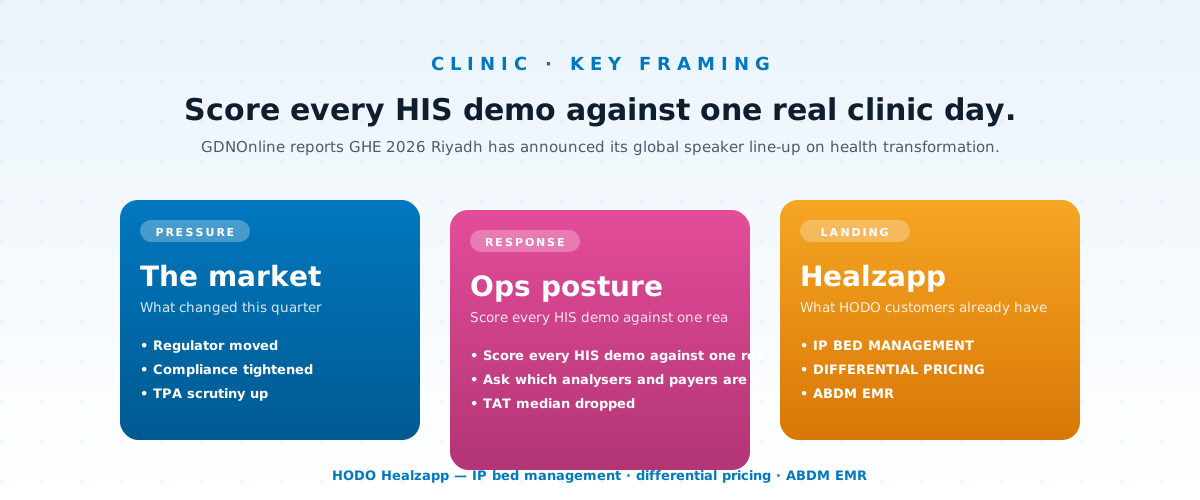
Score every HIS demo against one real clinic day.
Run a 30-day pilot with a written exit
Nothing learned at an exhibition should go straight to a multi-branch cutover. One branch, one or two specialties, thirty days, with baselines measured before the pilot starts: registration-to-consult minutes, average counter time per bill, claim rejection percentage, report delivery lag, and doctor utilisation against scheduled slots. Without pre-pilot baselines the review becomes a discussion of opinions.
Write the exit criteria into the pilot agreement, what performance level triggers a rollout, what triggers a stop, who owns the data in either case, and how much of the implementation fee is at risk. Sequence the remaining branches rather than switching them together, and confirm commercials properly: implementation, per-user versus per-branch licensing, a separate charge per analyser interface, migration of historical records, training days, and the annual maintenance contract from year two. Those line items, not the headline licence price, are what the three-year cost looks like.
What this means for HODO customers
The checklist above maps to the parts of a clinic system that are hardest to retrofit later. Billing in Healzapp is built for multi-currency and GCC payer patterns, per-payer tariffs, Differential pricing for corporate and partner rates, and counter-level handling of co-pay so that receptionists are not improvising during a 6pm queue. Machine Interfacing covers the analyser and equipment links that decide whether lab and radiology results reach the consulting room without manual entry. For groups planning a second or third location after a good exhibition season, Multi-outlet scale-up with one-click new-centre setup is the difference between opening a branch in weeks and rebuilding masters from scratch, while EMR (AI-condensed history) keeps returning-patient review to seconds rather than scrolling.