
Medical Buyer reports that Clinics On Cloud has closed a USD 12.5 million Series A round. The headline number matters less than the assumption investors are underwriting: that clinic infrastructure now sits in the cloud by default, and that whoever owns the operational layer owns the account. For polyclinic operators in Dubai, Abu Dhabi, Doha, Kuwait City and Manama, a round like this reads better as a procurement signal than as a product endorsement.
Capital at Series A scale goes into categories where buyer behaviour has already shifted and the remaining work is distribution. The read-through for a polyclinic group is that cloud-delivered clinic systems have crossed from early adoption into default, and that the tower server in the back office is now the exception rather than the conservative choice. That changes the evaluation question. It is no longer whether to move off local installs; it is which operational layer to standardise on for the next five to seven years, because the switching cost of a clinic system is paid in staff retraining and disrupted insurance claims, not in licence fees.
A newly funded vendor also behaves differently. Roadmaps tilt toward whatever the investors backed, pricing is revised at renewal, and support capacity scales unevenly while headcount catches up. None of that is disqualifying, but it argues for harder scrutiny of contract terms than of demo polish: where patient data is hosted, how a full structured export is produced on request, what happens to historical records if the relationship ends, and whether a single-branch agreement extends to five branches without renegotiation. Operators who have migrated once already know the expensive part of a HIS decision is the exit, not the entry.
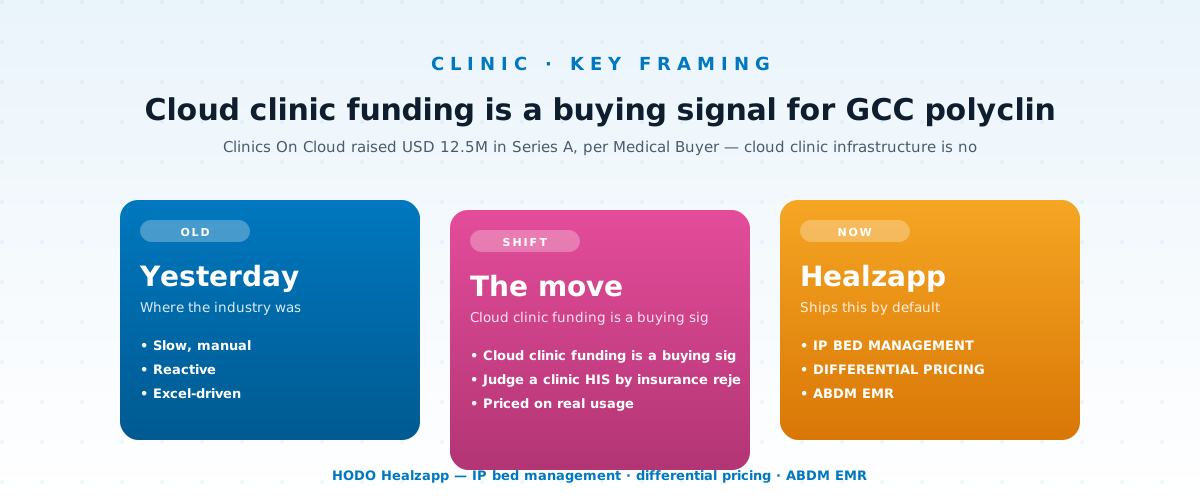
"Hosted" is the weakest possible definition. On a polyclinic floor, cloud has to mean one patient identity that travels across departments and branches, and a system that holds up during the evening peak when most Gulf clinics do half their day's volume. The defining trait of a polyclinic is that the same patient sees a GP, a dentist, a dermatologist and a physiotherapist under one licence, often across several weeks. If each department keeps its own version of that patient, the receptionist becomes the integration layer.
This is where Patient Management and the IP/OP split earn their place. Registration happens once; the visit type decides the workflow, not a separate module with its own patient list. A returning patient with eleven prior visits across four specialities is also where EMR (AI-condensed history) does real work — a consultant with a fifteen-minute slot will not read eleven free-text notes, and a condensed view of what has already been tried is the difference between an informed consultation and a repeated one. Practical tests for any shortlist: how many clicks from phone call to confirmed slot, how the system behaves when the clinic internet drops for ninety seconds, and whether a locum covering a shift can be productive after twenty minutes of orientation.
In most GCC polyclinics, revenue is insurance-heavy and cash is the minority. That makes billing configuration — not clinical features — the place where a clinic HIS either protects margin or quietly erodes it. Each insurer brings its own price list, co-pay rule, pre-approval threshold and documentation expectation. Corporate screening contracts bring a third pricing layer. Cross-border and medical-tourism patients bring a fourth. A system that models only one tariff forces staff into manual overrides, and manual overrides are where rejections originate.
Billing (incl. multi-currency / GCC patterns) and Differential pricing exist for exactly this shape of problem: the same procedure carrying different realisable value depending on who is paying. Corporate and referral volume adds another requirement — B2B Referral / Outsource Lab / Corporate-partner logins let a partner organisation see its own patients and its own contracted rates without a staff member mailing spreadsheets every week.
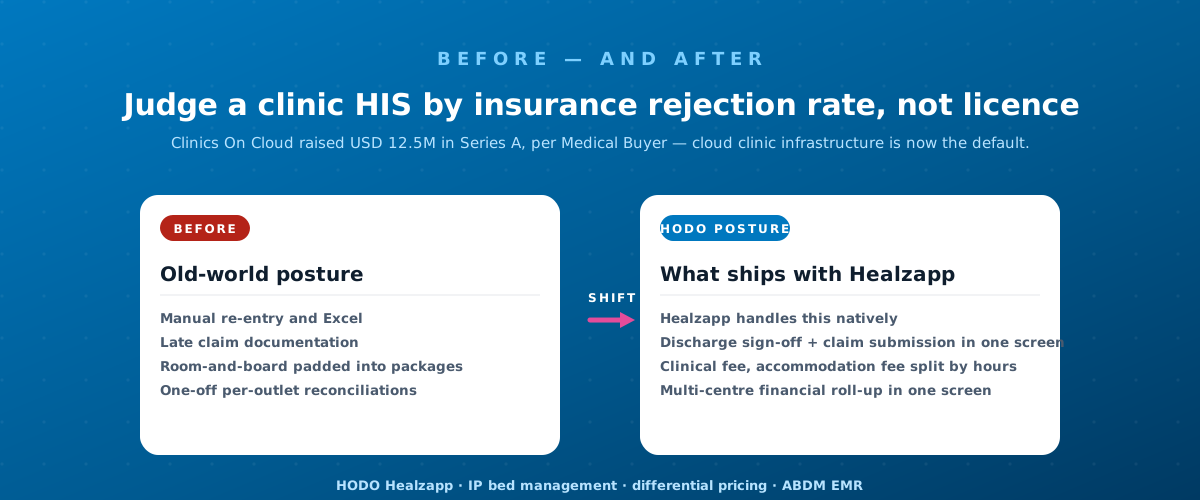
The metric worth instrumenting is rejection rate broken down by insurer, by doctor and by rejection reason. Clinics that track only a blended monthly figure cannot act on it. Clinics that track it per doctor usually find that two or three consultants account for most documentation-driven rejections, which is a training problem with a short payback period rather than a systemic one. Every rejected claim also costs a second pass through reception and coding, so the operational cost of rejection is roughly double its face value.
A polyclinic's capacity is set by rooms and shifts, not by demand. Ten consulting rooms, twelve doctors across two shifts and twenty-minute slots gives a theoretical ceiling; no-shows between 10% and 20% and uneven speciality demand pull the realised figure well below it. Scheduling policy is therefore an operational lever, not an administrative detail — which specialities can be overbooked, how long a slot is held after a confirmation, and who is allowed to release an unused block mid-shift.
Appointments has to support this at the level of a doctor-and-room grid rather than a single calendar, including shift patterns, leave and clinic-wide session templates. Two adjacent features change the waiting-room experience measurably: TV Token Display removes most of the "how long more" traffic at reception, and Teleconsultation absorbs follow-up and report-review visits that do not need a room at all. For clinics with an in-house lab or imaging unit, WhatsApp/SMS report delivery and the Patient Health App stop patients from returning purely to collect paper — a visit category that occupies reception without generating revenue.
The scaling test for any polyclinic system is what it costs to open the next location. If branch two requires a fresh implementation project, a new master data build and a parallel reporting stack, the system has capped the group's expansion rate regardless of how well it runs one site. Multi-outlet scale-up with one-click new-centre setup is the alternative model: service masters, tariffs, user roles and templates inherited from the group, with only location-specific items configured locally.
The same logic applies to everything attached to the clinic. Pharmacy and Inventory need shared item masters with per-branch stock, so that a dispensing unit at a new site does not start from an empty catalogue. Machine Interfacing matters wherever in-house analysers feed results back into the record, because manual result entry scales linearly with volume and brings transcription error with it. Warranty+AMC asset tracking is the unglamorous one that pays off in year three, when a group running equipment across five locations needs to know which service contracts lapse this quarter. Licensing regimes across DHA, MOHAP and their regional equivalents also expect retrievable records and clean staff-to-privilege mapping — easier to maintain from one group-level configuration than from five divergent installs.
The capital flowing into cloud clinic platforms confirms the direction but does not settle the vendor question. For a GCC polyclinic, the decision rests on three practical capabilities: whether billing models the full set of insurer, corporate and cash tariffs; whether scheduling reflects how doctors and rooms are actually staffed; and whether the next branch is a configuration task or a project. Billing (incl. multi-currency / GCC patterns), Appointments and Multi-outlet scale-up with one-click new-centre setup are the parts of HODO Healzapp built around those three questions, with EMR (AI-condensed history) and TV Token Display reducing the per-visit load on consultants and reception. Operators evaluating a replacement are better served by running their own rejection and no-show numbers through a shortlist than by reading funding announcements as rankings.
See how Healzapp handles this — book a 30-min demo.
See how Healzapp, Labzapp and EReazy fit your speciality in a free 30-minute demo.
Book a Free Demo