Jordan's health minister has publicly credited the UAE as a partner in his country's healthcare digital transformation programme, in a report carried by برق الإمارات (Burq Al Emarat) and indexed via Google News. The diplomacy matters less than the direction of travel: health ministries across the Gulf and the wider Middle East now treat digital health capability as an exportable asset, negotiated government to government. For a six-doctor polyclinic in Dubai, Doha or Manama, that has one concrete consequence, standards agreed above your head arrive later as a licensing or reporting requirement.
What a government-to-government digital health pact actually changes
Bilateral digital health cooperation is rarely about software licences. It is about agreeing on the shape of the data: how a patient identifier is issued, which coding system a diagnosis is recorded in, how a lab result travels between a public hospital and a private clinic, and who is accountable when two records cannot be reconciled. When a ministry adopts a partner's model, it inherits that partner's assumptions, and private providers downstream inherit them too.
The UAE has spent the better part of a decade building this out domestically. Dubai's health authority and the federal ministry both run health information exchange programmes that private clinics must feed, and Abu Dhabi's payer-side data discipline is stricter still. A clinic that has been filing clean, coded claims and structured encounter data for three years treats each new mandate as a configuration change. A clinic running on spreadsheets, a standalone billing package and a shared drive of scanned PDFs treats the same mandate as a six-month project with consultant fees attached.
The operational read on the Jordan story is therefore not geopolitical. It is that the compliance floor keeps rising on a schedule nobody publishes in advance, and the clinics that absorb each change cheaply are those whose data was already structured for running the business rather than for compliance.
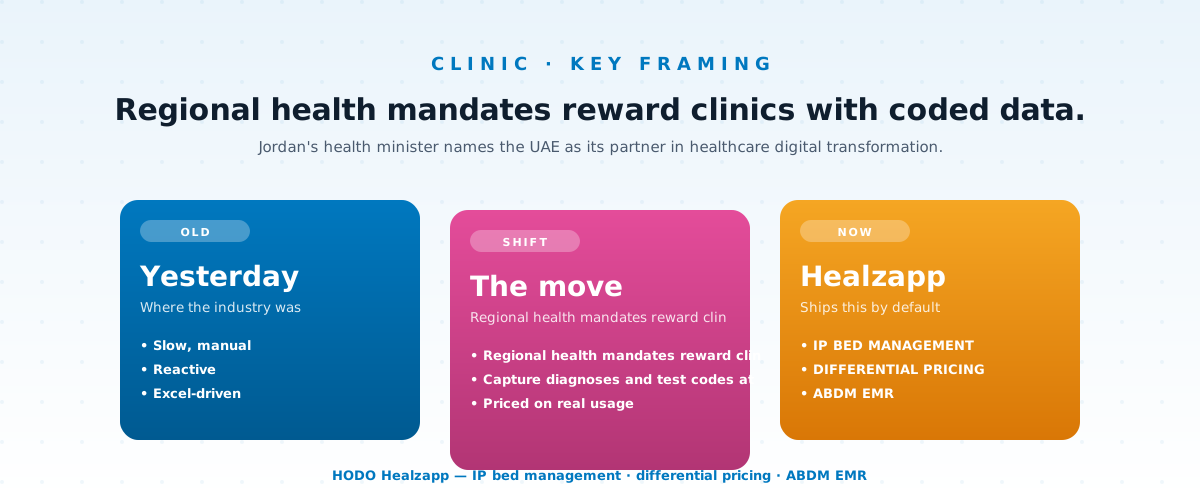
Regional health mandates reward clinics with coded data.
Coded data pays for itself before any regulator asks
The common trap in clinic operations across the region is treating structured data as a regulatory tax to be paid as late as possible. Consider instead the questions a polyclinic manager cannot answer without coded encounters. Which three payers account for most rejected claims, and on what grounds? Which consultant's prescriptions trigger the most pre-authorisation delays? Which packages sell at the front desk but never convert into a repeat visit? Each of those is a margin question, not a compliance question, and each requires that diagnoses, procedures and test codes be captured at the point of entry rather than reconstructed later from free text.
The discipline involved is unglamorous. Diagnosis entry should be picklist-first with free text as an annotation, never the reverse. Test and package names should map to a single master catalogue across every branch, so that "Vitamin D" at one centre and "25-OH Vitamin D" at another resolve to the same line item in the monthly report. Insurance plan names should be normalised to the payer's own list, because an approximate plan name is how an otherwise clean claim becomes a rejected one. None of this requires artificial intelligence. It requires a system that declines to accept ambiguous input, and a front desk trained to work within it.
Clinics that get this right often discover their denial rate was never a payer problem. It was a data-entry problem wearing a payer's clothes.
Billing is where Gulf and Indian clinic software diverge most
A HIS built for the Indian market and a HIS built for a Gulf polyclinic look similar on the appointment screen and diverge sharply at the cash counter. The Gulf pattern involves multiple currencies inside one group, co-payment and deductible rules that vary by plan tier, pre-authorisation thresholds, corporate contracts with negotiated rate cards, and cash-paying expatriate or medical-tourism patients priced differently from insured residents. A single clinic may run four effective price lists at once.
This is why differential pricing per payer or partner is not a reporting nicety. If the system cannot hold a distinct rate card per corporate account and per insurance plan, reconciliation moves into a spreadsheet maintained by one person, and realisation per consultation becomes an estimate rather than a number. Multiply that across three branches and the group's true margin by service line is simply unknown.
The second divergence is licensing. DHA, MOHAP, DOH and their regional equivalents tie permissions to individual practitioner licences carrying expiry dates, scope limits and renewal cycles. A system that treats a doctor as a name string rather than a credentialled entity will eventually allow an expired licence to sign a report.
Multi-doctor scheduling: the throughput problem hiding in plain sight
Polyclinics sell doctor time in slots, so slot utilisation is the business. Yet most clinics measure it in aggregate, patients seen per day, which hides precisely the variance that costs money. A specialist running at 55% slot fill while the general physician runs at 95% is a staffing and marketing problem invisible inside a daily footfall figure.
Three measures are worth instrumenting before any transformation plan is drafted. First, slot fill rate per doctor per session, not per clinic. Second, no-show rate per doctor and per booking channel, because walk-in, telephone, WhatsApp and app bookings behave very differently. Third, average consultation overrun, because a consultant who routinely runs eleven minutes long converts a full afternoon into a waiting-room complaint that the front desk absorbs.
Once those numbers exist per doctor, the interventions are cheap: reminder timing moved earlier for high no-show channels, slot lengths set per specialty instead of a uniform fifteen minutes, controlled overbooking only where the no-show data supports it, and a queue display in the waiting area so patients stop asking the receptionist how much longer. That is additional throughput without additional clinical hires.
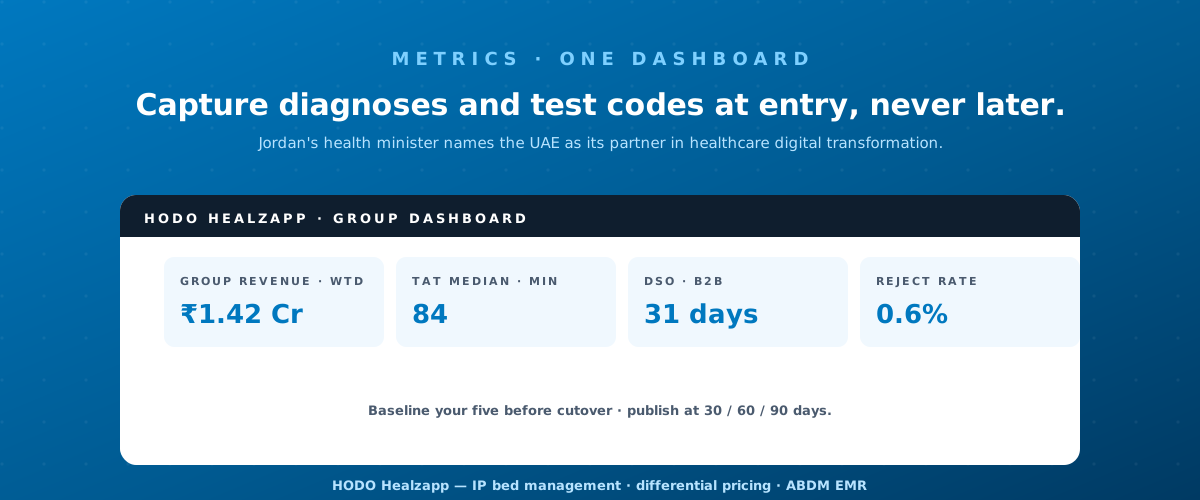
Capture diagnoses and test codes at entry, never later.
Sequencing a plan that survives contact with the clinic
Ministry-level programmes move in multi-year phases. A private polyclinic cannot. The sequence that tends to hold is roughly this: one patient identity and one master catalogue across all branches, since every later report depends on both; then billing and payer rules inside the same system as the clinical record, so claims are assembled from what happened rather than re-keyed; then structured clinical entry with coded diagnoses; then analyser and device integration so results land in the record without transcription; and only then patient-facing channels and analytics.
Running that order backwards, patient app first, data foundation later, is the most common and most expensive mistake in the region. It produces a visible front end sitting on unreliable data, and the credibility lost with clinical staff is hard to win back. The opening of a new branch is the natural moment to reset: if a fourth centre needs a fresh implementation project rather than a configuration copy, the group's growth is capped by its software rather than its market.
What this means for HODO customers
The Jordan-UAE partnership is a reminder that regional digital health standards are set above the clinic and arrive with little notice. The defence is a clinic system whose data is already structured for operational reasons. In Healzapp, Appointments gives per-doctor slot fill and no-show visibility across walk-in, phone and app channels, with TV Token Display taking the queue question away from the front desk. Billing (incl. multi-currency / GCC patterns) combined with Differential pricing holds a separate rate card per insurance plan and corporate contract, so realisation per consultation becomes a report instead of a spreadsheet estimate. Multi-outlet scale-up with one-click new-centre setup means the fourth branch inherits the catalogue, price lists and workflows of the first three rather than starting from zero.