Sheikh Nahyan Bin Mubarak Al Nahyan inaugurated the Forbes Middle East Healthcare Leaders Summit in Abu Dhabi, according to a Menafn report, bringing together regional operators, investors and policy voices around how care in the Gulf gets delivered over the next decade. Summits of this kind set the agenda in broad strokes: AI adoption, patient experience, capacity, capital. The harder question for a multi-doctor polyclinic in Dubai, Doha, Manama or Al Ain is which of those strokes turns into something a practice manager can act on next quarter.
Summit headlines and the Tuesday-morning queue
Regional healthcare gatherings in the Gulf converge on a familiar set of themes, and all of them are real. None of them, however, arrives at a clinic as a project with a budget line. What arrives instead is a Tuesday morning where three of eight consulting rooms are running late, the insurance desk is holding a stack of rejected pre-approvals, and the manager is deciding whether to add a fifth GP slot or a second dermatology session. The distance between the summit agenda and that morning is an operating-system problem. In most mid-sized polyclinics the data that would answer the question is spread across a booking sheet, a standalone billing package, a WhatsApp group and the memory of whoever has worked there longest. Investment flowing into the region is pushing single-site clinics into two-, three- and five-branch groups, and that distance widens with every new location. The useful reading of an event like this is not "adopt AI", it is that the operating floor is about to be measured far more closely than before, by insurers, by regulators and by whoever writes the next cheque.
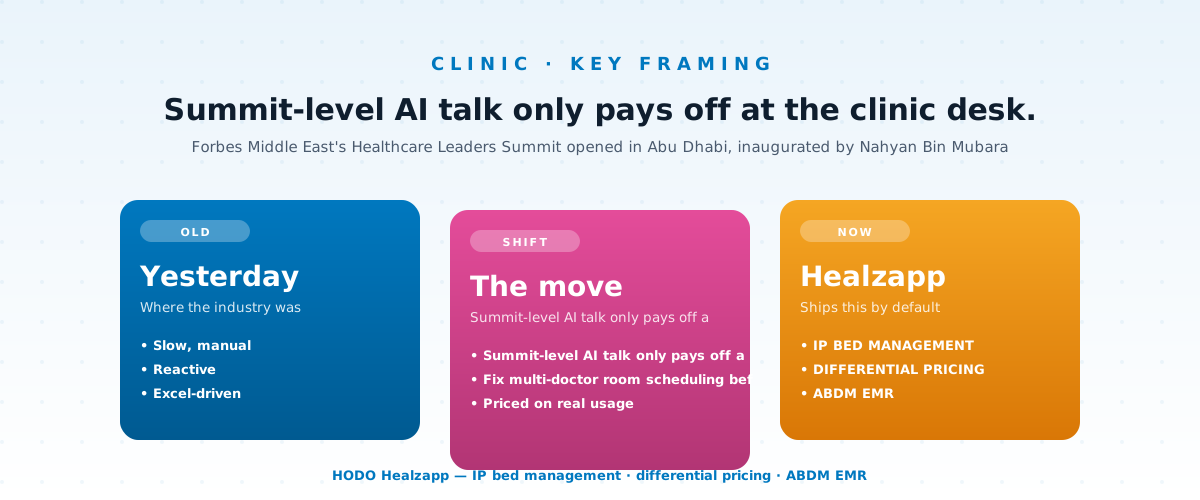
Summit-level AI talk only pays off at the clinic desk.
Multi-doctor scheduling is the real capacity constraint
Polyclinic economics are decided by a narrow set of numbers: billable consultations per room per day, the share of those that convert into a lab order, a procedure or a pharmacy sale, and the no-show rate. Most GCC polyclinics run a mix that makes this hard to track manually, resident GPs on full schedules, visiting specialists who consult two afternoons a week, shared rooms that switch speciality at midday, and a walk-in stream that does not respect the appointment book at all. When scheduling lives in a spreadsheet, the room-utilisation number simply does not exist, and capacity decisions get made on the loudest complaint rather than the data. A clinic HIS earns its keep here by treating the doctor, the room and the slot as three separate resources with their own rules: consultation durations that differ by speciality, rosters that change weekly, and a queue view that the front desk and the waiting area see at the same time. Teleconsultation slots folded into the same calendar stop follow-ups from consuming a physical room they do not need.
Billing in the GCC: many payers, one reconciliation
The payer mix is where Gulf polyclinics differ most sharply from their Indian counterparts, and where generic clinic software tends to break. A single day's revenue can include mandatory-cover claims under an emirate or national scheme, corporate contracts negotiated at different rate cards, self-pay residents, and visitors settling in cash or on foreign cards. Each of those has a distinct approval path, a distinct rejection pattern and a distinct collection lag. Clinics that run billing separately from the clinical record end up reconciling twice, once against the claim file and once against the ledger, and they discover denied pre-approvals weeks after the consultation, when recovery is unlikely. The operationally sound setup keeps the encounter, the tariff and the claim in one chain, supports differential pricing per corporate partner without manual overrides, and gives corporate and referral partners their own logins so that statement disputes are settled against shared data rather than emailed spreadsheets. Multi-currency handling is not a nice extra in a region where clinics serve transient populations; it is a basic requirement of the ledger.
Records that survive an inspection, and a doctor's exit
Licensing regimes across the region, DHA and MOHAP in the UAE, and comparable frameworks in Qatar, Kuwait and Bahrain, put weight on documentation quality, clinician credentialing and traceability of who did what. That sits awkwardly against a second regional fact: clinician turnover is high, because many consultants work on fixed-term contracts and move between groups. When a specialist leaves, a paper-heavy or doctor-specific record system leaves the clinic holding files nobody can interpret and a patient panel that quietly follows the doctor out. An electronic record that condenses history into a readable summary at the point of care makes handover to the replacing consultant a matter of minutes rather than a rebuild. It also changes the patient experience: reports delivered to the patient's phone rather than collected in person, and a patient-facing app that carries prescriptions and past visits across a change of doctor. Both reduce the clinic's dependence on any single clinician, which is the actual institutional risk behind the turnover statistic.
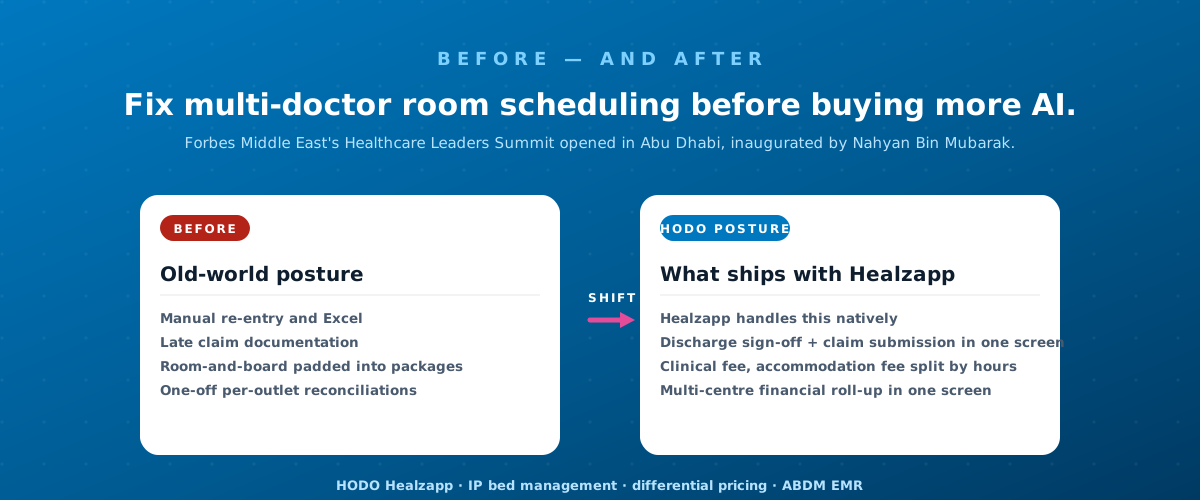
Fix multi-doctor room scheduling before buying more AI.
Second-branch economics
The growth plan most Gulf polyclinic groups are working on is not a bigger clinic but a second and third location in a different community or emirate. Branch two is where informal process breaks: pricing drifts, the pharmacy at one site stocks differently from the other, inventory and expiry are tracked locally, and group-level reporting becomes a month-end assembly job. Analyser interfacing that was configured once by hand at the first site takes weeks to replicate. Asset warranties and AMC dates, tracked in someone's folder, lapse unnoticed. The groups that scale cleanly treat a new centre as a configuration event, same master data, same tariff structure, same roles, rather than a fresh implementation. That is the difference between opening a branch in days and opening one in a quarter, and over three or four locations it compounds into a real cost-per-patient advantage.
What this means for HODO customers
The gap between a leadership summit agenda and clinic-floor performance closes through specifics, not strategy decks. Appointments with per-doctor consultation rules, shared-room handling and Teleconsultation in the same calendar gives the practice manager a room-utilisation figure that is worth acting on, and TV Token Display turns the waiting area into a queue that manages itself. Billing, built for multi-currency and GCC payer patterns and paired with Differential pricing and corporate-partner logins, keeps claims, tariffs and the ledger on one chain instead of three. EMR (AI-condensed history) protects clinical continuity when a consultant's contract ends, while WhatsApp/SMS report delivery and the Patient Health App keep the patient attached to the clinic rather than the individual doctor. For groups planning location two and three, Multi-outlet scale-up with one-click new-centre setup is the feature that decides whether expansion is a configuration task or a re-implementation. None of this is an AI story, which is exactly the point: the summit-level conversation only pays off if the front desk, the insurance counter and the branch rollout are already running on shared data.