The UAE used a Forbes summit to restate its healthcare direction: artificial intelligence and genomics treated as national infrastructure rather than isolated pilots, as reported by wam.ae. For a single-site polyclinic in Deira, or a four-branch group spread across Abu Dhabi and Sharjah, that headline is easy to file away as someone else's agenda. It should not be, because the groundwork that makes national AI and genomics programmes function is the same groundwork that decides whether a clinic can close its month on time.
A national AI agenda lands as a data-quality problem
Genomic risk scoring, AI-assisted documentation, population health dashboards, every one of these describes an output that depends entirely on inputs. A genomic result is only clinically useful when it can be attached to a longitudinal record that a doctor will actually see at the next visit. An AI summarisation layer is only useful when the record it reads is structured data rather than a scanned PDF of a consultant's handwriting.
Most GCC polyclinics sit on the wrong side of that line, and not through any reluctance. The operating software was usually chosen to print a compliant invoice and satisfy an insurer, and the clinical record was bolted on afterwards. The practical consequence is predictable: a clinic can subscribe to every AI service on the market and still get nothing back, because what it exports is inconsistent between branches, between doctors, and between the front desk and the lab bench. National-level AI ambition raises the value of clean operational data sharply. Clinics that already capture diagnosis, procedure, drug and result in structured fields inherit that value. Clinics that capture it as free text inherit a migration project instead, usually at the moment a partner, insurer or regulator asks for the data in a hurry.
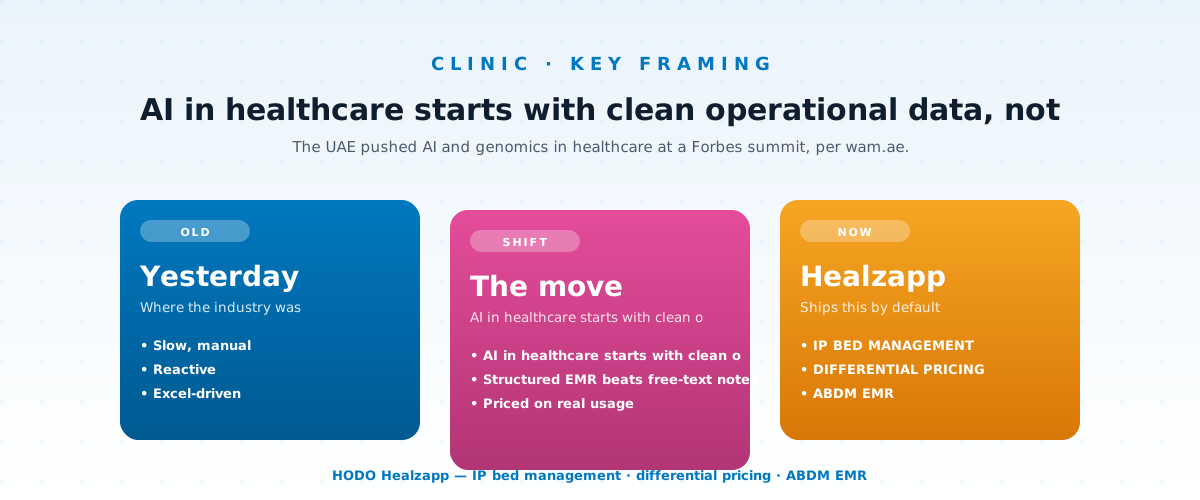
AI in healthcare starts with clean operational data, not models.
Genomics needs a record that survives the next visit
Genomics is the part of the summit agenda that looks furthest from a walk-in polyclinic, yet it exposes the gap most clearly. A genomic or advanced diagnostic finding is a long-lived fact. It is relevant five years after it is generated, to a different doctor, possibly at a different branch of the same group. A visit-based record, where each consultation is its own island and history is retrieved by scrolling, cannot carry that fact forward reliably.
What carries it forward is a record built around the patient rather than the encounter, with prior conditions, allergies, chronic medication and significant results surfaced at the top of the consultation screen instead of buried three clicks down. This is also the honest, unglamorous version of AI in a clinic today: not autonomous diagnosis, but condensing a messy multi-year history into something a doctor can absorb in the ninety seconds before the patient sits down. That single capability changes consultation quality more than any model announcement, and it is measurable, repeat investigations ordered because the previous result was invisible are a real and quantifiable cost line in most multi-branch groups.
Where a GCC polyclinic actually loses margin
Strip the summit language away and the operational questions stay the same. How many minutes does a patient spend between arrival and the consultation room. How many lab and imaging results are keyed in manually from an analyser printout. How many claims are resubmitted because a code, an approval reference or an eligibility check was wrong at the point of billing. How long does a receptionist spend on the phone confirming appointments that a message could have confirmed.
Each of these is a data-capture failure before it is a staffing failure, and each of them also blocks the AI layer. Manual result entry, in particular, does double damage: it consumes technologist time and it introduces transcription errors that make the resulting dataset unsafe for any downstream analysis. Direct analyser interfacing removes both problems with one change. Similarly, a queue and token flow that the front desk controls from the system, rather than by calling names across a waiting room, produces usable throughput data as a by-product. The operational fix and the data fix are the same fix. That is the argument for acting now rather than waiting for AI tooling to mature.
Insurance and licensing set the floor
Nothing in the AI agenda relieves a UAE or wider GCC clinic of its billing and licensing obligations, and those obligations shape the system choice more than any feature list. Multi-payer insurance work, co-payment rules that differ per plan, cash and card patients alongside corporate contracts, multi-currency handling for groups operating across the UAE, Qatar, Kuwait or Bahrain, this is the daily reality, and DHA or MOHAP-style licensing and documentation requirements sit on top of it.
A clinic system that handles this cleanly produces something valuable almost by accident: a complete, timestamped, attributable record of who did what, for which patient, under which plan. That audit trail is the precondition for introducing any automated or AI-assisted step, because the first question a regulator or an insurer asks about an automated decision is what data it used and who signed off. Clinics running on spreadsheets beside their HIS cannot answer that. The ones that can are in a position to adopt new tooling quickly instead of spending eighteen months reconstructing their own history to prove it is trustworthy.
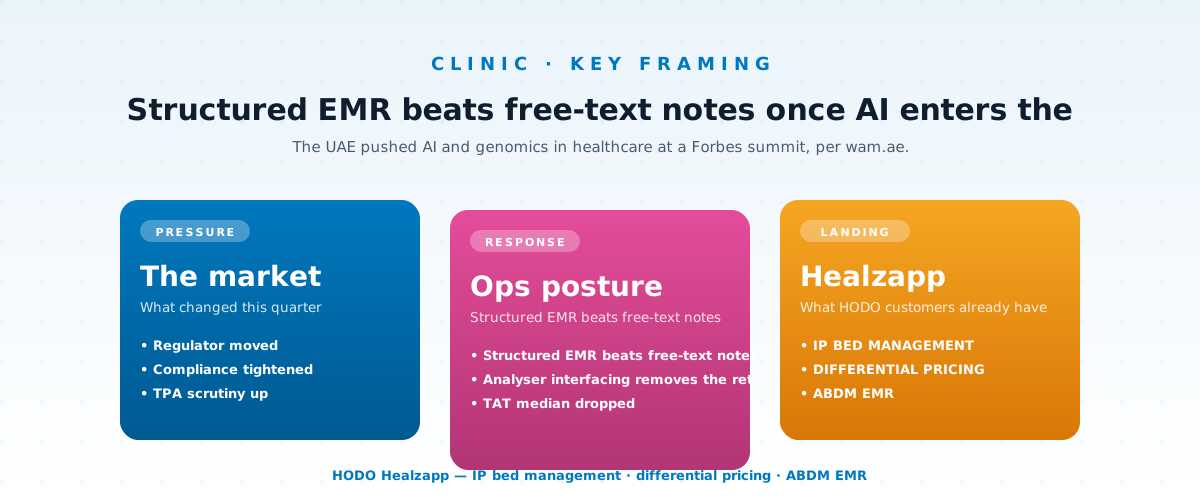
Structured EMR beats free-text notes once AI enters the workflow.
Adding branches is the test most clinic systems fail
Growth in GCC polyclinic groups tends to be branch-led: a second location in a new emirate, a specialist wing, a partner clinic under the same brand. The system test is what happens on day one of the new centre. If opening a branch means a fresh installation, a fresh master list of services and prices, a fresh doctor roster and a reconciliation exercise at month-end to combine the numbers, the group has just fragmented its own dataset, and every branch will drift further apart with each pricing change.
Centralised service masters, shared patient identity across locations, per-branch pricing where contracts demand it, and consolidated financial reporting are what keep a growing group analysable. This matters for AI specifically: a model or a dashboard built on three branches that define a consultation differently will produce three different answers and no insight. Consistency at setup is cheaper than reconciliation later, and it is the difference between a group that can answer a question about its own performance in an afternoon and one that cannot answer it at all.
What this means for HODO customers
The summit is a useful prompt to audit the layer beneath the ambition. HODO Healzapp is built for exactly this class of clinic, and three capabilities carry most of the weight here. EMR (AI-condensed history) gives the consulting doctor a usable summary of a long record rather than a scroll through past visits, which is where genomics and prior-result visibility actually pay off. Machine Interfacing pulls analyser and equipment results in directly, cutting transcription time and keeping results structured enough to be analysed later. Multi-outlet scale-up with one-click new-centre setup keeps a second or fifth branch on the same service masters, pricing logic and reporting spine as the first, alongside billing designed for multi-currency and GCC insurance patterns. None of this is an AI strategy on its own, it is the condition under which an AI strategy stops being a slide.