The Indian Express published a report this week headlined "In India's private hospitals, MRP means 'Manipulated Raised Price'", describing how in-house hospital pharmacies bill medicines at printed prices well above what the same pack costs outside the gate. The story is Indian, and the regulatory fix being debated there is Indian. But the underlying mechanism, an in-house pharmacy whose prices nobody reconciles against an external reference, is an exposure that every polyclinic in the Gulf carries too, with one important difference: in the GCC, the reference price is published by the health authority and the payer checks it line by line.
Why an Indian drug-pricing story lands in Dubai and Doha
The Indian Express piece turns on the spread between the price printed on a pack and the price the hospital actually paid for it, and on the practice of stocking brands with inflated printed prices so the pharmacy can bill high and still appear to discount. India's answer is price capping and public pressure. The GCC took a different route some years ago: health authorities register medicines and publish retail and wholesale prices, then revise them through circulars. A polyclinic in Dubai, Abu Dhabi, Doha or Manama does not set the retail price of a registered drug. What it can do, accidentally, through a stale price master or a front-desk user with override rights, is bill something other than that price. The commercial upside of that error is small and usually unintended. The downside is a rejected claim, an audit finding, or a licensing query from DHA, DoH or MOHAP. Read from the Gulf, then, the Indian story is less a pricing scandal than a data-governance warning. Any clinic whose pharmacy prices live in a spreadsheet, or in three spreadsheets across three branches, is one circular away from billing wrong, and will not find out until the payer's remittance advice arrives four weeks later.
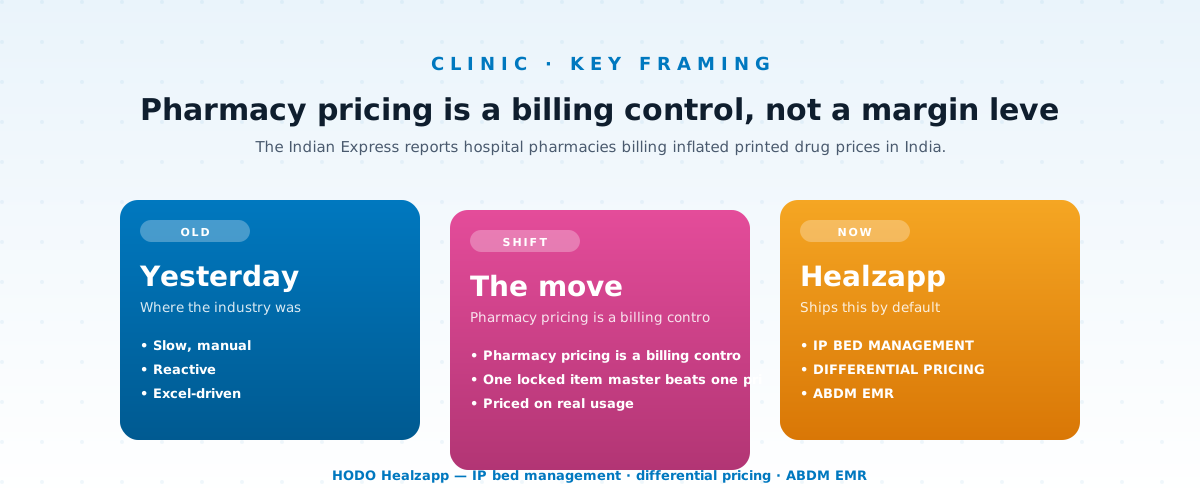
Pharmacy pricing is a billing control, not a margin lever.
The pharmacy counter is where billing discipline gets tested
For a multi-doctor polyclinic, the pharmacy is usually the second-largest revenue line after consultation and procedures, and the first place where operational sloppiness becomes visible in money. Consultations are priced once per doctor grade and rarely change. Medicines change constantly: new registrations, delisted packs, supplier substitutions, batch-level purchase price movement, pack-size changes from the same manufacturer. A clinic dispensing 150 to 400 items a day across two or three branches is maintaining a live catalogue, not a static price list, and it is maintaining it while a queue builds at the counter.
That is why pharmacy pricing errors are rarely deliberate. They are the residue of speed. A pharmacist cannot find the item, creates a near-duplicate with a typed price, and dispenses. A supplier circular reduces the retail price of a fast-moving antibiotic, the update reaches the purchase team but not the billing master, and the clinic keeps billing the old figure for six weeks. A branch opened last quarter was set up by copying an older branch's item list, including prices that have since moved. None of this requires bad intent. All of it produces the same audit trail an inspector or an insurer sees: charges that do not match the published rate.
Where price mismatches actually enter the bill
Operators who have traced these errors back usually find them entering at four points. First, item master duplication, the same molecule and pack existing under two or three item codes with different prices, so the billed amount depends on which one the user picked. Second, open price override at the billing screen, where a field meant for rare exceptions becomes routine because it is faster than fixing the master. Third, unit-versus-pack dispensing, where a strip is dispensed against a price recorded for a box, or vice versa, and the arithmetic quietly doubles or halves. Fourth, branch-level divergence, where each outlet maintains its own copy of the catalogue because the system was never configured to share one.
Each of these is a configuration problem rather than a training problem, which is useful news: configuration can be locked, training decays. A polyclinic HIS that enforces a single item master, restricts price override to named roles, records pack and unit conversions explicitly, and distributes catalogue updates to every branch at once removes most of the error surface without asking the pharmacist to be more careful under the same queue pressure.
Insurance is the enforcement layer in the Gulf
In India the check on hospital pharmacy pricing is regulatory and reputational, applied after the fact. In the UAE and across much of the GCC, the check is financial and near-immediate, because most polyclinic volume is insured. A pharmacy line billed above the published rate, or coded against an item the payer does not recognise, does not become a newspaper story, it becomes a denial, a partial payment, or a resubmission that consumes a coordinator's afternoon. Clinics running 60 to 80 per cent insured volume feel this as a working-capital drag long before they feel it as a compliance issue.
The operational implication is that pharmacy pricing belongs to the revenue cycle, not to the pharmacy in isolation. The price that leaves the dispensing counter is the price that enters the claim, and if the two systems are reconciled monthly instead of at the point of billing, the clinic is discovering its errors after submission rather than before it. Tightening this is unglamorous work: a clean item master, a restricted override, a clear rule for which price applies to cash patients versus each insurer and corporate contract, and visibility for the billing team into what was actually dispensed against what was actually charged.
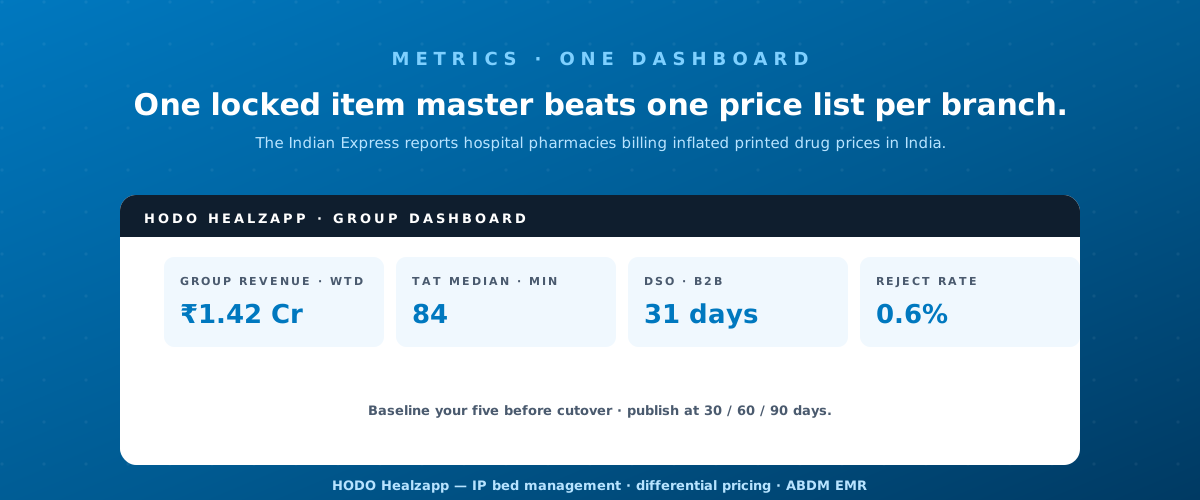
One locked item master beats one price list per branch.
Multi-branch growth multiplies the problem quietly
The pattern gets worse with scale, and it gets worse in a way that is hard to see from the group office. One branch with a drifting price list is a small leak. Four branches each drifting in a different direction produce inconsistent pricing for the same medicine across the same brand, which patients notice and payers audit. Groups expanding across emirates or across borders add a second axis, different published price lists, different currencies, different insurer panels, and the copy-the-last-branch setup method that worked at two outlets stops working at five.
The alternative is to treat new-centre setup as a controlled deployment from a group-level master rather than a fresh build, so a new polyclinic inherits the current catalogue, the current contract pricing, and the current override rules on day one. That also makes the reverse traceable: when a regulator's circular changes a price, there is one place to change it and a defensible record of when the change took effect at every branch.
What this means for HODO customers
HODO Healzapp is built for exactly this shape of clinic, multi-doctor, multi-branch, part cash and part insured. Its Pharmacy and Inventory modules hold a single item master with batch-level tracking, so dispensing draws from a controlled catalogue rather than a typed price. Differential pricing covers the real pricing matrix a Gulf polyclinic runs, cash patients, each insurer panel, and corporate contracts, without duplicating items to achieve it, which is the root cause of most mismatch errors. Billing handles the multi-currency and GCC billing patterns groups operating across emirates and countries need, and Multi-outlet scale-up with one-click new-centre setup means a new branch starts from the group's current prices instead of a copied spreadsheet. The objective is narrow and worth stating plainly: the price that leaves the dispensing counter should be the price the regulator published and the price the payer expects, at every branch, on the same day.