MyRx has raised fresh funding to scale its primary healthcare operation, according to a report carried by vohnetwork.com and surfaced through Google News. The headline number matters less than the verb attached to it: capital raised to scale primary care, not to prove that people want it. For founders building clinic networks, lab-at-home services or homecare platforms across India and the Gulf, that single word is where most business plans quietly break.
What a scale round actually buys
Primary care rarely suffers from a demand problem. A walk-in clinic in Kochi, a two-doctor polyclinic off Sheikh Zayed Road, a home-collection route in Doha, all of them fill their first hundred slots without much marketing. The difficulty starts at the point where one site becomes five, and five become fifteen. Funding in this category converts into three predictable things: more locations, more doctors and phlebotomists, and more diagnostics attached to each encounter. Every one of those multiplies the cost of any process still held together by one experienced person remembering how things are done.
That is why a scale round should be read as an operations commitment rather than a marketing budget. A clinic network that grows tenfold does not need ten times the front-desk skill; it needs the front-desk skill encoded once and repeated. The founders who struggle are usually the ones who raised on a demand thesis and then discovered that their second and third sites were staffed by people improvising the workflow from scratch. The capital buys time to fix that. It does not fix it automatically.
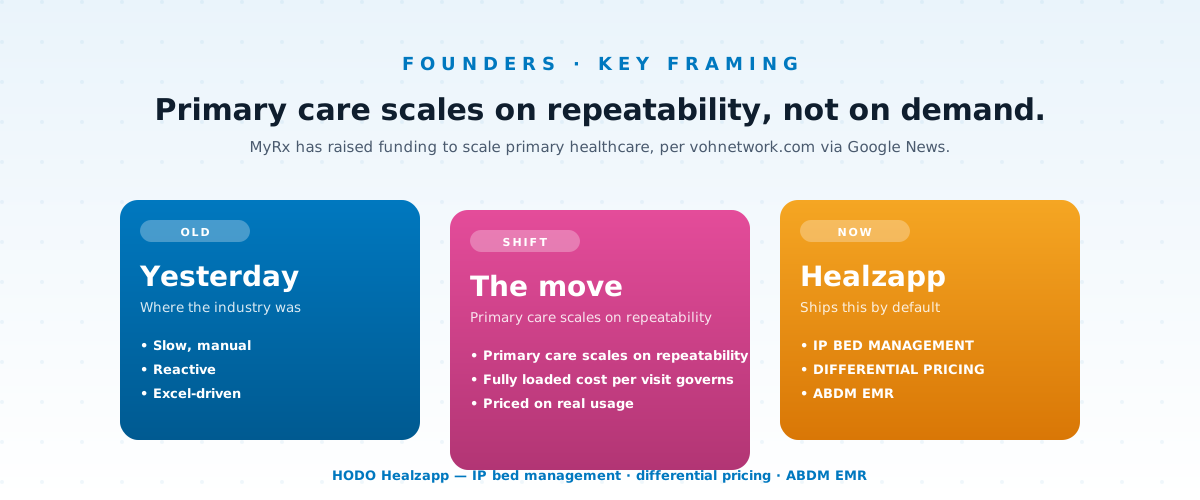
Primary care scales on repeatability, not on demand.
Cost per visit is the only number that survives site three
Primary care runs on thin per-encounter margins and only works at volume. That makes cost per visit, fully loaded, not gross, the governing metric for anyone building in this space. Fully loaded means consultation time, reception and billing minutes, the share of rent and licence cost allocated to that slot, consumables, payment gateway or insurance handling cost, and the follow-up attempts needed to close the loop on a report or a review appointment.
Most early-stage founders track revenue per visit and patient acquisition cost, then discover at site three that their real variable cost is administrative. A receptionist who spends four minutes per patient reconciling an insurance eligibility check in Abu Dhabi, or twelve minutes at the end of the day matching cash collections to consultations in Kerala, is a cost line that scales linearly with growth. Automating it is unglamorous and it is exactly where the margin lives.
Two practices are worth adopting before opening the next location. First, instrument the current site: measure how many minutes of non-clinical staff time each visit consumes, by role. Second, separate one-off setup cost from steady-state cost per visit, so that the payback period on a new centre is a real number rather than an average pulled from the flagship site. Investors will ask for this eventually; founders benefit from knowing it first.
Repeatability is the real product
The operating asset in a clinic or lab network is not the building. It is the configuration, the service catalogue, the price lists, the doctor rosters, the billing rules, the report templates, the referral partners. When that configuration lives in someone's head or in a spreadsheet emailed between managers, each new site is a bespoke build. Opening a location takes six weeks instead of six days, and the variance between sites becomes permanent.
Founders operating across India and the GCC feel this sharply because the rules differ by market. A polyclinic in Dubai or Sharjah handles insurance-led billing, licensing requirements from the local health authority, and a patient population that expects multilingual communication. An Indian clinic chain handles cash and package-driven pricing with a different payer mix entirely. Building one system that can express both, without forking the product per country, is the difference between a network and a collection of unrelated businesses.
The practical test is simple: how long does it take to open a new centre with the correct price list, doctor calendar, tax setup and report format already in place? If the answer involves a founder flying in, the model is not ready for the next ten sites. Systems built for multi-outlet operation treat new-centre creation as a configuration event, not a project.
The diagnostics tail decides the margin
Primary care almost never ends at the consultation. Tests, follow-up, repeat prescriptions and referrals are where both revenue and leakage concentrate. A patient who completes a prescribed blood panel at the network's own lab is worth several times one who walks out with a slip and never returns. Conversely, a report that reaches the patient late, or reaches them by phone call from a staff member chasing it, burns the margin that test was meant to produce.
This is where the lab and clinic sides of a primary care business need to be one workflow rather than two integrations. Barcoded samples, machine interfacing so results are not retyped, turnaround-time reporting so slow steps are visible, and automated report delivery over WhatsApp, SMS or email are the mechanics that make attached diagnostics profitable instead of merely busy. For home-collection models, add chain-of-custody and route visibility, because a sample sitting in a bag in a car is an unbilled visit waiting to be repeated.
Founders should also decide early how partner and referral economics will be handled. Differential pricing per partner, referral-doctor portals and corporate-partner logins are not enterprise luxuries; they are the entry fee for B2B volume, and B2B volume is often what makes a primary care network's fixed costs bearable.
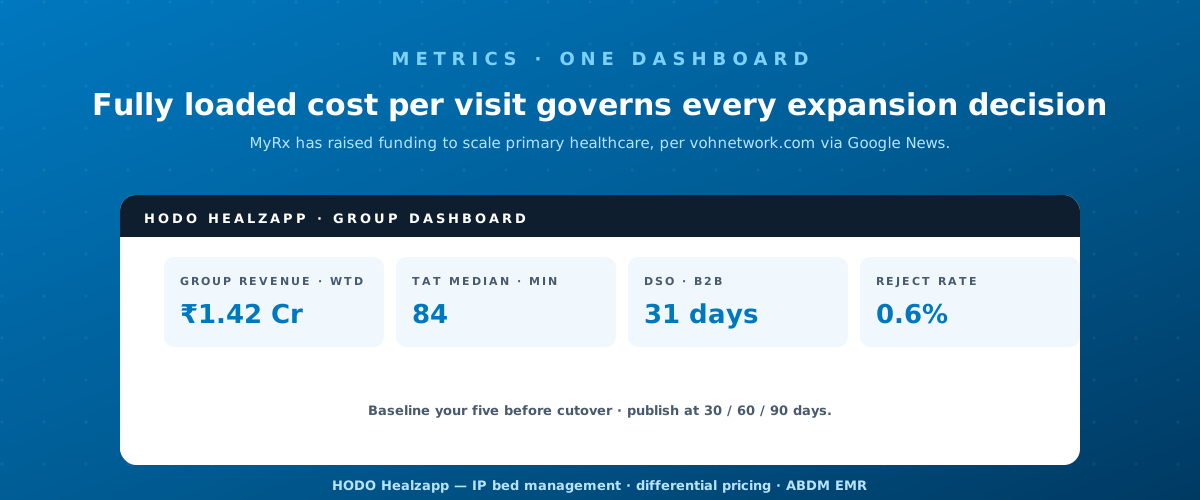
Fully loaded cost per visit governs every expansion decision.
Build or buy: where founder engineering time pays back
Nearly every healthcare founder builds some software. The question is which part. Custom engineering earns its keep on the differentiated layer, the routing logic for home visits, the pricing model, the patient-facing experience, the marketplace mechanics. It rarely earns its keep on billing engines, bed and roster management, inventory, tax reports or report delivery plumbing, all of which are solved problems with long regulatory tails and no competitive upside.
The pattern worth copying is to treat a proven clinical and lab system as the reference architecture underneath, then spend scarce engineering capacity on the layer investors and patients actually notice. HODO has run this path since 2013 from Trivandrum across more than 500 client outlets and 11 million patient visits, which makes the module boundaries, what belongs in the platform, what belongs in the founder's own product, reasonably well tested. Borrowing those boundaries is cheaper than rediscovering them at site twelve.
What this means for builders
A funding round to scale primary care is a bet that the operating model repeats. Making it repeat is a systems decision taken before the capital is deployed, not after. HODO Healzapp handles the parts founders should not be writing themselves: Multi-outlet scale-up with one-click new-centre setup so a new location inherits price lists, rosters and billing rules instead of being rebuilt; Appointments and Patient Health App as the spine for repeat visits, teleconsultation and doctor-at-home models; and Differential pricing for corporate, partner and package rates that stop margin leaking at the counter. For the diagnostics tail, HODO Labzapp adds barcoded samples, machine interfacing and automated WhatsApp report delivery on the same stack.