The Union health ministry has directed state governments to ensure that hospitals display their treatment costs in public view, according to a report in ABP Live English. The direction is not a new law so much as an instruction to enforce what the Clinical Establishments framework already asks for, rates on display, visible before a patient commits to treatment. For a 100-bed hospital or a multi-outlet clinic chain in India, the compliance item is a notice board; the operational item is considerably larger.
What the direction actually lands on
Enforcement will run through state health departments, which means the format, the language and the inspection checklist will vary by state. Some will ask for a printed rate chart at the registration counter. Some will ask for a digital display. Some will ask for the same list to be filed with the district authority or uploaded to a state portal. A hospital with a single location can satisfy any of these with a laminated sheet and a diligent front-office manager.
The difficulty begins the moment a published rate meets a real bill. A displayed charge for a procedure is a promise, and a patient who has photographed the board at 10 a.m. will hold the hospital to it at discharge. That promise is only as good as the service master behind it. In most hospitals running on older HIS installations or on a mix of HIS plus spreadsheets, the rate on the board was typed from a document that nobody has reconciled against the live billing master for several quarters. The board says one number, the bill prints another, and the front office absorbs the argument. That gap, not the display itself, is what inspection and patient grievance will both find.
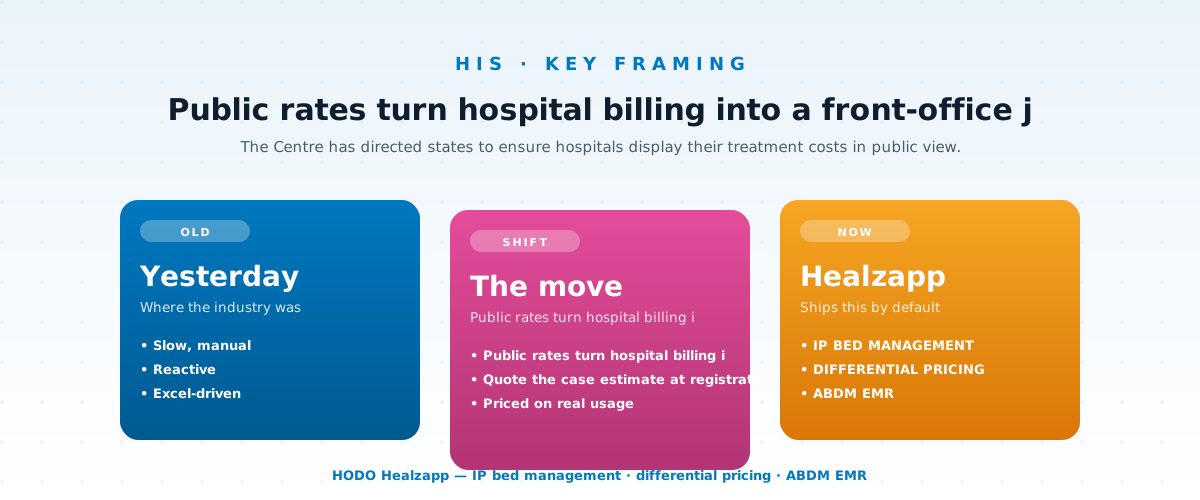
Public rates turn hospital billing into a front-office job.
Price disclosure moves to the registration counter
Published rates shift the pricing conversation from the billing counter at discharge to the registration counter at arrival. This is a real change in where staff time goes. Today, most OP and IP price questions are answered late, by a billing executive with the system in front of them, after the service has been delivered. Once rates are public, the questions arrive early, at the busiest desk in the hospital, and they are asked by patients holding a number they have already read.
Three things need to be in place for that desk to cope. First, the receptionist must be able to see the same rate the patient saw, for the correct payer category, without opening three screens. Second, an admission must generate a written estimate before treatment begins, so that the published rate is translated into a case-specific number the patient can keep. Third, the estimate and the final bill must be comparable line by line, because the variance between them is the question that will be asked. Hospitals that treat the display as a notice-board task and leave the counter unchanged will find their OP queue slowing down in the first month, with registration staff fielding price negotiations they are neither trained nor authorised to settle.
Multi-centre chains get caught by rate divergence
A hospital with one building publishes one list. A chain with four centres and two satellite collection points publishes four lists, and that is where the trouble sits. Rate divergence across outlets is extremely common in Indian chains, and usually for defensible reasons, a newer centre was priced to fill capacity, an older one carries a legacy discount for a nearby employer, a third absorbed a competitor's rate card when it was acquired. None of that is a problem while the rates stay internal. Published side by side, they become a question the chain has to answer in writing.
The practical fix is not uniform pricing, which most chains cannot afford to adopt overnight. It is a single rate structure with deliberate, documented variation: one code set for every service across the group, with a centre-level and payer-level price attached to each code. That way the chain can explain why the same investigation costs differently at two locations, and the explanation is a pricing policy rather than an accident. It also means a new centre opens with the group's price master already loaded, instead of inheriting someone's spreadsheet. Chains that have been scaling outlets faster than they have been cleaning masters should treat this direction as the deadline for that cleanup.
Pharmacy, consumables and lab add-ons are where the number leaks
Patients compare the published figure with the total they paid, not with the professional-fee line. The gap is almost always made up of pharmacy, consumables, implants and investigations ordered during the stay. A displayed package rate that quietly excludes four categories of charge will generate more grievance than no display at all, because the hospital will be accused of concealment rather than of being expensive.
This argues for publishing inclusion and exclusion boundaries alongside the rate, and for tightening the systems that produce those excluded charges. Pharmacy issues against an IP case need to flow into the same bill in real time, not get reconciled at discharge. Consumable issue from the ward and the OT needs to be indented and costed as it happens. Investigation charges, particularly where a hospital outsources some tests to a reference lab, need to land on the bill at the hospital's own published rate, not at whatever the outsourcing arrangement produced. For hospitals running a diagnostics arm, the same discipline applies to the test menu: a public price list for investigations is only credible if the test master, the machine interface and the billing master agree on what was run.
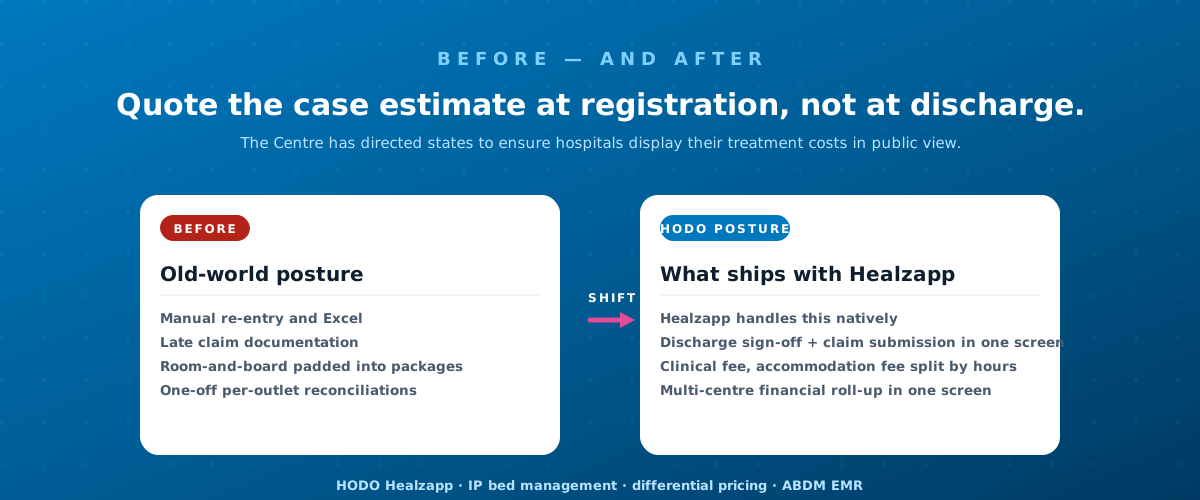
Quote the case estimate at registration, not at discharge.
Build the version history before an inspector asks
Rates change. Tariffs are renegotiated, TPA contracts are revised, consumable costs move, and a published list that is six months stale is its own violation. The requirement that follows from public display is therefore version control: every rate revision dated, with the authorising approval recorded, so that a bill raised on 4 August can be shown to match the rate published on 4 August. A chain running prices in spreadsheets cannot produce that. A hospital whose billing master carries an effective-from date on every price can produce it in a minute.
The same record answers a second question that tends to arrive later, whether the hospital charged different patients different amounts for identical treatment without a declared basis. Payer-wise differential pricing is legitimate and universal; undocumented differential pricing is not. The audit trail is what separates the two, and it has to be generated by the billing system as a by-product of normal work, because nobody is going to maintain it by hand.
What this means for HODO customers
Public rate display is a billing-master problem wearing a signage costume. HODO Healzapp handles it from the master outward rather than from the board inward. Differential pricing holds one service code set across the group with distinct cash, TPA, PMJAY, corporate and centre-level prices attached to it, so a published list and a printed bill are drawn from the same source. Billing ties pharmacy, consumables and investigation charges into the live case bill as they are incurred, which is what keeps the estimate-to-final variance defensible. For chains, Multi-outlet scale-up with one-click new-centre setup means a new location inherits the group price master on day one rather than three audits later, which is the only way four published lists stay explainable.