RailTel Corporation has bagged a ₹12.85 crore purchase order to supply Hospital Information Management Systems, per a report on scanx.trade this week. The deal is modest by defence-PSU standards but tells a bigger story: government-owned integrators are now credible bidders in a market that private hospital groups and diagnostic chains have long treated as their own procurement patch. The pricing and scope that come out of these public tenders will shape private HIS renewals over the next 18 months.
What the RailTel order actually covers
RailTel is a Government of India enterprise best known for laying fibre along Indian Railways rights-of-way. Its move into HIMS supply is not a one-off, the company has been chasing e-governance and healthcare digitisation contracts for several years, most recently around eOffice, video conferencing, and NIC-adjacent stacks. A ₹12.85 crore HIMS order likely covers a bundle of licences, integration services, and post-go-live support for a state-run or PSU hospital network. The exact end-client will surface in a subsequent BSE filing, but the shape of the deal is familiar: a public tender, a lowest-technically-qualified bidder, and a multi-site rollout schedule that will unfold over 18-24 months.
For owners and MDs of 50-500 bed private hospitals, the immediate question is not whether RailTel wins more of these. It will. The real question is what the public-sector benchmark for HIMS pricing and scope now looks like, because that benchmark quietly flows into the terms your CFO and IT head will be handed at the next vendor renewal cycle.
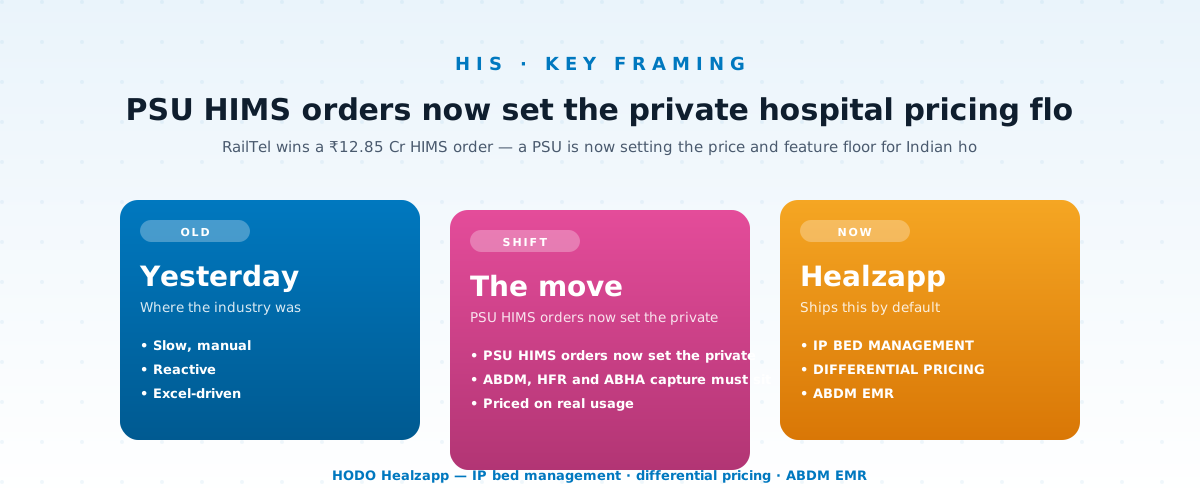
PSU HIMS orders now set the private hospital pricing floor.
Why a PSU HIMS deal changes private-sector expectations
Public tenders publish detailed scope-of-work documents. Those SoWs get scraped, forwarded, and referenced by private procurement committees within weeks of publication. A ₹12.85 crore order, spread across whatever bed count and outlet mix it covers, sets an implicit per-bed and per-outlet price ceiling that private buyers will cite in vendor conversations for the next two years.
Three shifts follow. First, the assumed feature list widens. Government tenders now routinely specify ABDM integration, e-Sanjeevani hooks, HMIS reporting, and ABHA capture at registration, features that were optional line items in private HIS contracts as recently as 2023. Second, the audit bar rises: PSU contracts typically ask for seven-year data retention, quarterly security audits, and CERT-In compliant hosting. Third, integration burden shifts to the vendor: pharmacy, lab, radiology, and billing must speak to each other on day one, not in phase three.
Private hospital groups running HIS platforms that were architected between 2010 and 2015 should check whether the current contract can absorb these expectations without a rewrite. Most cannot.
The build-vs-buy conversation is settled, poorly
A decade ago, mid-size Indian hospital chains often built their own HIS with an in-house team of five developers and an ambitious CIO. That path has quietly ended. The RailTel order, like the AIIMS eHospital rollouts and the Ayushman Bharat PM-JAY infrastructure contracts before it, confirms that HIMS is now a packaged-product category, not a custom-build project. Even the government has stopped building from scratch.
But buy has its own trap. Purchasing a HIS whose core was written for a single 200-bed hospital, and then bolting on modules as the chain grows to eight outlets, produces the operational headaches that administrators complain about at every FICCI and NATHEALTH panel: reports that do not reconcile across sites, master data drift, TPA claim rejections because ICD mapping differs between OP and IP, and pharmacy stockouts because inventory does not roll up. The vendors surviving this cycle are the ones whose architecture assumes multi-outlet from day one and whose implementation teams can stand up a new centre without a three-month integration project each time.
Multi-site rollout is the real test
RailTel-style contracts will be judged not by licence value but by go-live speed and outlet-level uptime. Private hospital groups scaling from three to eight outlets, or diagnostic chains adding collection centres monthly, face the same test on a smaller budget. The operational questions that separate a working HIS from a stalled one are worth asking out loud.
How long from signed contract to first patient billed at a new outlet, two weeks or two months? Does the same master patient index survive across outlets, or does each new centre start with a fresh set of duplicates? When a lab report is generated at the referral centre, does it show up in the referring doctor's dashboard the same day, or does a courier still move paper? Does the finance team close monthly books in five working days across all outlets, or does consolidation eat two weeks? The answers determine whether an ₹8 crore HIS contract earns back its cost in 24 months or drags on the P&L for four years.
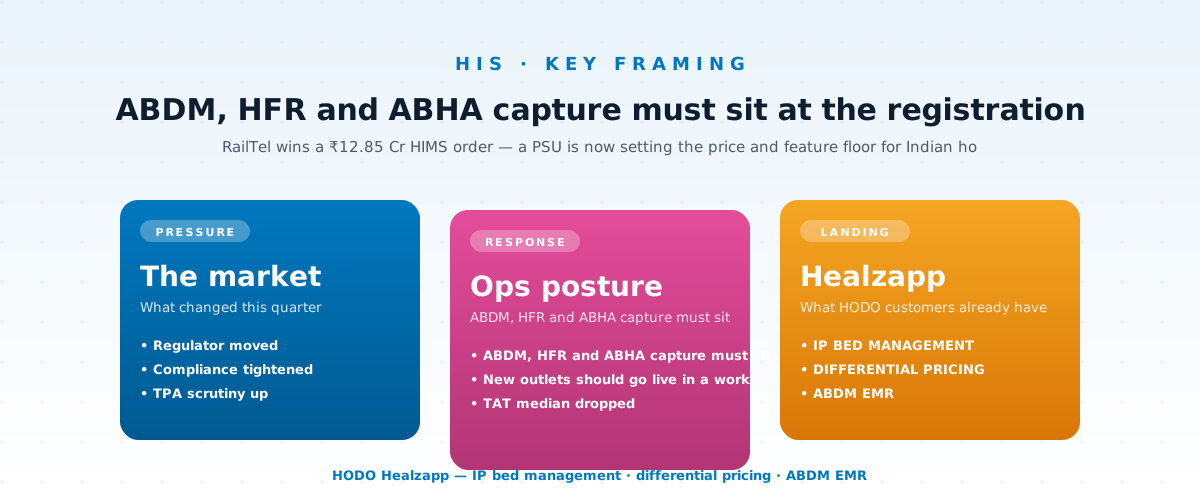
ABDM, HFR and ABHA capture must sit at the registration desk.
ABDM and audit-readiness are non-negotiable
The RailTel deal will almost certainly specify ABDM compliance, Health Facility Registry linkage, Healthcare Professionals Registry mapping, and ABHA capture at registration. Private hospitals that treat ABDM as a someday project are now behind the curve. Insurance TPAs and corporate clients have started asking for ABHA-linked discharge summaries in claim files. State-level empanelment for PMJAY, ESI, and CGHS increasingly requires HFR ID as a precondition. Hospitals that finish ABDM integration this quarter will spend the next four quarters selling the compliance as a corporate tie-up advantage.
What this means for HODO customers
The signal from the RailTel order is that HIMS procurement is standardising around a broader default feature set, ABDM compliance, multi-site consolidation, integrated pharmacy and lab. HODO Healzapp customers are already covered on the three pieces that most often show up in these tender scopes. ABDM-compliant EMR handles HFR, HPR, and ABHA capture at the registration desk without a separate workflow. Multi-outlet scale-up with one-click new-centre setup means a new branch or acquisition can be brought onto the same master data, billing rules, and inventory ledger inside a working week, not a quarter. And Machine Interfacing alongside the Pharmacy and Inventory modules closes the loop that PSU tenders now insist on: lab analysers, radiology, and pharmacy dispensing sitting inside the same audit trail as billing.