India's insurance regulator, IRDAI, is forming working groups on real-time health claims tracking and a standard set of claim metrics, according to Business Standard. The rule itself will bind Indian insurers. The signal it carries — that claim status is moving from a month-end reconciliation exercise to an observable, measured pipeline — is already the operating reality for polyclinics across the UAE and the wider GCC, and most of them cannot yet produce those numbers about themselves.
What the IRDAI working groups actually signal
The reported brief is narrow: study real-time tracking of health claims, and define metrics that insurers report consistently. Two parts are worth separating. The first is the tracking rail — the plumbing that lets a claim's state be queried at any moment instead of discovered at settlement. The second, and the more consequential one for providers, is metric standardisation. Once a payer has to report denial rates, turnaround times and settlement lags in a defined format, those numbers become comparable. Comparable numbers get published. Published numbers get used in negotiation.
Providers usually read regulatory news for the compliance burden it creates. The more useful reading here is directional. Across markets, the claim cycle is being instrumented from the payer side first. A provider that cannot produce the same class of numbers about its own claims walks into every tariff renewal and every panel negotiation holding less information than the party across the table. That asymmetry has nothing to do with which regulator happens to be involved, and it is not an Indian problem. It is a question of whether the claim cycle is measured inside the clinic's own system or left as an inference drawn from bank credits.
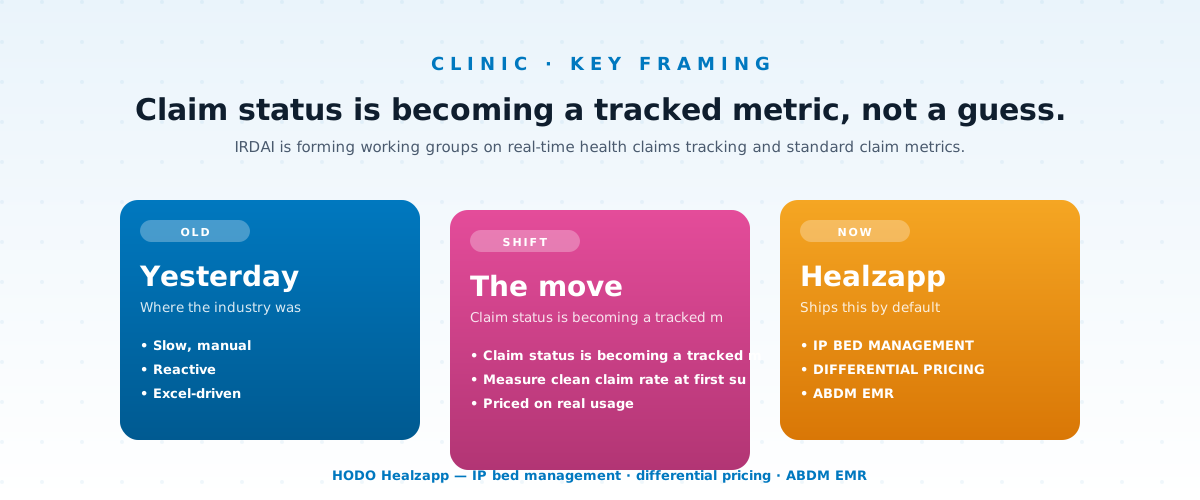
Claim status is becoming a tracked metric, not a guess.
The GCC polyclinic is already running on claim rails
In Dubai, Abu Dhabi, Doha, Kuwait and Manama, insurance is not an edge case in clinic revenue — for most polyclinics it is the majority of it. A typical multi-doctor clinic already runs eligibility verification at reception, prior approval for a defined list of procedures, investigations and pharmacy items, electronic claim submission against payer-specific tariffs, and a resubmission cycle when lines are rejected. The rails exist and are mandatory. What is usually missing is the clinic's own view of what happens on them.
The common pattern is a split in ownership. The front desk knows whether a claim was submitted. Finance knows what was eventually collected. Nobody owns the gap between the two, broken down by payer, by doctor, by branch, by month. Rejections get worked as a queue of individual cases rather than as a dataset with causes. A clinic can resubmit diligently for a year and never learn that one payer rejects a specific investigation on documentation grounds most of the time, or that one consultant's notes attract three times the median denial rate.
That gap rarely appears as a loss on a P&L. It appears as working capital locked in ageing receivables, as staff hours spent on rework that was avoidable at the desk, and as renewals signed without evidence to argue with.
Four numbers worth instrumenting now
Clean claim rate at first submission, by payer. This is the single most diagnostic figure a polyclinic can hold. If three in ten lines need rework before they are paid, the cost is not the rejection — it is the second and third touch on each claim by staff who could be doing registration or follow-up instead.
Claim ageing by payer, not in aggregate. An average of 45 days hides a panel where half the value sits past 90 days. Ageing buckets held per payer turn a vague cashflow complaint into a specific conversation with a specific account manager.
Denial reasons grouped by cause. Eligibility lapsed, member identifier wrong, prior approval missing, documentation insufficient, service not covered, tariff mismatch. Six buckets are enough. Three of those six are fixable at reception within a week; the others need either clinical documentation changes or a contract conversation.
Rejected value as a share of billed value, split by doctor and by branch. This is the figure that tells a clinic whether it has a payer problem, a process problem or a specific-consultant problem. Prior-approval turnaround is a useful fifth: how long a patient waits between the doctor's recommendation and a decision determines how many recommended procedures are never performed at all.
Denials are created before the claim is built
Most rejections trace back to two moments, and neither of them is the submission. The first is registration. A member identifier mis-keyed, a policy that lapsed last month, a co-pay not collected at the desk, a dependant recorded against the wrong plan — each produces a rejection weeks later, when the patient has gone and the correction costs a phone call that may not connect. Validation at the point of capture is cheaper than any resubmission workflow built downstream.
The second is the consultation note. Payers do not reject a diagnosis; they reject a claim whose documentation does not support the service billed. The practical constraint is time. A consultant running a full session will not scroll through two years of visit history to construct a justification. Where the history arrives condensed and readable at the start of the encounter, the note is more likely to carry the detail the payer asks for — and the same note holds up on appeal months later.
Cash and self-pay volume deserves the same discipline. Expat patients paying out of pocket, visitors on travel cover and corporate walk-ins often sit on different price lists and sometimes different currencies. A clinic that cannot separate insured margin from cash margin by service line is guessing when it decides which panels are worth keeping.
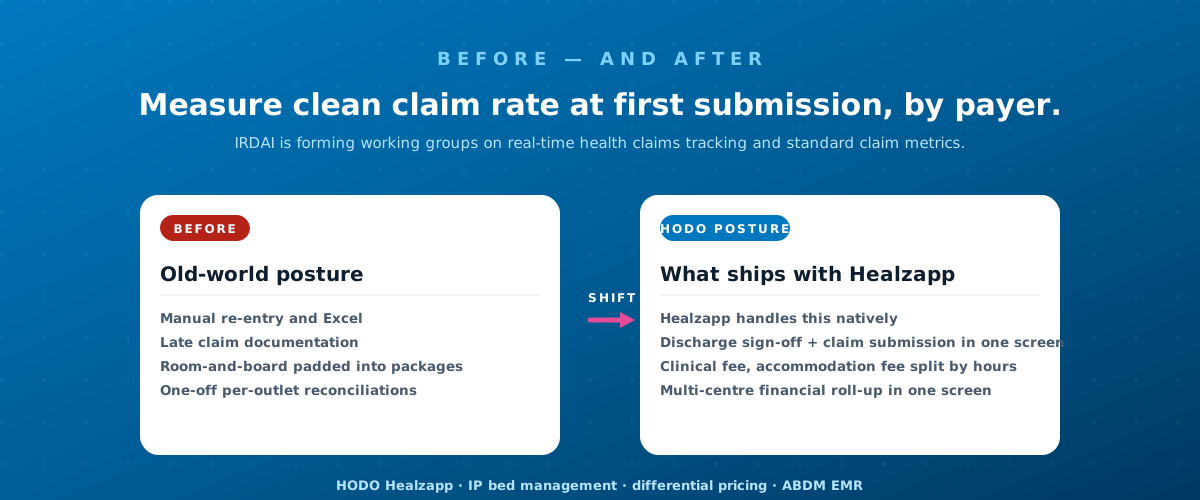
Measure clean claim rate at first submission, by payer.
Why the metric has to roll up across branches
Single-site polyclinics can survive on a spreadsheet. Groups cannot. Once a clinic runs three or four locations across an emirate — or across two GCC markets with different payer sets and licensing regimes — claim performance has to roll up without manual consolidation. The comparison between branches is where the learning sits: the same payer, the same service, the same tariff, two very different clean claim rates usually means one front desk has a habit the other does not.
The same applies to partner volume. Referring doctors, corporate accounts and outsourced lab work each carry their own pricing and their own documentation expectations. When those partners can see their own activity and settlements directly, reconciliation stops being a monthly email thread.
What this means for HODO customers
Claim-cycle instrumentation is not a reporting add-on — it depends on where the data is captured. In Healzapp, Billing (incl. multi-currency / GCC patterns) holds payer-specific tariffs, co-pay rules and ageing in the same place the claim is raised, so clean claim rate and ageing by payer are byproducts of normal work rather than a month-end project. EMR (AI-condensed history) puts a readable history in front of the consultant during the encounter, which is where defensible documentation is actually produced. Multi-outlet scale-up with one-click new-centre setup keeps a new branch on the same payer configuration and the same metric definitions from its first day, and B2B Referral / Outsource Lab / Corporate-partner logins give partners their own view instead of a reconciliation thread. See how Healzapp handles this — book a 30-min demo.