The Free Press Journal reports that IRDAI is constituting two working groups — one aimed at real-time tracking of health insurance claims, the other at greater transparency for policyholders through the claim journey. For a 100-bed hospital in Kochi, Nashik or Vijayawada, this is not insurer news. It is a signal that the claim file a hospital submits is about to become visible, timestamped and comparable while the patient is still in the bed.
Two groups, one direction of travel
The regulator's brief, as reported, splits into status visibility and disclosure. Status visibility means the policyholder — and by extension the insurer and the TPA — can see where a claim sits at any moment: intimated, pre-authorisation raised, query pending, sanctioned, settled. Disclosure means the reasons behind deductions and rejections become harder to leave unexplained.
Both sit on top of plumbing that already exists. The National Health Claims Exchange has been live since 2024, moving pre-auth and claim messages in a common format between hospitals, TPAs and insurers. The General Insurance Council's cashless push has been pulling the same direction. What the working groups add is the expectation of a clock. Once a claim has a visible state, the time it spends in each state belongs to someone — and a large share of that time belongs to the hospital, not the insurer.
That is the shift worth planning for. Today, when a claim stalls for eleven days, the hospital's billing desk can reasonably describe it as a TPA delay. Under a tracked, timestamped flow, the eleven days decompose. Three days were the insurer's query turnaround. Eight were the hospital waiting on a consultant to sign a discharge summary, or on a duplicate investigation report, or on an implant invoice sitting in a drawer in stores.
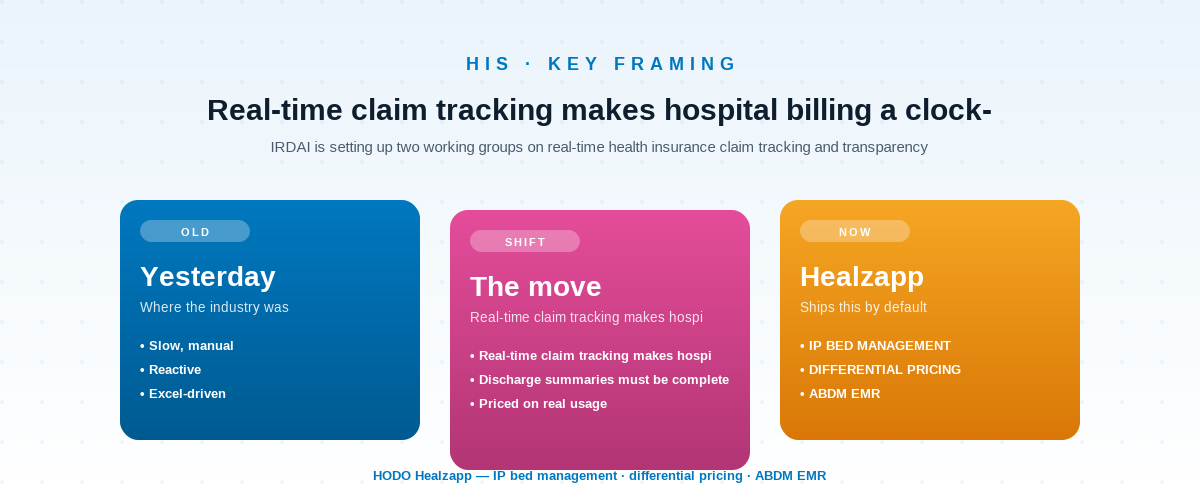
Real-time claim tracking makes hospital billing a clock-driven job.
Real-time tracking is a documentation deadline
Most claim rejections at the ~100-bed level are not clinical disputes. They are documentation defects: discharge summary without a clear admission indication, missing line-item breakup on the final bill, investigation reports that do not match the billed items, an ICU stay with nursing notes too thin to justify the level of care, a pre-auth raised on a provisional diagnosis that the discharge summary then contradicts.
These defects survive today because the feedback loop is long. A deduction arrives six weeks after discharge, lands in a reconciliation sheet, and never reaches the consultant or the nursing station that caused it. Shorten that loop to days and the same defects become operationally visible — which is useful, but only for hospitals whose records are built to be assembled on demand.
The practical test is simple. Pick a discharged insurance patient at random and ask how long it takes to produce the complete claim packet: admission notes, daily progress notes, nursing charting, every investigation report, pharmacy issue records against the IP bill, implant invoices, OT notes, discharge summary and the itemised final bill. If the answer involves walking to three departments and one scanner, the hospital is not ready for a tracked claim cycle. If it is one patient record with everything attached, it is.
Where a 100-bed hospital actually loses money
The cashflow arithmetic is unforgiving at this scale. A hospital running ₹4 crore of monthly billing with 60 per cent insurance and PMJAY mix carries roughly ₹2.4 crore of receivables in motion. Every additional ten days of average collection period locks up about ₹80 lakh — working capital that otherwise funds salaries, pharmacy purchase and the next CT upgrade.
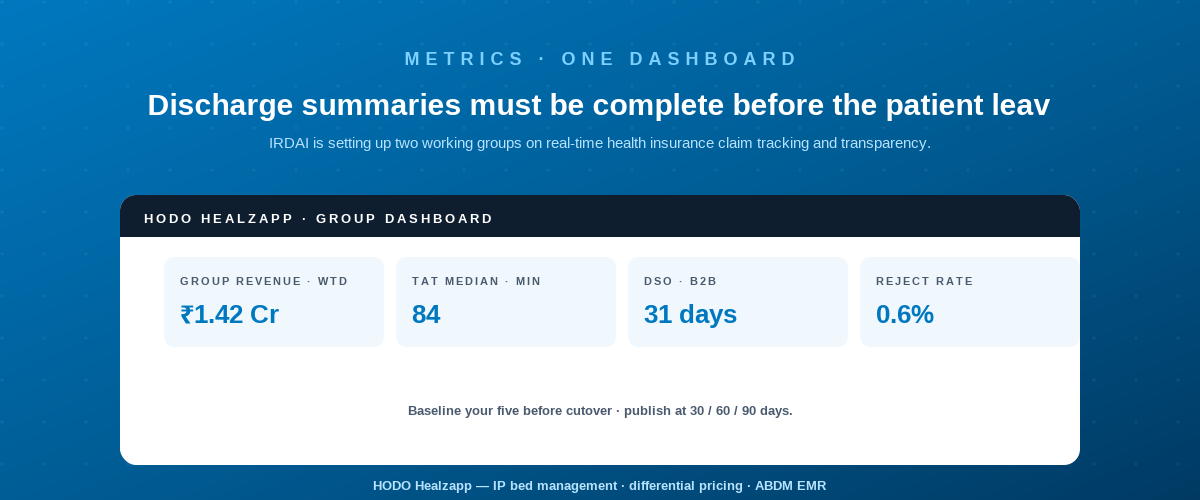
Three numbers deserve a dashboard, measured per payer rather than blended. First, days in accounts receivable split by TPA, insurer and government scheme — a single average hides the one payer sitting at 90 days. Second, first-pass acceptance rate: the share of claims sanctioned without a query. Third, deduction rate by reason code, mapped back to the department and consultant that generated the defect.
Discharge turnaround belongs in the same frame, because it is where claims and bed occupancy meet. A cashless discharge that waits four hours for final approval holds a bed that an admission from OP is waiting for. At 100 beds and 70 per cent occupancy, an hour shaved off average insurance discharge time is worth real additional throughput across a month — and it is bought almost entirely through sequencing: raising enhancement requests early, closing pharmacy returns before the final bill, and getting the discharge summary written on the morning of discharge rather than at the counter.
The claims desk becomes a throughput function
Hospitals at this size typically staff claims with two or three people who chase everything by phone and email, with a personal spreadsheet as the only system of record. That model breaks under a tracked cycle, because the work changes shape. Less chasing of status — the status will be published — and more preventing defects before submission.
The organisational move is to put a pre-submission check between the billing counter and the claim upload: a fixed list of required documents per procedure, validated against what is actually attached to the patient record. Claims that fail the check do not go out; they generate a task against the person who can close the gap. Hospitals that run this discipline report their query volume falling faster than their collection period, which is the right order — queries are the cause, collection period the symptom.
The second move is to stop treating payer rules as tribal knowledge. Package rates, sub-limits, implant caps, scheme-specific documentation quirks and differential pricing per payer should live in the system that raises the bill, not in the memory of a senior billing executive who may resign in March.
Discharge summaries must be complete before the patient leaves.
What this means for HODO customers
Readiness for a tracked claim cycle is mostly a records-architecture question, which is where an HIS either helps or quietly costs money every month. In Healzapp, EMR (AI-condensed history) keeps admission notes, progress notes, investigation results and the discharge summary against one patient record, so the claim packet is assembled rather than hunted. Billing carries itemised IP and OP bills with Differential pricing per payer, so TPA, corporate and scheme rates apply at the counter instead of being corrected after a deduction. IP bed management ties discharge sequencing to occupancy, so an approval delay shows up as a bed held rather than as a surprise at month end. Tally integration moves the resulting receivables into the books without a parallel re-entry, and ABDM-compliant EMR keeps the record structure aligned with the national rails these claim flows ride on. Hospitals running multiple centres get the same payer configuration replicated through Multi-outlet scale-up with one-click new-centre setup.