
VC-backed Redcliffe Labs has closed its first diagnostic lab chain acquisition, as reported by VCCircle. The move underlines what many regional lab chain owners have been sensing for eighteen months: consolidation in Indian diagnostics is no longer a coastal-metro story, and the operational playbook for absorbing an acquired chain now decides whether the deal actually earns its multiple.
Redcliffe's shift to inorganic growth signals that VC-backed diagnostic majors are done waiting for greenfield ramp-ups. Building a new collection centre from scratch takes six to nine months to reach break-even in a tier-2 city; buying twenty operational centres delivers instant revenue, established referral relationships and, crucially, historical patient data. But that speed comes with a cost most acquirers underestimate — the acquired chain's LIMS, billing rules, panel pricing and machine drivers rarely match the parent's stack. For the owner-operator watching this news, the read-through is simple: whether you are a potential seller looking to make your chain acquisition-ready, or a mid-sized player worried about being outflanked, the technology layer of your operation just became a valuation input. Chains that still run on paper registers, disconnected billing software and manual report despatch will attract steep discounts. Chains with structured data, cross-centre financial visibility and clean partner integrations command a premium and, more importantly, integrate faster post-deal — meaning the acquirer actually realises the synergies pitched to the board.
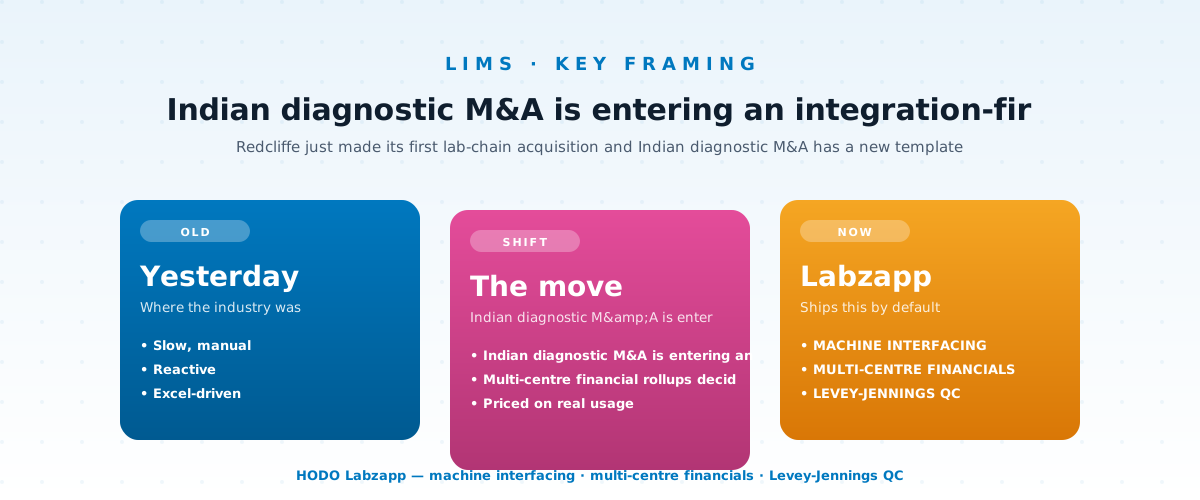
Ask any post-merger integration head at a listed diagnostic and you will hear the same eighteen-month grind: mapping test codes, rationalising panel prices across geographies, migrating patient histories, retraining phlebotomists on a new sample workflow, and — most painfully — reconciling three months of overlapping AR from two billing systems. Value leakage during this period typically runs at 8-15% of acquired revenue, and referring doctors quietly shift volume to competitors while the integration team is heads-down on data mapping. The chains that survive integration well have two structural advantages. First, barcoded sample tracking that works across sites — so an acquired centre's samples can enter the parent's processing hub without manual re-entry. Second, differential pricing per partner already built into the LIMS, so a corporate MOU or insurance TPA rate signed at the acquired chain can be honoured on day one without a pricing war-room. Owners preparing for either side of an M&A conversation should audit both capabilities before the term sheet arrives, not after.
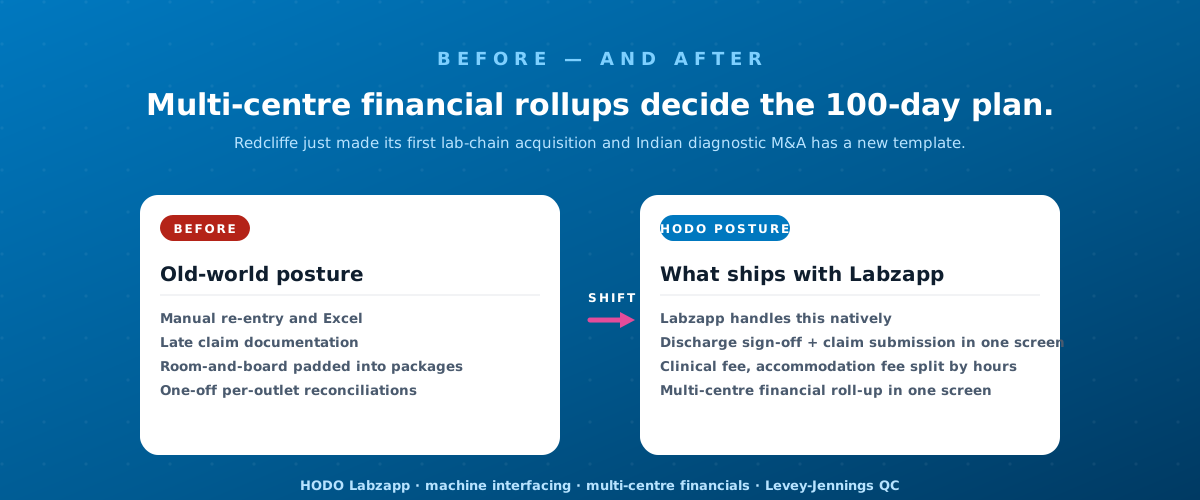
The single biggest surprise for private-equity boards after a lab acquisition is how long it takes to get consolidated financials. If the acquired chain runs one billing system per centre, the CFO cannot answer basic questions — revenue per test, contribution margin per outlet, DSO by TPA — for two to three quarters after close. That opacity delays the 100-day plan and, worse, hides the exact centres that should be rationalised or expanded. A lab chain running on a stack with multi-centre financial rollups from day one avoids this entire problem: centre-level P&L, cross-centre franchisee settlements and partner-wise realisation reports are available the morning after the acquisition closes. The same discipline benefits the seller. A regional chain owner who can walk into an M&A meeting with three years of clean, centre-wise EBITDA data — rather than a shoebox of Tally exports — has materially more negotiating leverage. This is not a technology-vanity point. It is the difference between an 8x and a 12x EBITDA multiple in a diligence room.
Acquired chains are usually bought for their geographic footprint and referral book, not their operational polish. Which means the acquirer typically inherits a TAT problem — sample-to-report cycles that are 40-60% slower than the parent's benchmark, driven by manual result entry from analysers, courier-based sample transfers between centres, and paper report despatch. The fix is technical but well-understood: direct machine interfacing so haematology, biochem and immunoassay analysers push results into the LIMS without a tech typing them in; barcoded samples so an acquired centre's phlebotomist collects once and the sample moves through the network without re-labelling; and automated report despatch over SMS, WhatsApp and email so the patient — and the referring doctor — never wait on a courier. Chains that operationalise this within ninety days of close protect the referring-doctor loyalty that justified the acquisition price. Chains that do not watch referral volume slip to whichever local competitor still delivers reports faster.
Most diagnostic chain acquisitions are, in economic terms, acquisitions of a partner network. The physical centres matter less than the panel of referring doctors, the corporate accounts, the outsourcing arrangements with specialty labs, and — for larger chains — the franchisee agreements. Preserving those relationships through an ownership change requires role-specific tooling: referral-doctor portals so the doctor's login, TAT visibility and commission statements do not break the day the signage changes; corporate-partner logins so HR teams at client companies keep booking without a fresh procurement review; anonymised sample tracking with outsourced specialty labs so complex tests continue to flow without breaking patient confidentiality; and clean franchisee management so contract terms, revenue shares and territory rights are honoured without dispute. Chains that migrate these relationships onto the acquirer's platform within the first sixty days retain 90%+ of partner revenue. Chains that do not lose a quarter of it, permanently.
The Redcliffe deal is a signal, not an outlier — the next twenty-four months will see more mid-sized lab chains changing hands in India. HODO Labzapp is built for exactly this operating environment. Multi-centre financials give the CFO of an acquired or acquiring chain a consolidated P&L view from day one, so the 100-day plan runs on real numbers rather than reconciled guesses. Barcoded samples with machine interfacing cut TAT on inherited centres to parent-benchmark levels within weeks, protecting the referring-doctor loyalty that made the acquisition worth doing. And differential pricing per partner together with referral-doctor and corporate-partner portals lets the acquirer honour every existing MOU on day one, avoiding the partner-attrition that quietly destroys deal value. For owners preparing to sell — or to buy — a lab network in this cycle, the technology layer has become part of the price.
See how Labzapp handles this — book a 30-min demo.
See how Healzapp, Labzapp and EReazy fit your speciality in a free 30-minute demo.
Book a Free Demo