BW People reports that only 6.7% of Indian enterprises have scaled AI across their workflows, while a far larger share sit on pilots, licences and proofs of concept. The usual reading is that organisations lack budget or talent. For healthcare operators and founders in India, the sharper reading is that most of them never chose a workflow to scale, they bought access and waited to see what happened.
A selection problem dressed up as a budget problem
Access to AI tools in Indian healthcare organisations is close to universal already. A lab chain's marketing lead drafts campaign copy with one. A hospital's billing executive pastes a denial letter into another to decode the rejection reason. Add it up and the organisation has dozens of AI interactions a week, none of which the BW People survey would count.
What the 6.7% measures is stricter: AI sitting inside a workflow that runs on a schedule, with a named owner and an output someone else depends on. That is a process decision, not a procurement decision. And process decisions require choosing, which task, which sequence, which function first. Most organisations skipped that step, distributed logins, and ended up with what is effectively a very expensive typing aid.
The cost structures are completely different. Ad-hoc use costs one person's attention and produces one output that nobody can find next month. A scaled workflow costs design time upfront, then runs every week at falling marginal cost, and compounds because the context behind it accumulates. An operator with three diagnostic centres and a 40-rider home-collection network does not need forty AI users. It needs four workflows that run whether or not anyone remembered to start them.
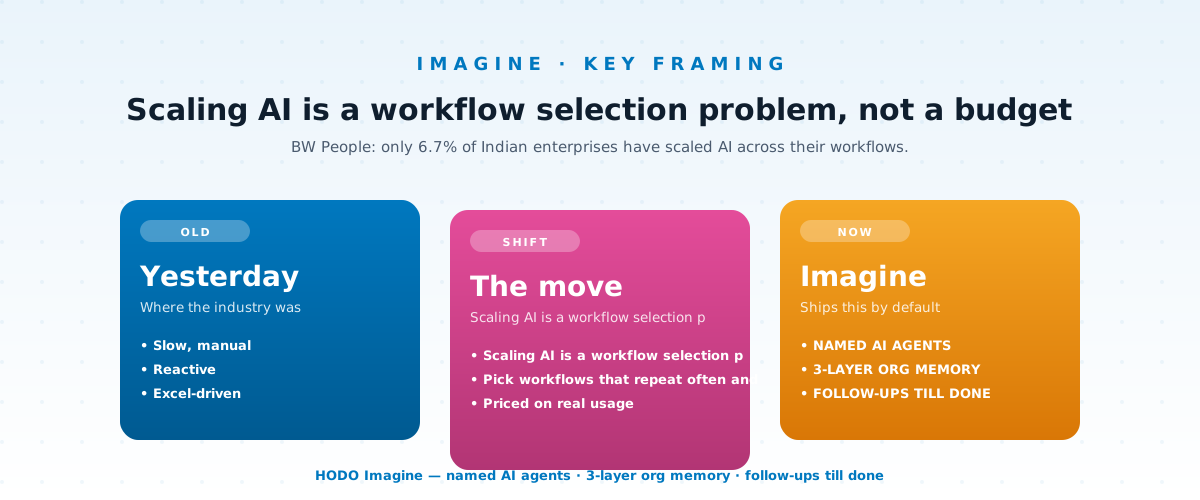
Scaling AI is a workflow selection problem, not a budget one.
The test for picking the first workflow
Two variables decide whether a workflow is a good first candidate: how often it repeats, and how much of it is already written down somewhere in the organisation.
Frequency matters because it determines payback. A task done daily by three people pays back design effort within weeks. A quarterly board deck does not, no matter how painful it feels. Written-down-ness matters because it determines how much context has to be reconstructed from scratch. If the TPA escalation ladder, the empanelment numbers, the standard phrasing for a short-payment appeal and the three rejection codes that account for most of the file already exist in emails and spreadsheets, that workflow can be stood up in days. If all of it lives in one billing manager's head, the first job is extraction, not automation.
Plotted against each other, these two variables usually point Indian healthcare operations at the same unglamorous shortlist: payer and TPA follow-up correspondence, referral-doctor and corporate-partner communication, recruitment and onboarding answers for front-office and phlebotomy roles, and the weekly operations summary that currently takes a manager half a day to assemble from four systems. None of these are clinical. All of them repeat, and all of them are already documented in fragments.
What gets picked first in practice is almost the opposite, a patient-facing chatbot, because it demos well. Patient-facing work is the hardest category to scale: highest consequence of error, most regulatory exposure, and the least written down. It belongs in month six, not month one.
Why the second month kills most pilots
Pilots in Indian healthcare rarely fail on capability. They fail on continuity, and the shape of the failure is predictable enough to plan around.
In month one, an operations manager works out a genuinely good way of drafting payer follow-ups. The output is better than what the team produced manually. In month two, that manager shifts to the second branch or leaves, and the entire arrangement goes with her, because it existed as a habit rather than an organisational asset. Her replacement starts from an empty box and concludes the tool is weak.
Churn at the front office, billing and phlebotomy layers is high in Indian healthcare operations, frequently above a third annually. Any AI arrangement that stores its working context in individual staff memory will therefore reset at least once a year, which is exactly the cadence at which nothing ever reaches scale. This is why organisational memory, not model choice, is the variable that separates the 6.7% from everybody else. The question to ask a vendor is not what model sits underneath. It is what survives the resignation of the person who set it up.
What "scaled" has to look like on paper
Scaled AI should be auditable in the same way a duty roster is auditable. Four things need to be answerable without a meeting.
First, ownership: which agent or person owns this workflow, and who do they report to? An AI workflow without a reporting line behaves exactly like an unassigned task, it gets done when someone is free. Second, memory: what context does the workflow carry forward, and where does it live? Today's open items, this week's running threads and the permanent record of rates, partners and standard phrasing are three different retention needs, and collapsing them into one chat history is why context keeps getting lost. Third, closure: does the workflow chase its own loose ends, or does it produce a draft and stop? Follow-up correspondence that is drafted but never re-sent on day seven has not changed any receivable. Fourth, voice: does the output read like the organisation, or like a generic assistant? For a lab chain writing to 200 referring doctors, inconsistent tone is a commercial problem, not a cosmetic one.
An operator who can answer those four questions about even two workflows is doing something materially different from one holding fifty licences. Licence count is a vanity metric. The honest measure is how many recurring outputs the organisation produced last week without a human initiating them.
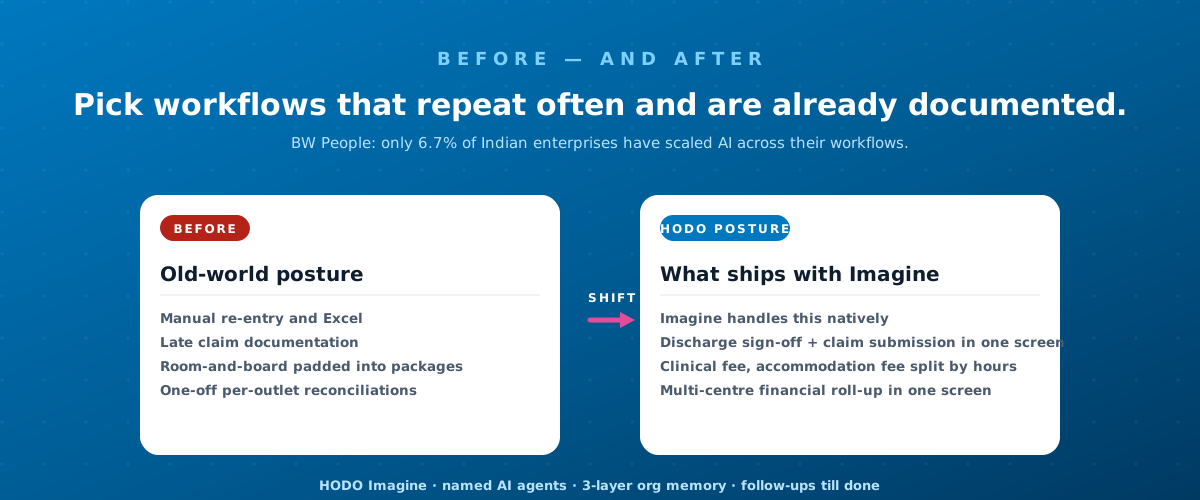
Pick workflows that repeat often and are already documented.
A 90-day sequence that actually lands
The pattern among organisations that cross over is narrow in scope and boring in execution. Days 1 to 15: pick one workflow from the high-frequency, well-documented quadrant and extract its context into writing, rate cards, escalation ladders, standard responses, the names and quirks of the counterparties. Days 16 to 45: stand up that single workflow with a named owner and a fixed weekly review, and keep a plain log of what it produced. Days 46 to 75: add the second workflow, and reuse the context already captured rather than rebuilding it. Days 76 to 90: measure, then decide whether to extend or stop.
The decision point matters. Many pilots in the 93% were never killed, merely abandoned, which leaves spend in place and learning at zero. An explicit stop is a better outcome than a quiet drift, and it frees the budget for the workflow that does repay effort.
What this means for digital transformation
The 6.7% figure is not a verdict on AI quality in Indian enterprises. It is a verdict on how AI was introduced, distributed as access rather than assigned as work. For healthcare founders and operators, the digital USP is not having AI. It is having AI that remembers the organisation's rate cards, partners and payer history well enough that the next hire inherits it instead of rebuilding it.
That is the layer imagine is built for: named AI agents with jobs and reporting lines so each workflow has an owner, 3-layer memory across today, this week and forever so context accumulates instead of resetting, follow-ups until tasks close so drafted work actually completes, and brand voice consistency so output reads like the organisation across every partner and patient communication. It does not replace Microsoft 365, Copilot or ChatGPT, it connects them with memory the organisation owns.
See how imagine turns AI into organisational intelligence, explore imagine.