GBM has opened an AI lab in the UAE with Cisco and NVIDIA, positioned around secure enterprise AI, according to a report carried by Konsulteer via Google News. The substance of the announcement is infrastructure: GPUs, segmented networking, and a controlled environment where regional enterprises can test workloads before committing to them. For a founder running a clinic group, a lab network or a home-collection platform in Dubai, Doha or Manama, the useful question is not what hardware sits in that lab. It is which parts of the AI stack stop being a differentiator once facilities like it exist in the region.
The layer below the founder is getting cheaper and safer
GBM is a long-standing systems integrator in the Gulf, and the pairing with Cisco and NVIDIA follows a familiar pattern: capability that used to require a capital project becomes something an enterprise rents, tests and audits. Secure hosting, model access, network isolation and reference architectures move from the strategy deck into the procurement file. That shift has happened before: in 2012 running a hospital information system meant buying servers, and by 2020 it meant choosing a hosting region.
The consequence for healthcare operators and product builders in the region is specific. Access to a frontier model is no longer scarce, and neither is a defensible place to run it. Two polyclinic chains in the same emirate can buy the same model, the same GPU capacity and the same compliance paperwork within a quarter of each other. Anything that can be bought at that speed is not a Digital USP. What remains scarce is the organisational layer above the infrastructure, the part that decides which jobs AI actually does inside the business, who is accountable for each one, what the system remembers between staff rotations, and whether a task that was started last Tuesday has closed yet. No integrator sells that, because it is not a product shipped into a rack. It is an operating decision the founder makes.
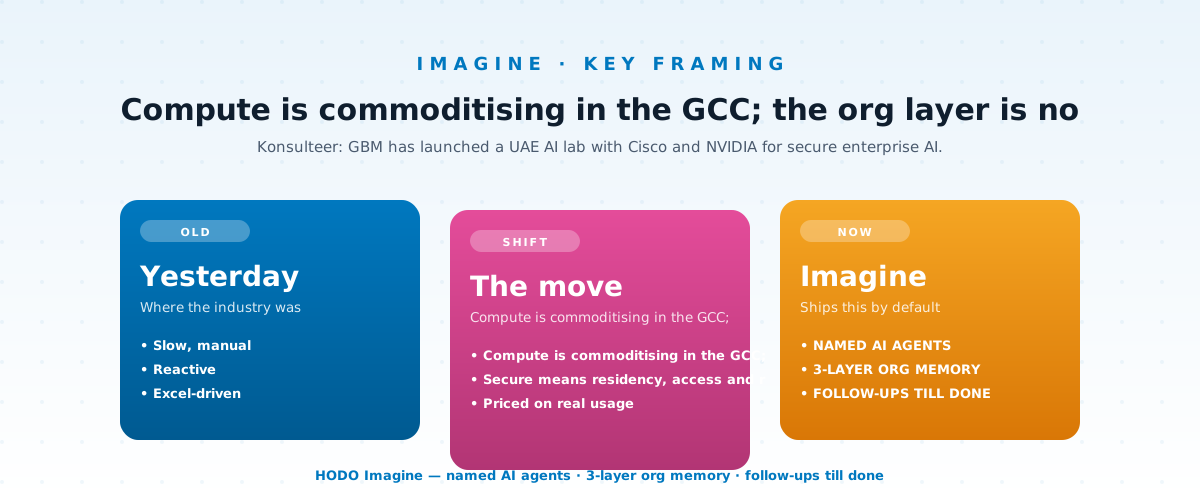
Compute is commoditising in the GCC; the org layer is not.
In the Gulf, "secure" means three separate things
The word secure is doing heavy lifting in announcements like this one, and it is worth splitting into its parts, because a buyer who conflates them will pay for one and assume the other two.
The first is residency: where the data physically sits and under whose jurisdiction. Regional infrastructure answers this directly, and for a clinic group handling patient records across multiple licensing authorities, it matters.
The second is access: which people inside the organisation can see which information. This is partly an infrastructure question and largely a configuration one. A secure data centre does not stop a branch manager from pulling a price list they should not have.
The third is reconstruction: when someone asks six months later who did what, when, and on whose instruction, can the organisation answer. Licensing inspections, insurance disputes and partner contracts all tend to resolve into that single question. Infrastructure vendors do not answer it. Chat transcripts scattered across personal accounts answer it badly. This third form of security is organisational rather than technical, and it is the one most AI pilots in the region leave undone, which is why a pilot can be hosted on fully compliant regional infrastructure and still fail an audit on process.
Most leakage happens in a chat window, not a data centre
The practical risk inside a growing healthcare business is rarely a breached server. It is a coordinator pasting a patient list into a personal AI account to draft a reminder message. It is a lab supervisor who has worked out a reliable way to explain a delayed turnaround time to referring doctors, and keeps that phrasing in a note on their own phone. It is a marketing hire who leaves at the end of a visa cycle and takes the tone of voice with them.
Staff turnover in the Gulf runs on contract cycles, and knowledge transfer is usually a handover document written in the last week of employment. The cost of that is not dramatic enough to appear in a board pack: it shows up as the same questions being re-answered, the same pricing explanation being rewritten, the same partner onboarding sequence being reinvented at each new branch. Shadow AI use makes it worse, because the useful judgement now lives in accounts the organisation does not control and cannot search.
A secure regional AI lab does nothing about any of this. The exposure is not in the compute; it is in the fact that nobody can say which account holds the institutional knowledge.
Named agents give the work an owner
The structural fix is to stop treating AI as a shared chat window and start treating it as staff. That is the approach imagine takes: named agents with defined jobs, their own memory, and reporting lines into the organisation. An agent that handles referring-doctor follow-ups is a different entity from one that drafts partner pricing notes, with a different scope and a different record of what it has done.
The security benefit is structural rather than cryptographic. When a task has a named owner, access can be scoped to that owner, output can be reviewed against that owner's remit, and an audit question has a subject. "Who sent that message to the corporate client" has an answer. Compare that with a single company-wide assistant used by thirty staff, where every query is anonymous and every answer is unattributable.
It also changes how adoption gets measured. A shared chat tool is measured in usage, which tells a founder almost nothing. Agents with jobs are measured the way a team is measured: tasks assigned, tasks closed, work redone. That number survives a change of model vendor.
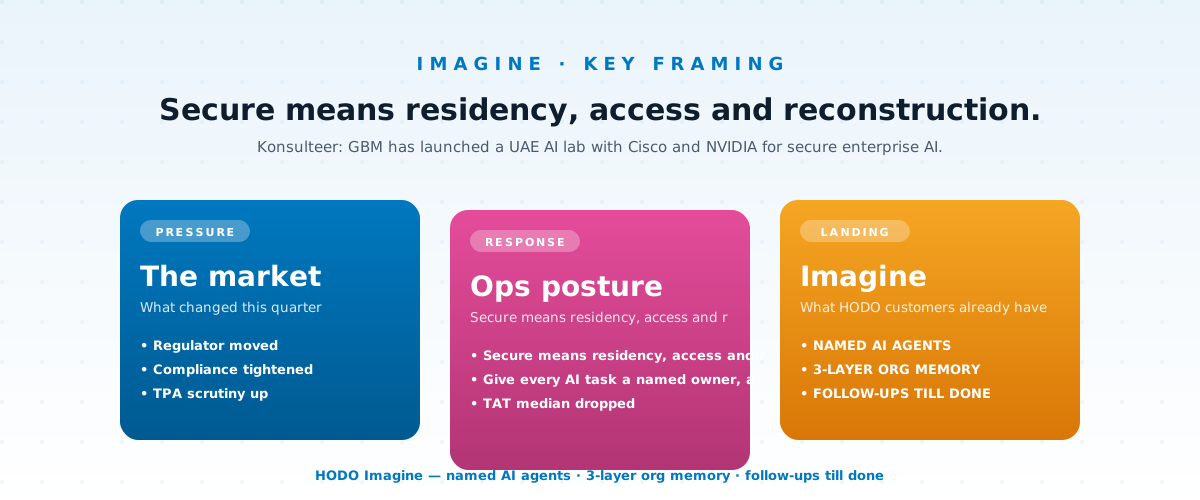
Secure means residency, access and reconstruction.
Memory is a retention policy in disguise
Knowledge that compounds requires somewhere to accumulate. imagine structures this in three layers, today, this week, and forever, so that an operational detail from this morning is treated differently from a pricing rule that should hold for three years. The layer that matters most to a founder is the last one: it is where the organisation's own judgement collects, independent of who happens to be employed this quarter.
Two downstream effects follow. First, consistency across outlets. A clinic group operating in three emirates, or a lab chain adding franchise partners, needs the same explanation of the same policy regardless of which branch a patient contacts. Brand voice consistency is the mechanism, and it is an operational control as much as a marketing one, because inconsistent answers generate disputes.
Second, closure. Follow-ups that continue until a task is actually finished produce something the organisation did not previously have: a record of what was chased and what settled. That record is the reconstruction layer described earlier. It is also the cheapest audit trail a growing business can build, because it is a by-product of the work rather than a separate reporting exercise.
What this means for digital transformation
Regional infrastructure announcements are a signal that the lower half of the AI stack is becoming a commodity in the GCC. The differentiator moves up: to whether an organisation's knowledge is owned institutionally, whether AI work is attributable, and whether tasks close. Named AI agents with jobs, memory and reporting lines give each workflow an owner. Three-layer memory, today, this week, forever keeps hard-won operational judgement inside the business when a contract ends. Brand voice consistency and follow-ups until tasks close convert that memory into consistent output and a usable trail. imagine does not replace Microsoft 365, Copilot or ChatGPT, it connects what an organisation already uses with memory that persists, which is precisely the layer no integrator can sell.
See how imagine turns AI into organisational intelligence, explore imagine.