
The Association of Healthcare Providers (India) has demanded immediate restoration of cashless services by Star Health Insurance, after a fresh round of network disputes left admitted patients paying out-of-pocket at empanelled hospitals, according to The New Indian Express. For hospital owners, this is not just another payer skirmish. It is a stress test of how well the billing desk, TPA cell and HIS talk to each other when a large payer goes dark.
Reports from the past week describe patients arriving with valid Star Health policies being told at admission that pre-authorisation is not going through. Some hospitals have paused cashless outright; others have shifted patients to reimbursement mode, which pushes the entire treatment cost onto the family before discharge. The provider body has cited unilateral tariff revisions, delayed pre-auths and rising claim denials as the trigger. Whether this specific dispute settles in a week or drags on, the pattern is now familiar. A big TPA changes terms, the network absorbs the shock, and the hospital's working capital takes the hit while finance scrambles to reclassify patients from cashless to self-pay mid-stay. Owners with 50-500 bed footprints, or a chain of clinics feeding a central IP block, cannot afford to run this drill manually every quarter. The billing SOP has to assume payer volatility is now baseline, not an exception, and that assumption has to be wired into the system rather than left to counter staff to remember.
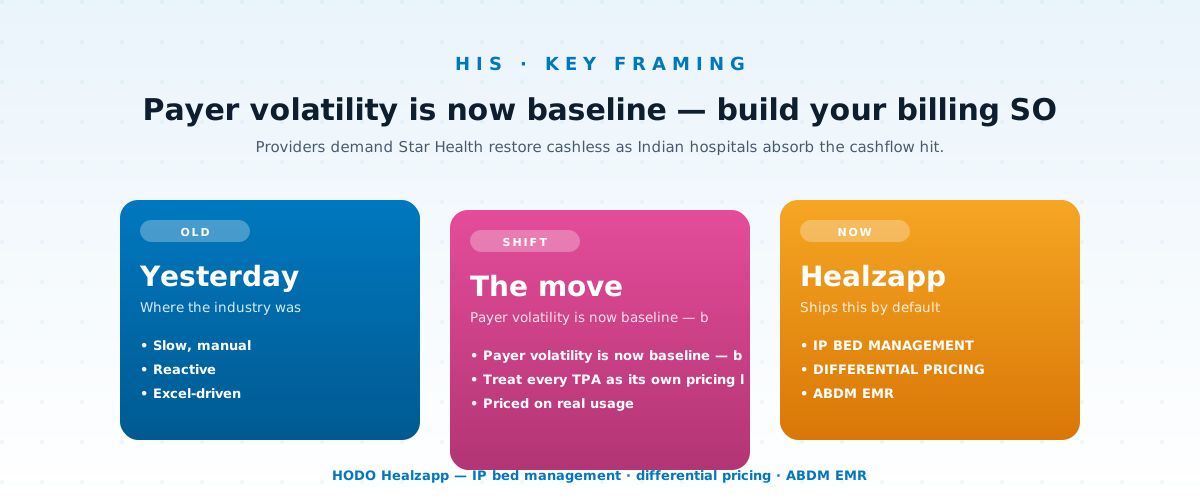
A typical mid-size Indian hospital books 35-55% of IP revenue through insurance and TPA channels. When one large payer freezes, three things break at once. First, admissions drop, because families walk out when told cashless is unavailable. Second, discharges pile up, because settled bills need to be recomputed at self-pay tariff, refunds routed, and consent re-taken. Third, receivables age. Claims already in the pipeline sit longer because the TPA is dealing with fresh disputes rather than clearing old ones. If the HIS treats a payer as a single flag on the patient record, there is no easy way to freeze a tariff, switch a batch of in-house patients to reimbursement, or run a pricing rule for the payers still on network. The finance team then rebuilds Excel sheets to figure out who is on which tariff, and the delay shows up in days-sales-outstanding two months later. This is a workflow problem, not just an insurance problem, and the fix sits in configuration rather than in negotiation with the payer.
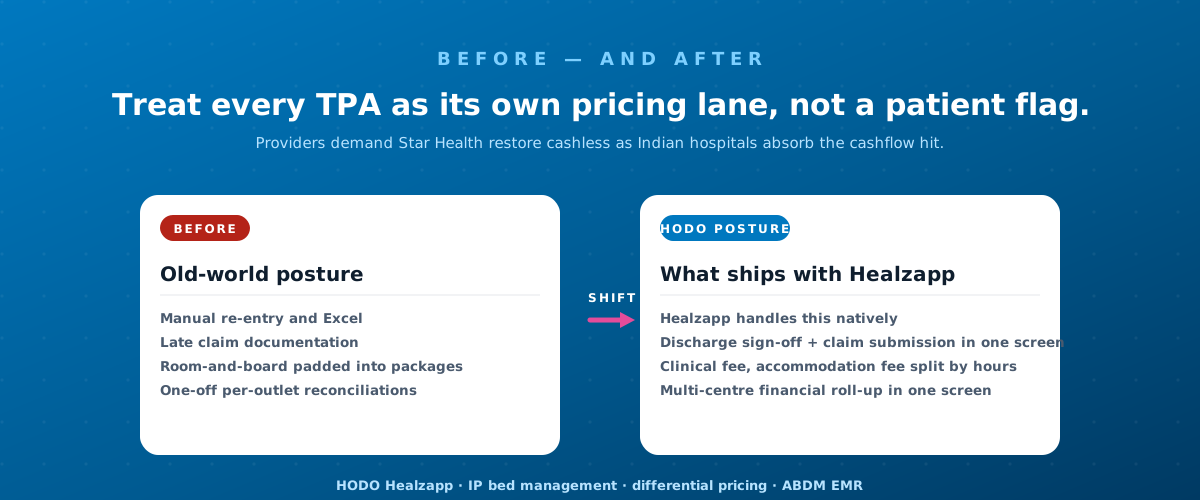
The fix starts with treating each payer as a distinct pricing lane in the system. HODO Healzapp's Billing module lets administrators maintain payer-specific tariffs and toggle them centrally, so if Star Health has to be moved from cashless to reimbursement at 8am on a Monday, one config change reflects across all active IP and OP encounters. Differential pricing lets the same procedure carry different rates for cash, corporate, TPA A, TPA B and government schemes without manual overrides at the counter. The Patient Management workflow captures pre-auth status against the encounter, not the patient master, so a repeat visitor whose earlier admission was cashless does not get auto-tagged the same way. For chains running multiple centres, the same tariff switch propagates in one action rather than through a spreadsheet routed to every branch. When the payer restores service, the reverse switch is equally clean and there is an audit trail of which patients were billed under which regime, which matters when the TPA later disputes a claim.
Owners should assume at least one large TPA will do this again in the next 12 months. The operational homework is boring but pays back fast. Segment IP and OP revenue by payer for the last four quarters; if any single insurer is above 20% of IP revenue, there is concentration risk that needs a pricing and communications playbook. Draft a patient-facing script for the front desk that explains reimbursement mode without sounding evasive, and get it into the TV Token Display and SMS templates so it is consistent across shifts. Reconcile TPA-wise receivables weekly, not monthly, so ageing above 60 days shows up before it becomes a board-meeting problem. And confirm that HIS-to-Tally posting keeps payer-wise ledgers separate. Collapsing everything into one debtor account is why hospitals discover receivables gaps only during statutory audit. None of this needs new capex; it needs the modules already inside a modern HIS to be configured for the real world.
Four numbers are enough. Pre-auth turnaround per payer, in hours: anything above six hours for a scheduled admission signals payer friction before it becomes a dispute. Cashless-to-reimbursement conversion rate: the percentage of admitted patients who had to switch mid-stay, which is a leading indicator of family dissatisfaction and social-media escalation. Payer-wise DSO: days sales outstanding by TPA, so finance can rank chase priority. And denial rate by procedure code: if a payer is quietly rejecting the same three codes, the tariff or the coding needs a fix, not more follow-up calls. All four are calculable inside a well-configured HIS if payer, tariff, pre-auth and posting are captured as structured fields rather than free text. Owners who read these four numbers every Monday morning will see the next payer standoff coming a fortnight earlier than those relying on month-end MIS.
Hospitals running HODO Healzapp already have the levers for this scenario. Differential pricing lets a Star Health tariff be paused and a reimbursement tariff activated in one place, with the change reflecting across every active encounter. Billing and Patient Management hold payer status at the encounter level, so mid-stay switches do not corrupt the patient master or the earlier admission record. And Tally integration keeps payer-wise ledgers separated on the finance side, so ageing and DSO reports remain trustworthy through the disruption. For multi-outlet chains, the same configuration applies via the one-click new-centre setup used when a branch is onboarded, so a tariff freeze at head office does not need branch-by-branch replication. The Star Health situation will pass; the next one will not wait as long.
See how Healzapp handles this — book a 30-min demo.
See how Healzapp, Labzapp and EReazy fit your speciality in a free 30-minute demo.
Book a Free Demo