The Association of Healthcare Providers India (AHPI) has publicly asked Star Health to restore cashless services after member hospitals reported blanket suspensions that left patients paying upfront and providers chasing reimbursement, per a recent report in Outlook Money. Whether the dispute ends in a truce or drags into arbitration, the operational lesson for hospital owners is the same: a single payer can freeze a meaningful share of monthly revenue without warning, and the systems on your side have to absorb that shock without breaking down at the billing counter.
The AHPI Notice and Why It Matters
AHPI's escalation is not an ordinary tariff squabble. The association represents a large slice of India's private-hospital capacity, and its notice frames the Star Health suspension as a patient-safety issue as much as a commercial one. Patients who bought cashless policies specifically to avoid liquidity stress at the point of admission are now being asked to arrange lakhs in cash within hours. Hospitals, in turn, are being blamed at the front desk for a decision they did not make.
For administrators, the underlying signal matters more than the specific dispute. India's TPA and insurer landscape has been consolidating and hardening its stance on tariffs, medical necessity, and documentation for over a year. Star Health today, another insurer next quarter, the pattern of unilateral cashless withdrawals is now a known operating risk. Treating it as a one-off will leave the finance team unprepared when the next notice lands in the inbox.
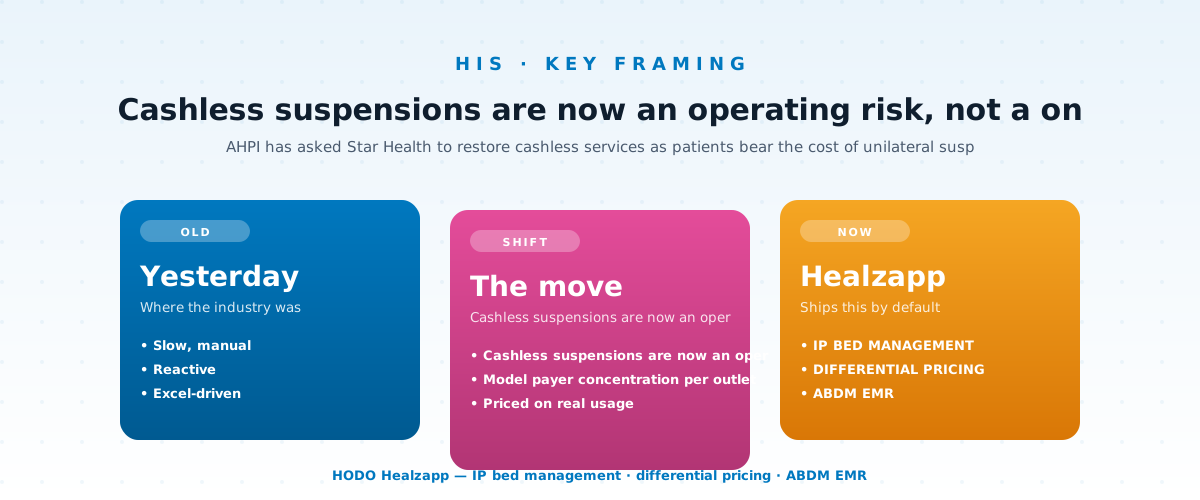
Cashless suspensions are now an operating risk, not a one-off.
The Immediate Impact on Hospital Cashflow
When a major insurer withdraws cashless, three things break in the same week. First, admissions dip because patients postpone elective procedures they can no longer fund through a hospital counter. Second, the revenue that does come in shifts from a 30-45 day TPA cycle to a mix of direct patient collection and reimbursement claims that patients themselves file, which slows realisation to 60-120 days and pushes bad-debt risk back onto the hospital when the patient's own claim is partially rejected.
Third, the finance team's forecast collapses. Weekly cash projections built on assumed TPA settlement dates now sit alongside a growing pile of patient IOUs and part-payments. Owners who run outlets on tight working-capital lines discover very quickly which centres were being kept afloat by one or two large payers. The immediate audit question is not "how much Star Health revenue do we book" but "if any single insurer went dark tomorrow, how many days of payroll can each outlet self-fund from its own collections?"
Where Billing and Documentation Usually Break
Under a normal cashless flow, the pre-authorisation quote, the discharge summary, the final bill, and the claim file all have to agree line by line. In hospitals still running billing on spreadsheets, or on an HIS where TPA tariffs are entered manually per admission, drift is inevitable. A pharmacy line added after pre-auth, a room upgrade approved verbally by a relative, a consumable billed at rack rate instead of the negotiated payer rate, each of these is a legitimate reason for a TPA to short-pay or deny.
The moment cashless is suspended, those same weaknesses become worse. Every bill now goes to the patient directly, so any inconsistency between what was quoted, what was consumed, and what was billed becomes a customer-service argument at the discharge desk rather than a paper exchange with a TPA desk. Hospitals that had never quantified their leakage per admission find out in the worst possible way, through refunds, write-offs, and Google reviews.
The Audit Every Administrator Should Run This Week
Regardless of a hospital's view on the AHPI-Star Health dispute, five questions are worth putting to the billing head this week. One: what percentage of the last quarter's IP revenue came from the top three payers, per outlet? Two: for each of those payers, what is the average denial rate and top three denial reasons? Three: how many days does a cashless claim take from discharge to money-in-bank, and how has that number moved over the last six months?
Four: does the HIS hold a separate rate card per payer, or does the billing team apply discounts by hand at final bill? Five: when a pre-authorisation is approved for a fixed package, does the system block additional line items from being added without a fresh approval, or does it silently allow overruns that the TPA will later deny? If the answer to any of these is "we'd have to pull it manually," that is the gap the next cashless suspension will exploit.
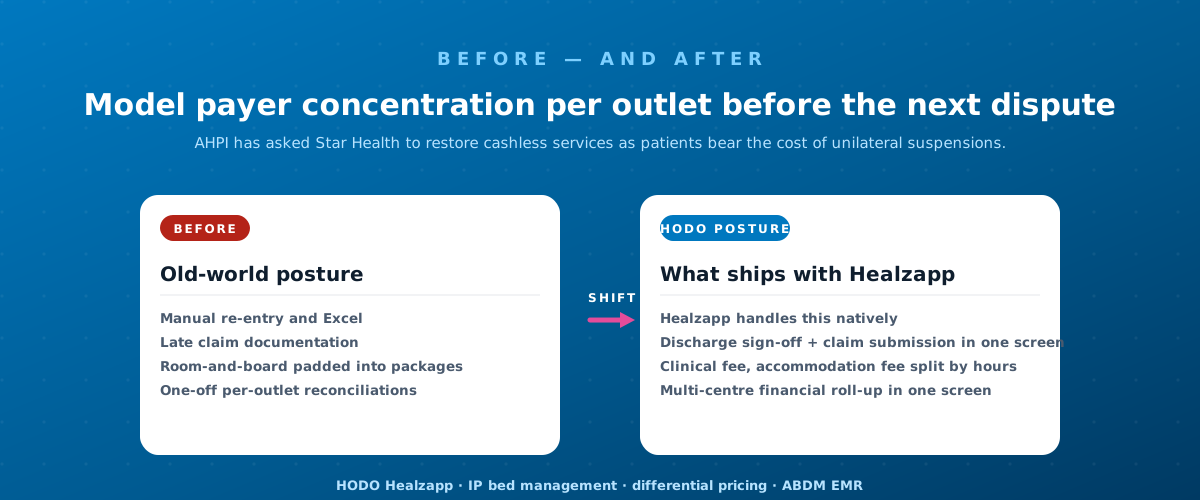
Model payer concentration per outlet before the next dispute.
TPA Risk Is a Systems Problem, Not a Ward Problem
The instinct after a payer dispute is to push the pain to the wards, tighter approval loops, more paperwork per admission, an extra sign-off before a consumable is used. That approach burns out billing staff and slows down clinicians without meaningfully reducing denial rates. The durable fix is upstream, in how the HIS models payer contracts and how documentation flows from pre-auth through to claim submission.
Hospitals that have moved from manual TPA handling to system-enforced payer rules typically see two measurable shifts within a quarter: first-pass claim acceptance rises because the bill mechanically matches the pre-auth, and the finance team can produce ageing reports by payer without a week of reconciliation. Neither is a magic bullet against a Star-Health-style suspension, but both mean that when a payer does go dark, the exposure can be quantified in an afternoon and the affected patient cohort switched to a direct-billing flow without losing money in the transition.
What this means for HODO customers
The Star Health situation is exactly the scenario HODO Healzapp Billing is built to absorb. Payer-specific tariffs sit in the system as first-class objects rather than manual discounts, so the same procedure bills at the correct rate whether the patient walks in cash, corporate, or under any TPA, and if cashless is withdrawn, switching a cohort to direct billing is a payer-flag change, not a re-quotation exercise. Differential pricing lets multi-outlet groups hold different tariffs per centre, per corporate, and per TPA without the billing team memorising them. Tally integration then closes the loop into finance so ageing by payer is visible weekly, not on a quarterly scramble. None of this makes an insurer dispute pleasant, but it does mean the next one is a controlled event instead of a firefight.