DD News reports that the Swasth Bharat Portal has been launched as a single integration point for India's health information systems, positioned as the next step in the country's digital health transformation. For a 100-bed hospital or a regional lab chain, the headline is not the portal itself. It is the direction of travel: the numbers your hospital generates are increasingly read, compared and acted upon outside your building.
What a central integration portal actually changes
India already has plenty of health reporting. Hospitals file programme returns, state dashboards, infectious disease notifications, Ayushman claim data, NABH evidence files and ABDM linkage counts. What has been missing is a common place where those streams sit beside one another. That is what an integration portal is for, and it changes the economics of reporting in three ways.
First, data that used to travel as a one-off submission starts travelling as a continuous feed. A number submitted once a quarter gets checked once a quarter. A number flowing continuously gets compared against last month, against the district average, and against whatever you claimed in a different return.
Second, inconsistency becomes visible. If your IP census says 68 occupied beds and your claim file implies 81 admissions for the same day, that gap used to live in two separate filings. On a portal that joins sources, it becomes a query someone else runs.
Third, the reporting burden shifts from compilation to verification. Compilation is what junior staff do in spreadsheets at month-end. Verification means your systems have to agree with each other before anything leaves. Hospitals that treat this as an IT problem will keep paying for compilation. Hospitals that treat it as a data discipline problem will stop.
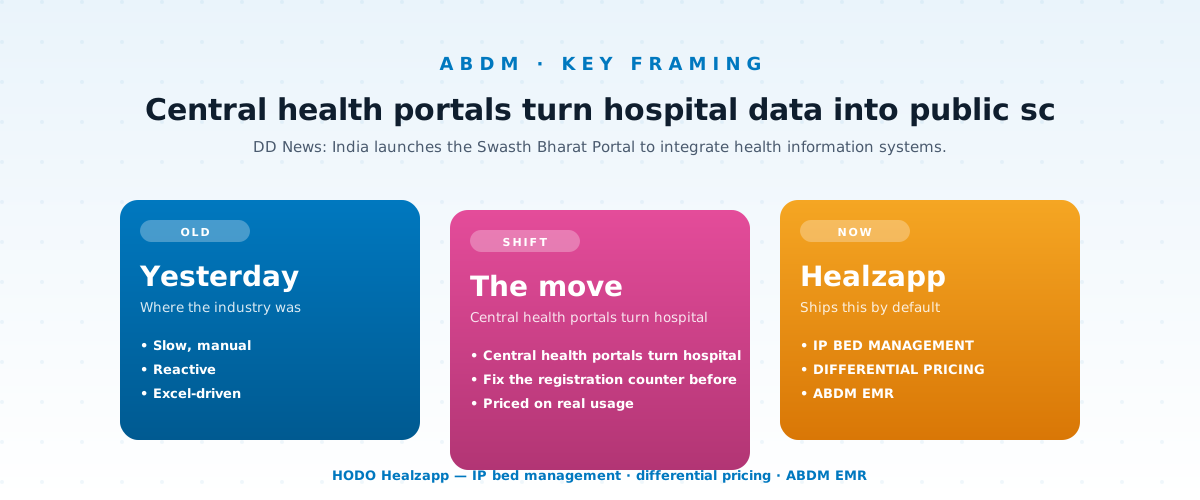
Central health portals turn hospital data into public scorecards.
Data quality is decided at the registration counter
Every reporting problem in an Indian hospital can be traced back to the first ninety seconds of a patient's visit. If the front desk creates a new record because it could not find the existing one, every downstream count inflates. Unique patients, repeat visit rates, follow-up compliance, ABHA linkage percentage, all of them break at the counter, not in the report.
The practical test is simple. Pull your patient master for the last six months and count records sharing a mobile number with a different patient ID. In most 100-bed hospitals the duplicate rate sits between 8 and 15 per cent. In lab chains with multiple collection points it runs higher, because each outlet registers walk-ins independently and nobody reconciles across centres.
Fixing this is unglamorous work. Search must be fast enough that staff actually use it rather than creating a fresh record to clear the queue. Mobile number must be mandatory and validated, not a field that accepts 0000000000. Address and age should come from the ABHA record where one exists, so the same patient is not 34 at the OP desk and 43 in the IP file.
Hospitals that have done this report a secondary benefit that has nothing to do with compliance. Once the patient master is clean, recall and follow-up campaigns start working, because messages reach one patient once rather than three partial records thrice.
The hidden cost is manual MIS compilation
Ask a hospital administrator how many person-hours go into monthly reporting and the answer is usually a shrug. Measure it and the number is uncomfortable. A typical 100-bed setup spends 40 to 70 person-hours a month assembling returns, pharmacy consumption from one register, bed days from another, lab volumes from a third, claim status from a payer portal, and an accountant reconciling all of it against the ledger.
That cost is not just salary. Manually compiled numbers are late, which means they are never used for decisions. A bed occupancy figure that arrives on the 12th cannot change staffing for the month it describes. An OP throughput number compiled by hand tells you nothing about which consultant's slot pattern caused Tuesday's two-hour wait.
The alternative is not a better spreadsheet. It is making every operational event produce its own record as it happens, the billing line, the bed transfer, the analyser result, the pharmacy issue. When reporting is a read on live data rather than a reassembly of it, the portal submission becomes a by-product of running the hospital rather than a separate project each month.
This is also where machine-generated data earns its keep. Lab values typed by hand carry transcription error and timestamp drift. Values pulled directly off the analyser carry neither, which matters when turnaround time becomes a reported metric rather than an internal one.
Multi-outlet chains have a definitions problem
For a single hospital, integration is a data quality exercise. For a chain running five centres, or a lab with twenty collection points, it is first a definitions exercise.
Take something apparently trivial: when does a test get counted? One centre counts at registration, another at sample collection, a third at report release. Roll those up and the chain's daily volume is wrong by whatever is in process. Same with discharge timestamps, same with "new patient", same with how a partner-lab outsourced test is attributed.
Before any portal integration, a chain should write down the ten metrics that matter, tests registered, tests reported, turnaround time, cost per test, bed occupancy, average length of stay, OP throughput per consultant, collection efficiency, outstanding by payer, revenue per outlet, and define each one once, in writing, with the exact system field it reads from. Then check whether every outlet produces it the same way.
This is also the moment to look at new-centre setup. If opening an outlet means someone recreates the service master, the price list and the report templates by hand, definitions drift from day one. Chains that clone a configured template keep their numbers comparable across centres; chains that configure from scratch spend the next two years explaining why outlet four looks different.
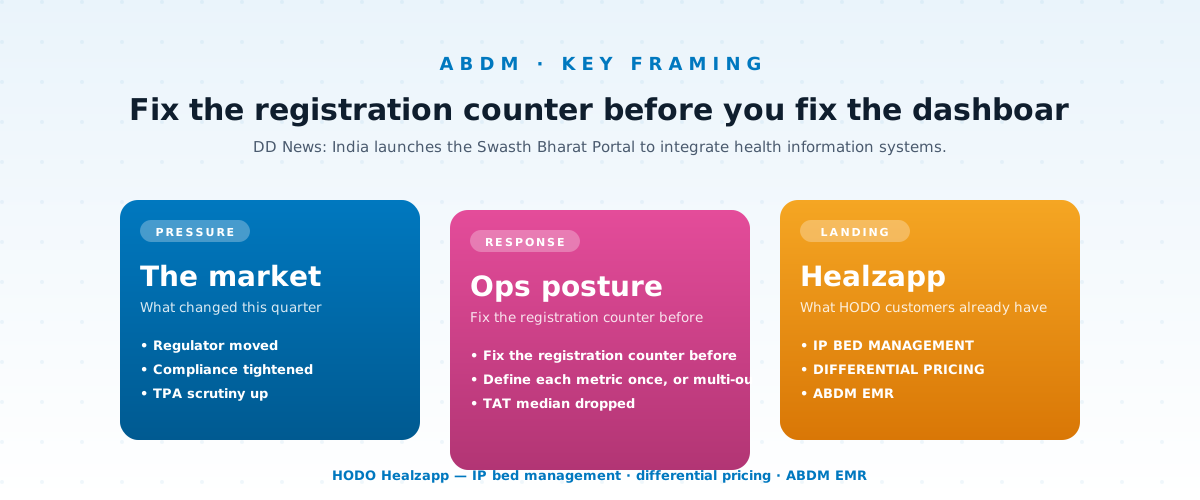
Fix the registration counter before you fix the dashboard.
A thirty-day readiness drill
None of this requires waiting for a mandate. Week one: run the duplicate patient audit and publish the number to the front-office team. Week two: list every report your hospital currently files, who compiles it, and how many hours it takes, this becomes the business case. Week three: write the metric dictionary, one page, ten definitions, signed off by the administrator and the finance head. Week four: identify which of those ten metrics your current system cannot produce without manual work, because that gap is your actual software requirement.
Hospitals running HIS replacements should carry this list into vendor conversations. The question is not whether a system is ABDM-ready; most claim to be. The question is whether it produces your ten metrics from live data, across every outlet, without a month-end assembly exercise.
What this means for HODO customers
HODO Healzapp was built around the assumption that reporting is a read on operations, not a parallel activity. ABDM-compliant EMR (India) keeps linkage and clinical documentation on the same record the billing and bed workflows use, so submissions do not need reassembly. Machine Interfacing pulls analyser output directly, which keeps turnaround and result data free of transcription drift. Multi-outlet scale-up with one-click new-centre setup clones a configured centre rather than rebuilding it, so metric definitions stay identical as a hospital or lab chain adds locations. HODO was among the first 20 ABDM-integrated HealthTechs in India and is NRCeS listed, across 500+ client outlets.