
Tata AIG has suspended cashless payments at Max Hospitals across India, joining Star Health, Niva Bupa and Care Health in a widening row between insurers and one of the country's largest hospital chains, LatestLY reported this week. For hospital owners and administrators, the pattern is no longer an outlier — it is a structural risk that touches billing, admissions, receivables and patient trust in the same week.
Over the last eighteen months, cashless suspensions between major insurers and hospital chains have moved from being a once-a-year escalation to something operators can expect quarterly. The Tata AIG-Max stand-off follows earlier suspensions by Star Health, Niva Bupa and Care Health at the same chain, and similar disputes have surfaced at other groups. The disputes typically centre on tariff renegotiation, alleged overbilling, delayed claim payouts or unilateral rate revisions.
For a 50-500 bed hospital or a multi-outlet clinic chain, the operational read is straightforward. Cashless is not going to become a more stable revenue channel. If a Max-sized group cannot force parity with a top insurer, mid-market hospitals have even less leverage. The reasonable response is not to abandon insurance — cashless still drives 30-60% of inpatient revenue at most private hospitals — but to build the internal systems that make disputes survivable. That means clean claim data, TPA-wise ageing reports, fallback reimbursement workflows, and patient communication that does not collapse the front desk when a suspension is announced at 9 am on a Monday. Most Indian hospitals still do this on Excel.
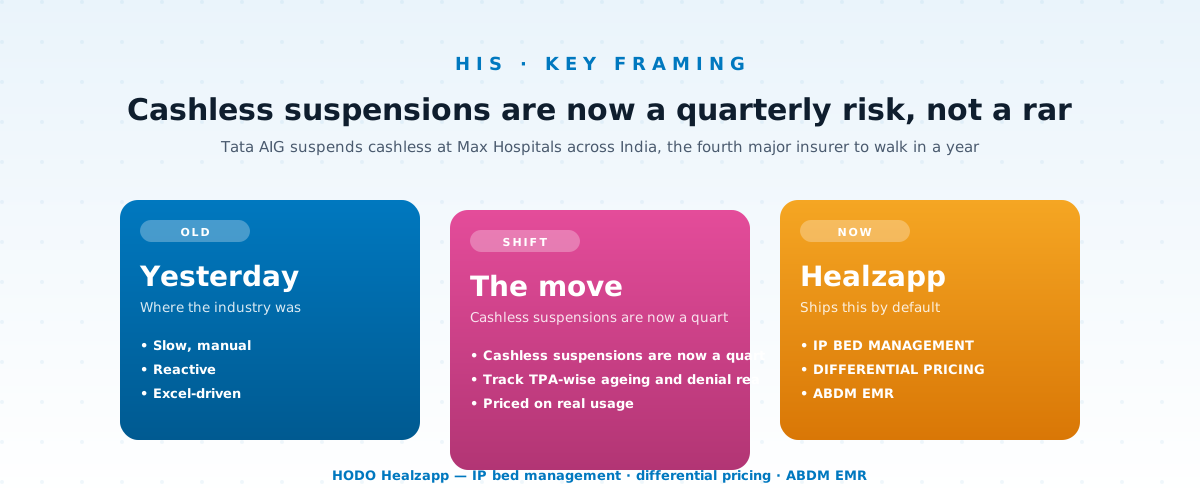
Max can absorb a single insurer going dark because it has diversified payer mix, corporate tie-ups, cash-paying medical tourists and treasury reserves. A 120-bed hospital in a Tier 2 city typically does not. When 15-25% of inpatient revenue depends on one insurer and that channel closes overnight, the cascade is predictable: elective admissions drop, day surgery calendars empty out, and the finance team starts stretching supplier payments within a fortnight.
Three internal weaknesses make it worse. First, most hospitals do not know their true TPA-wise revenue split until a suspension forces the accounts team to pull the number manually. Second, patient-facing counters have no scripted fallback for "your policy is under dispute at this hospital" — the receptionist and the admissions officer end up giving contradictory answers, which becomes a Google review inside 48 hours. Third, the reimbursement workflow, where the patient pays cash and claims from the insurer directly, is treated as an exception rather than a productised path with pre-approval templates, receipt formats and follow-up support.
The hospitals that ride out these episodes are the ones that treat the shift from cashless to reimbursement as a workflow change, not a crisis. That requires the HIS to already support it — with pre-authorisation status visible at the counter, TPA-wise billing rules, and one-click switching between payment modes at discharge.
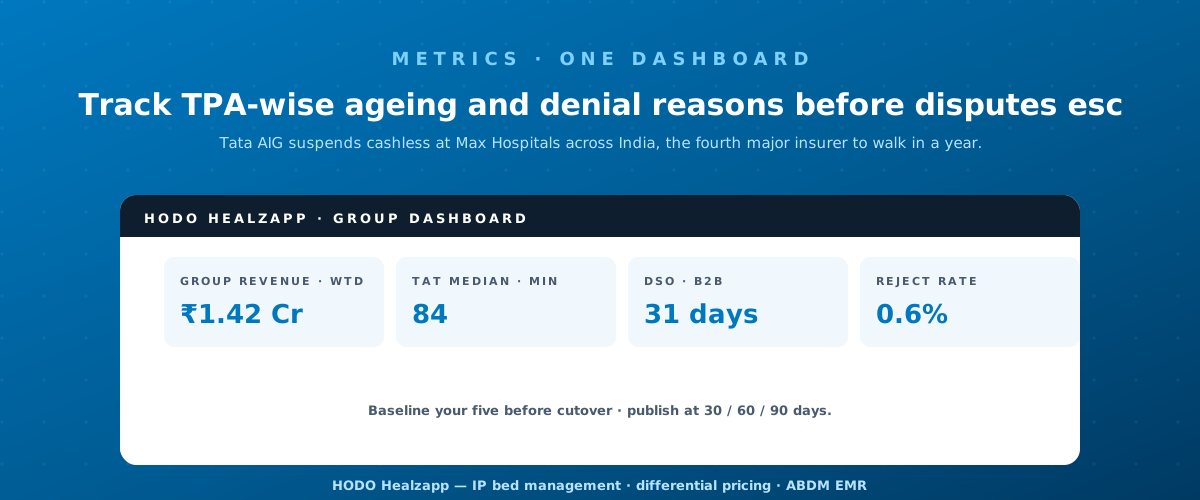
Ask most hospital CFOs for their 30/60/90-day insurance receivables broken down by TPA and the answer arrives two days later, assembled from three spreadsheets and a WhatsApp thread. That gap is the single biggest reason cashless disputes escalate — the hospital does not have the data to argue back when an insurer says claims are being submitted late or documentation is incomplete.
A structured HIS should produce, on demand: TPA-wise outstanding, average settlement TAT by insurer, denial reasons categorised by department, and claim submission lag from discharge date. Without those four numbers, negotiations with any insurer are one-sided. The insurer has claims data at the policy level; the hospital has invoices in a filing cabinet.
For multi-outlet operators the problem compounds. Each centre may have its own TPA relationships, its own billing quirks, and its own reconciliation calendar. Rolling this up manually every month is where finance teams burn out and mistakes creep into board packs. Machine-generated ageing, exception dashboards and centre-wise TPA mix reports are not analytics-team luxuries — they are the base layer for any conversation with a payer.
The under-used lever in most Indian HIS deployments is the corporate-partner login. Hospitals happily onboard 40-60 corporate tie-ups over the years, then continue to handle every pre-authorisation, employee eligibility check and monthly billing statement over email. When a large insurer suspends cashless, the corporate channel — direct tie-ups with employers, TPAs and PSU panels — is the natural buffer. But it only works if the corporate HR can log in, check eligibility, download utilisation reports and raise queries without calling the hospital's billing manager.
The same logic applies to TPA-side logins where the workflow allows. TPAs that can see documentation status, pre-auth queue and discharge summaries in a shared portal close claims faster and dispute less. Hospitals that keep the TPA on email keep the TPA on delayed payments.
This is not a technology gap. It is an implementation gap. The modules exist in most modern HIS platforms; they get skipped during go-live because the priority is OPD billing and IP discharge. Six months later, when a Tata AIG-style event lands, the hospital is scrambling to build in three weeks what should have been live from day one.
Even for hospitals with clean cashless workflows, the last-mile problem is reconciliation. Insurer settlements arrive as bulk transfers with cryptic reference numbers, partial payments against claim batches, and TDS deductions that need to match Form 26AS. Matching those to individual patient invoices is the step where most hospital finance teams lose 3-8% of billed revenue to write-offs that were never actually denials — just unmatched receipts.
An HIS that integrates directly with Tally, tags settlements against claim IDs at the point of upload, and flags partial payments as exceptions rather than closures, changes the maths. So does differential pricing configuration that lets the hospital set correct rack rates per TPA up front, so the disputed-tariff conversation happens at contract time rather than at every claim. The Tata AIG-Max episode will resolve — these standoffs usually do, within 30-90 days. The hospitals that come out of the next one in better shape are the ones fixing reconciliation now, not the ones waiting for the news cycle to move on.
Hospitals running HODO Healzapp already have the plumbing to handle a cashless suspension without breaking the front desk. Billing supports TPA-wise pricing, pre-authorisation status at the counter, and switching between cashless and reimbursement modes at discharge — the operational hand-off the news week demands. B2B Referral / Outsource Lab / Corporate-partner logins give corporate HR and TPA coordinators self-service access to eligibility, pre-auth status and utilisation reports, so the buffer channel is live before it is needed rather than built in a panic. Tally integration closes the reconciliation loop, matching bulk insurer settlements to individual claim IDs and flagging partial payments as exceptions instead of write-offs. None of this makes insurer disputes go away. It makes hospital cashflow resilient enough to keep admitting patients while the disputes get sorted.
See how HODO Healzapp handles this — book a 30-min demo.
See how Healzapp, Labzapp and EReazy fit your speciality in a free 30-minute demo.
Book a Free Demo