
Temasek has moved to acquire a reported 41% stake in an Indian hospital chain in a deal valued at roughly $2.7 billion, according to The Straits Times. For hospital owners watching from the outside, the headline is not the ticket size — it is what a Singapore sovereign investor now believes about the operating economics of Indian multi-outlet care. That belief has direct consequences for how mid-sized chains should think about throughput, TPA cashflow, and the software layer beneath both.
The Temasek trade is not an isolated event. Over the last 36 months, KKR, Blackstone, TPG, General Atlantic and CDPQ have all placed cheques into Indian hospital or diagnostic assets. The common thesis is straightforward: India's private hospital sector is still deeply fragmented, insurance penetration is climbing, and unit economics for a well-run 200-bed facility now compete with anything in Southeast Asia. For a 50-500 bed operator, the read-across is uncomfortable. The buyers are pricing in operational discipline that the average promoter-run hospital does not yet run. If capital is entering the market at these multiples, the exit expectation on portfolio hospitals will be built on measurable EBITDA per bed, ALOS trending down, and a TPA book that clears within 45 days. Every operator who wants to be an eventual seller — or simply wants to defend market share against a well-capitalised competitor — needs to close the gap on those three numbers. The Temasek headline is a reminder that the benchmark is no longer the hospital across town. It is the portfolio hospital three states away, running on standardised systems.
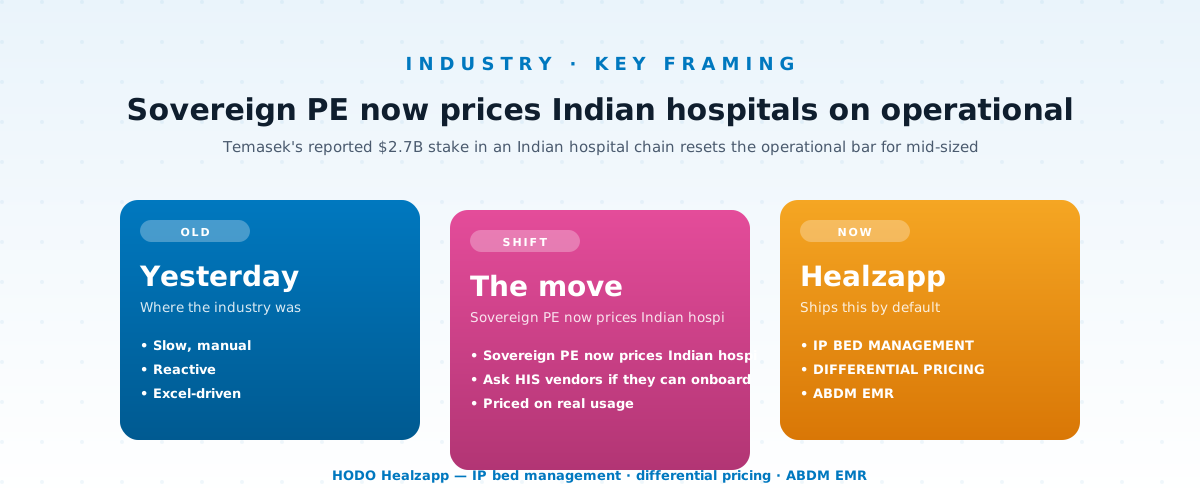
When a large chain adds a new unit — organically or through acquisition — the first 90-day problem is never clinical. It is data. Legacy HIS installations at the acquired facility rarely map cleanly to the parent's chart of accounts, discharge summary format or Tally integration. Pharmacy SKUs are named differently. Doctor payout logic sits in Excel. Corporate-partner rate cards are on paper. Chains that grow through M&A learn the hard way that a single-tenant HIS built for one hospital cannot absorb a second one without months of reconciliation. This is where multi-outlet scale-up capability stops being a slide and becomes the deal-breaker. Operators evaluating HIS for the next three years should be asking vendors a specific question: can you stand up a new outlet — with its own GST, its own doctor list, its own consumables master — inside a week, without breaking group-level MIS? If the vendor's answer involves a fresh implementation, they are not built for the market Temasek is investing in.
Institutional investors do not read discharge summaries. They read three things: OP-to-IP conversion, average length of stay, and lab TAT. Each is a software problem before it is a clinical one. OP throughput collapses when appointment slotting, token display and billing sit in three disconnected screens. IP length of stay drifts when nursing handovers happen on paper and bed status is updated only at ward rounds. Lab TAT slips when samples move without barcodes and reports go out by courier instead of WhatsApp. A hospital that fixes these three loops typically sees a 12-18% jump in daily patient volume without adding beds or staff — and that is precisely the operating leverage PE underwriters model. The Temasek deal signals the market will now reward operators who can prove those numbers with a live dashboard, not a monthly PDF. Chains still running quarterly manual audits of TAT are competing with a peer group that has already automated the measurement.
Any hospital acquisition in 2026 comes with an ABDM diligence checklist. Investors want to see the target is issuing ABHA-linked records, that consent artefacts are logged, and that the EMR can produce a FHIR-compliant discharge summary on demand. Non-compliant HIS installations quietly discount valuation because the buyer has to budget for a migration. For operators not on an ABDM-integrated HIS today, the cost is showing up as a haircut on the eventual exit multiple. The upside case: hospitals already running an ABDM-compliant EMR — with consent, ABHA lookup and gateway hooks in place — are eligible for empanelment revenue streams (PMJAY, state schemes, corporate ABDM programmes) that non-compliant peers cannot access. Regulatory readiness has moved from a compliance cost centre to a revenue enabler.
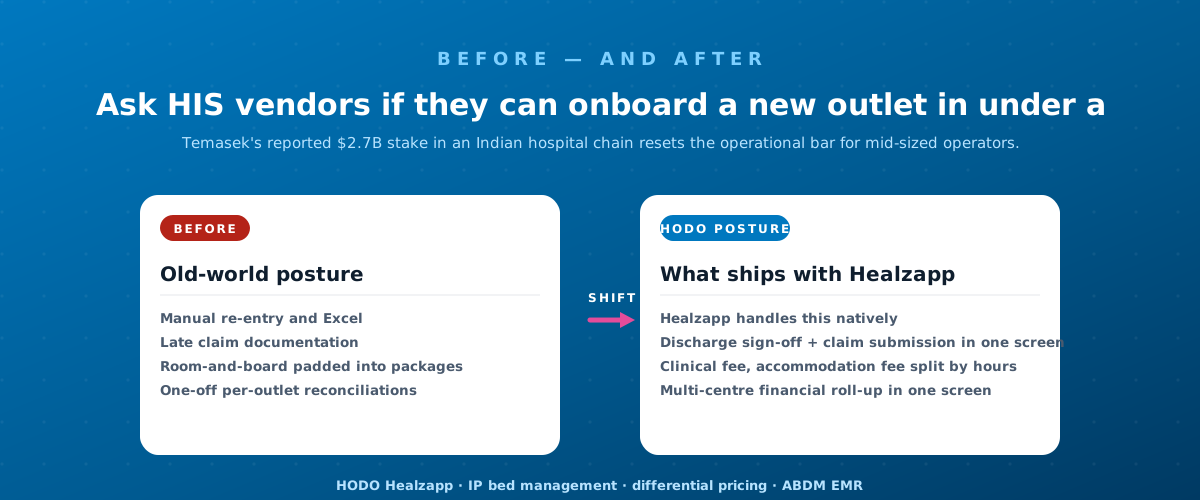
A 200-bed hospital with a 60% insurance mix typically has ₹12-18 crore locked in TPA receivables at any point. The gap between billing and cash realisation is the single largest working capital drag on the sector. PE-backed chains attack this with dedicated TPA cells, standardised pre-authorisation workflows and rejection-code analytics — none of which work if the underlying HIS cannot produce a clean claim packet. Differential pricing per corporate partner, cashless workflow inside billing, and audit-ready EMR documentation are no longer nice-to-haves. They are the reason a chain can offer a lower package rate to a TPA and still protect margin. The operators winning share right now are running rejection rates below 4%. That number is the software cost of capital.
The Temasek transaction is a marker for where the market is headed: consolidated, benchmarked and audited. HODO Healzapp is built for operators who intend to grow into that market rather than get bought out at a discount. Three features carry most of the weight here. Multi-outlet scale-up with one-click new-centre setup means an acquired facility can be onboarded to group MIS in days, not quarters — GST, doctor masters, consumables and rate cards ready before the first patient walks in. ABDM-compliant EMR keeps the chain eligible for scheme revenue and clears investor diligence without a separate migration project. Differential pricing lets the billing engine hold separate rate cards for each TPA, corporate and referral partner without breaking group-level financials — the mechanic behind clean claims and lower rejection rates. Chains that already run on these are, in effect, pre-built for the diligence cycle the market is now applying.
See how Healzapp handles this — book a 30-min demo.
See how Healzapp, Labzapp and EReazy fit your speciality in a free 30-minute demo.
Book a Free Demo