The Economic Times reported this week, in a story circulated through Google News under the health insurance TPA hospital India feed, on the widening stand-off between Indian hospital chains and general insurers over the suspension of cashless treatment. Several networks have flagged unpaid TPA dues, arbitrary tariff cuts and delayed reimbursements as reasons to pull specific insurers off their cashless panels. For owners, MDs and administrators, the coverage is not just a PR story about inconvenienced policyholders, it is a working-capital warning that reshapes how the front office, billing desk and finance team must operate this quarter.
The cashflow shock hospitals are absorbing
Cashless approvals, at their best, convert inpatient discharges into predictable receivables settled in 21-45 days. When an insurer or a TPA is pulled off the panel, or worse, when patients arrive expecting cashless and get told at the counter that it has been suspended, the discharge cycle stops working. Reimbursement queues stretch to 90+ days. Patients who were counselled for a package price now demand itemised bills. The billing counter becomes a complaint desk, and the finance team spends the month chasing paper instead of forecasting cash. Even a 50-bed hospital with a 30% cashless share can see ₹1-2 crore stuck in receivables inside a single quarter. The Economic Times piece pins the blame on tariff disputes; on the ground, the operational damage is more prosaic. Front-office scripts break. Package pricing sheets go out of date the moment a TPA arrangement lapses. Nursing station notes that were 'good enough' for cashless approvals get bounced by claims reviewers who now scrutinise every line. Every one of these failures shows up as either a denied claim or a delayed one, and both consume the same finite thing: working capital.
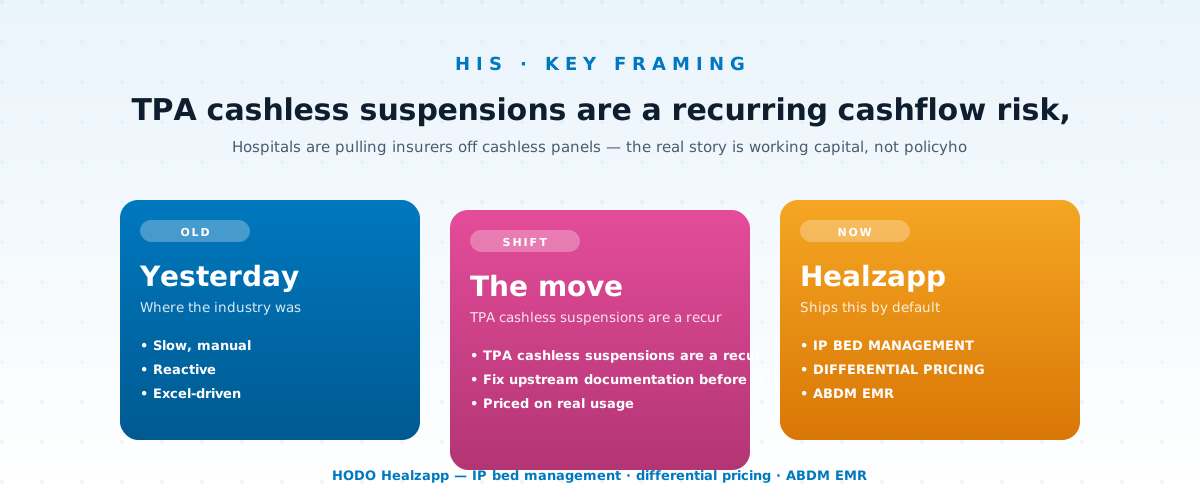
TPA cashless suspensions are a recurring cashflow risk, not a one-off.
Why the TPA-hospital dispute keeps recurring
This is not the first suspension and will not be the last. IRDAI has intervened multiple times over the last three years, and industry bodies on both sides, AHPI on the hospital side, GI Council on the insurer side, have publicly aired grievances that trace back to the same three fault lines. First, tariff mismatch: insurers benchmark against panel rates negotiated years ago, while hospitals cite input-cost inflation on consumables, implants and skilled staff. Second, medical necessity disputes: TPAs increasingly deny claims on the grounds that hospitalisation was avoidable, even for procedures that consultants routinely admit. Third, documentation quality: claim files with weak indication notes, missing investigation reports or inconsistent nursing charts get held up in review, often for weeks. For a hospital MD, the useful insight from the Economic Times reporting is that this is a structural problem, not a one-off. Preparing the hospital's own systems to survive suspensions, rather than lobbying for their reversal, is the only durable response.
The documentation gap that turns claims into denials
Every rejected cashless request has a paper trail, and most of them fail on the same three things: incomplete admission notes, mismatched investigation-to-diagnosis mapping, and missing consumables charge posting. When TPAs are on friendly terms with a hospital, minor gaps get waived. When the relationship sours, the same gaps become grounds for outright denial. Hospitals that rely on hand-written admission summaries, standalone Excel-based charge sheets or disconnected pharmacy billing find themselves reconstructing case files after the fact, which is exactly what a claims reviewer looks for as a red flag. The remedy is not more staff at the billing desk. It is upstream: capture the indication for admission, the doctor's clinical notes, the investigation reports and every consumable issued from pharmacy or stores directly against the IP encounter, in real time, on a system that presents them as a single unified case file. When a TPA queries a claim, the response should be one clean PDF, not a scavenger hunt across three departments.
Billing hygiene as a survival skill this quarter
When cashless is off the table for a chunk of patients, the front office has to switch to reimbursement mode within minutes of the patient arriving. That means differential pricing must be visible to the billing clerk, corporate rate, retail rate, insurer-panel rate, and switchable per encounter without a supervisor override. It means package pricing must be tagged to the exact TPA and version of the tariff, so that if the tariff changes tomorrow, yesterday's bills still print correctly. It means the pharmacy and consumables inventory must post charges to the encounter automatically, because reimbursement claims that miss a ₹4,000 stent posting will be scrutinised on far more than the missing stent. Hospitals that operate multi-speciality OPD alongside IP need to ensure that the OP consultation which precedes an IP admission is discoverable in the same patient record, TPAs increasingly ask for the antecedent OPD note as part of admission justification. Billing hygiene is not a back-office concern this quarter. It is the difference between a claim settled in 30 days and one settled in 120.
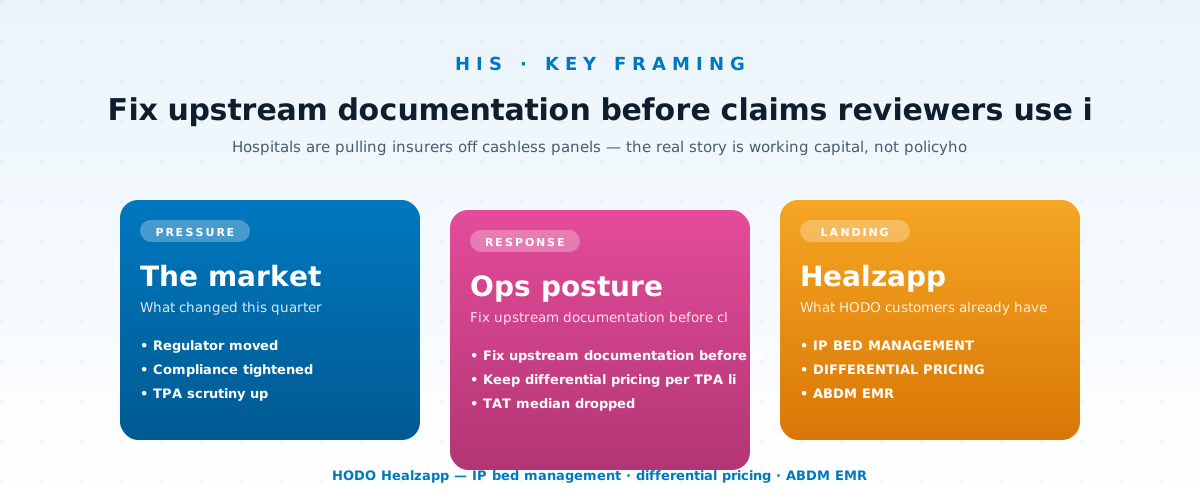
Fix upstream documentation before claims reviewers use it against you.
Preparing chain and multi-outlet operators for the next stand-off
For chain operators, three-outlet clinics, six-branch diagnostic networks, hospital groups adding a new unit each year, a TPA suspension at one outlet cascades faster than owners expect. Patients call the central helpline and hear inconsistent answers. Branch billing counters apply different work-arounds. Corporate-partner logins get flooded with queries about whether their empanelled staff can still avail treatment. The response is a single, centrally managed empanelment table and a single tariff engine, replicated across every outlet, updated once. When a TPA is suspended in Bangalore, the Chennai branch should show the same status without a phone call. When a corporate client's arrangement changes, every outlet's front office should see the new rate the same morning. Groups that still run each outlet on separate installations of separate systems will find that a national TPA dispute becomes a per-branch firefight. Groups that have consolidated on a single tenant, with centralised master data, can absorb the shock and keep discharging patients on time.
What this means for HODO customers
Hospitals running Healzapp already have the plumbing to weather a cashless suspension without a scramble. The unified IP/OP Billing module supports differential pricing per TPA, corporate and retail tariff, and posts pharmacy, inventory and consumables charges to the encounter as they happen, so claim files reconstruct themselves. The ABDM-compliant EMR with AI-condensed history keeps clinical notes, investigation reports and admission indications in a single case record that satisfies TPA reviewers on the first submission, not the third. And for chain operators, Multi-outlet scale-up with one-click new-centre setup means empanelment status, tariff changes and TPA suspensions propagate to every branch from a single console. None of this will end the TPA-hospital cold war, but it will keep receivables moving while it plays out.