Terna Speciality Hospital has hosted the TPA & Insurance Scientific Conclave 2026, convened around the theme of transparent, patient-centric healthcare financing, as reported by Pharmabiz.com. The headline is about transparency between hospitals, third-party administrators and insurers. The operational reading, for any Indian hospital in the 80-150 bed band, is narrower and more urgent: the money is already contracted, and the gap between contract and cash is a workflow problem.
A financing conclave is really an operations agenda
Conclaves of this kind tend to produce three recurring themes, standardised clinical documentation, agreed tariff interpretation, and faster turnaround on pre-authorisation and settlement. Each of those is a policy conversation on stage and a desk-level process inside the hospital. At a typical 100-bed facility, somewhere between 40% and 70% of inpatient revenue arrives through TPAs, insurers, corporate tie-ups and government schemes rather than directly from the patient. That share is not falling. It rises every time a hospital adds a specialty, empanels another payer, or opens a second centre in a tier-2 catchment.
Which means the hospital's working capital is governed less by occupancy and more by the lag between discharge and credit. A ward that runs at 78% occupancy and takes 71 days to convert a claim is financially weaker than one at 68% occupancy converting in 34 days. Finance teams know this. What is often missing is an instrumented view of where those days are actually spent, because the claim file lives half in the HIS, half in a shared folder, and half in a billing executive's head.
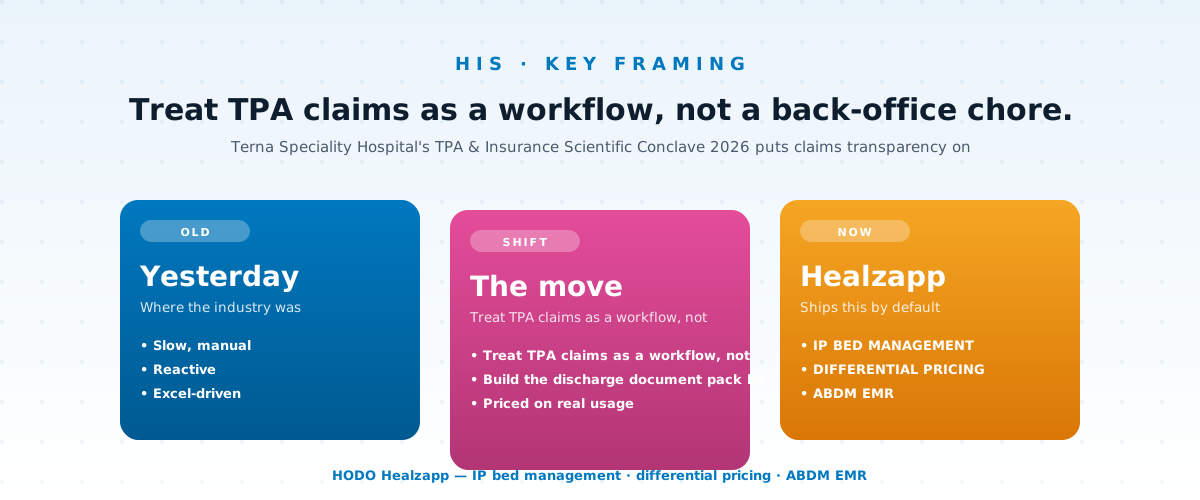
Treat TPA claims as a workflow, not a back-office chore.
Most denials are documentary, not clinical
Hospitals frequently describe deductions as arbitrary. In practice, a large proportion of first-cycle rejections and short payments trace back to documentation defects that the hospital controls. The commonest patterns are familiar: pre-authorisation raised after admission rather than at the point of decision; the discharge summary describing a procedure in language that does not map to the approved pre-auth; investigation reports referenced in the summary but not attached to the dispatched file; implant and high-value consumable invoices missing batch or serial details; and a mismatch between the room category on the bill and the one approved.
None of these are medical disputes. They are handover failures between the treating unit, the nursing station, the pharmacy and the billing desk. The fix is structural rather than exhortatory. The claim document pack should assemble itself as the episode progresses, not get compiled on the day of discharge by someone chasing four departments. When the clinical record, the investigation results, the pharmacy issue slips and the implant invoices are all attached to the same patient episode inside one system, the dispatch becomes an export rather than a search. Hospitals that make this shift typically see submission lag fall from eight or nine days to two, which alone moves the receivables curve.
Tariff mismatch is a billing-master problem
Transparency in payer relationships ultimately reduces to one question: does the rate the hospital bills match the rate the payer has agreed to pay? For a hospital with twenty-five empanelled TPAs and insurers, plus a government scheme and a dozen corporate contracts, that is not one rate card but forty, each with its own room-category linkage, package inclusions, proportionate-deduction clause and exclusion list.
Maintaining this in spreadsheets guarantees leakage in both directions. Billing below the agreed rate is silent revenue loss that nobody raises a ticket for. Billing above it generates a deduction, a reconciliation cycle and a strained payer relationship. The only durable answer is to hold payer-specific tariffs inside the billing engine itself, so the rate applied is determined by the patient's payer and room category at the time of charge posting, not corrected afterwards. Package definitions need the same treatment, what is inside the package, what is billable over and above, and what triggers a conversion from package to itemised billing.
The second-order benefit matters for multi-outlet groups. When a hospital opens a new centre, the payer master, tariff structures and package definitions should carry across rather than being rebuilt from memory by a local billing supervisor.
Age the claim by payer, not by invoice
Standard receivables ageing tells a hospital that forty lakh is over 90 days. It does not say which payer is slow, which is disputing, and which has already settled short without the hospital recording it. Those are three different problems with three different owners.
A more useful instrument set is small and specific. Track pre-authorisation turnaround from request to approval, split by payer. Track submission lag from discharge date to file dispatch. Track first-pass approval rate, claims settled without any query, because that single number predicts the entire downstream workload. Track average deduction per claim by payer and by reason code, so recurring deductions get escalated contractually instead of being absorbed one claim at a time. And track days-to-cash by payer, which is the figure that belongs in the monthly management review.
Reconciliation is the last mile. A settlement advice that credits a lump sum against thirty claims is useless until it is broken down and matched against individual bills, with the short-paid balance either re-raised or written off under a documented policy. Where this reconciliation flows into the accounting ledger automatically, the finance team spends its time on exceptions. Where it does not, it spends its time on data entry and the exceptions go unexamined.
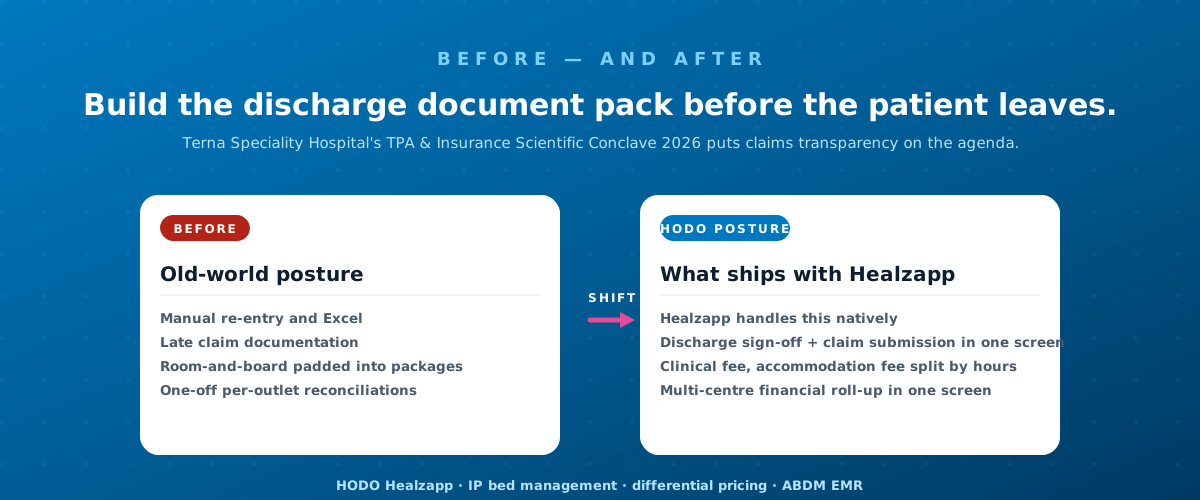
Build the discharge document pack before the patient leaves.
What this means for HODO customers
The Terna conclave's framing, transparent, patient-centric financing, lands on hospital operations as a demand for a claim file that is complete at discharge, a tariff that is correct at the point of billing, and a receivable that is visible by payer. In Healzapp, Billing carries the payer and room-category logic, with Differential pricing holding separate rate cards per TPA, insurer and corporate contract so the right rate is applied at charge posting rather than reconstructed during reconciliation. EMR (AI-condensed history) keeps the clinical record, investigations and discharge narrative attached to the same episode as the bill, which is what turns file assembly into an export. B2B Referral / Outsource Lab / Corporate-partner logins extend the same discipline to corporate and partner accounts, and Tally integration carries settlement and deduction entries into the ledger without a parallel data-entry cycle. For groups adding centres, the payer and tariff masters travel with the new site rather than being rebuilt.