Tripura's Health Secretary Kiran Gitte has set 31 October 2026 as the deadline for the state's healthcare system to go fully digital, according to a Northeast Today report carried on Google News under the Ayushman Bharat Digital Mission feed. For hospital owners, this is not a Tripura story, it is a preview of the enforcement calendar every state health department is now building against ABDM milestones. The operating question shifts from "we will digitise eventually" to "our discharge summary, prescription and lab report leave the system in an ABDM-compliant format by default."
What Tripura actually announced
The Tripura announcement covers government hospitals, sub-divisional facilities and primary health centres, and, read between the lines, the private facilities that participate in state insurance and referral networks. The Health Secretary's public framing is patient-record digitisation, but the operational requirements underneath are broader: unique ABHA-linked patient identity at registration, structured EMR entries instead of scanned PDFs, digitised prescriptions and diagnostic reports, and reporting hooks into state and central dashboards.
The deadline matters because it is short. Facilities that treated ABDM integration as a two-year project now have roughly eleven weeks to demonstrate an ABHA capture rate, a linked-EMR rate, and a report-push rate that the state can audit. Hospitals that have already integrated will be asked to demonstrate consistency; the ones that haven't will be asked to show a plan and a live date. Either way, the vendor evaluation window has closed. Nobody has time for a six-month HIS migration between now and 31 October.
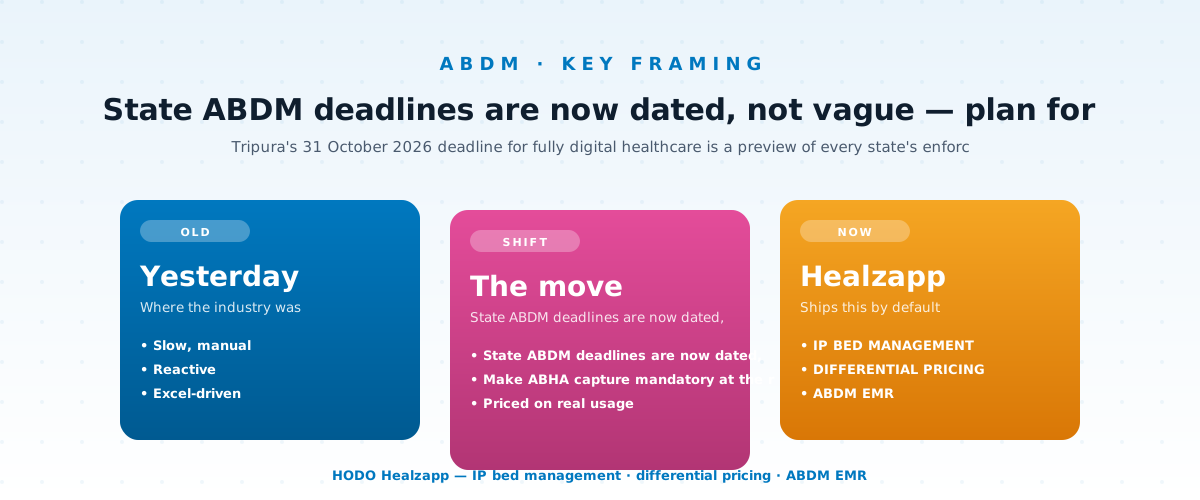
State ABDM deadlines are now dated, not vague, plan for enforcement.
Why this pattern will repeat state by state
Tripura is not an outlier. Andhra Pradesh, Karnataka, Tamil Nadu, Kerala, Maharashtra and Delhi have each published different flavours of digital-health mandates over the last eighteen months, and the National Health Authority's monthly ABDM dashboards make interstate comparison easy. Once one state publishes a hard date, neighbouring health departments face political pressure to match it. Administrators planning capex for the next two years should assume a rolling wave of state-level deadlines rather than a single national cut-off.
The practical consequence is that multi-state hospital groups can no longer stagger their ABDM rollout by geography. A group with outlets in three states will have three overlapping deadlines, each with slightly different reporting formats, and no realistic way to negotiate an extension in one state while another goes live. The only defensible answer is a single HIS backbone that produces ABDM-compliant records everywhere and lets each outlet toggle state-specific reporting on top.
The compliance gap most hospitals will hit
Most 50–500 bed hospitals in India already run some form of HIS. The compliance gap is rarely at the software layer, it is at the workflow layer. Front-desk staff continue to register patients without capturing ABHA; consultants dictate free-text notes that never make it into structured fields; lab reports get printed and handed over instead of pushed to the patient's health locker. When the state audit team arrives, the HIS shows 100% digitisation and the ABDM dashboard shows 8% linkage. Both are technically correct.
Closing this gap requires three parallel workstreams. First, registration desk SOPs that make ABHA capture mandatory, with a documented fallback for walk-ins who don't have one. Second, EMR templates that push clinicians into structured entry for at least the top 30 presenting complaints, not blank text areas. Third, an automated report-delivery pipeline that pushes lab and radiology reports to WhatsApp, SMS and the patient app in one action, with the ABDM push happening in the background. Hospitals that treat these as three separate IT projects will miss the deadline; hospitals that treat them as one workflow will hit it.
Cashflow, TPA and the digital-first claim
The under-discussed part of state digitisation mandates is what happens to insurance and TPA cashflow. Once the state insists on structured digital records, TPAs will follow, because structured records make claim adjudication faster and cheaper for them too. Hospitals that continue to submit scanned discharge summaries and handwritten prescriptions with their claims will see rejection rates climb and settlement TAT lengthen. Hospitals that submit structured EMR extracts alongside the claim will see the opposite.
For a mid-sized hospital, a ten-day improvement in insurance settlement TAT across a claim book of ₹40 crore a year unlocks meaningful working capital. That number is what should carry the ABDM business case to the board, not compliance for its own sake. The conversation shifts from "we have to spend on ABDM" to "ABDM compliance is what unlocks the TPA cashflow improvement."
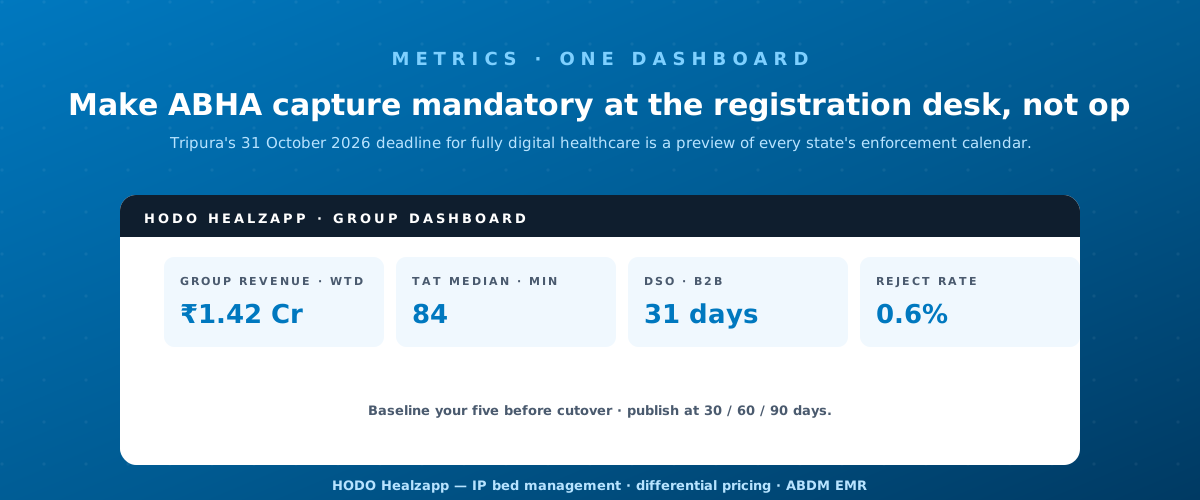
Make ABHA capture mandatory at the registration desk, not optional.
Multi-outlet groups: the co-ordination problem
Clinic chains and diagnostic groups have a different problem. HIS and LIMS decisions were often made outlet by outlet, sometimes by the local administrator, often on different vendors. Consolidating to a single ABDM-compliant backbone before 31 October is not realistic; but continuing with fragmented systems means the group cannot answer basic state-audit questions like "how many patients across your network have ABHA linkage." The pragmatic middle path is to standardise the new-centre setup: from the next outlet onward, every centre goes live on the same HIS/LIMS stack, with ABDM live from day one and a configuration template that mirrors the group's existing centres. Legacy outlets get migrated in a second wave against a published internal deadline, not the state's.
What this means for HODO customers
Hospitals already running HODO Healzapp have the ABDM-compliant EMR in place, the state-audit question moves from "can you produce structured records" to "what is your ABHA linkage rate." The Patient Management module supports mandatory ABHA capture at the registration desk, and the WhatsApp/SMS report delivery pipeline handles the patient-facing side of digital report distribution without adding a step for the lab or radiology team. For groups expanding across state lines against overlapping deadlines, Multi-outlet scale-up with one-click new-centre setup is what lets the next outlet go live ABDM-ready on day one, without a fresh three-month implementation cycle.