konsulteer.com reports that business AI adoption in the UAE has reached 72%, with enterprises now shifting from isolated experiments toward scaled deployment. For healthcare operators and founders in the Gulf, the second half of that sentence is the harder part. Getting a team onto an AI tool is a procurement decision; getting an organisation to run on one is an operating decision, and the two fail for completely different reasons.
A 72% adoption rate measures access, not capability
Adoption figures count organisations where somebody is using AI for something. In a polyclinic group or a diagnostics chain, that usually means a few managers drafting insurance correspondence, a marketing coordinator producing campaign copy, and a founder using a chat window as a thinking partner. All of it is real work, and none of it is institutional. Remove those three people and the capability leaves with them, because nothing about what they learnt is stored anywhere the organisation controls.
This is why adoption curves and productivity curves separate. The tooling is identical across competitors, the same frontier models, the same subscription tiers, available in Dubai and Doha on the same day they are available anywhere else. There is no advantage in access. The advantage sits in what an organisation accumulates on top of access: its tariff quirks, its referral relationships, the reason a particular test package was repriced last March, the escalation ladder when a payer disputes a claim. Scaled deployment, in practice, means moving that layer out of individual heads and chat histories into something the business owns. Until that happens, a group with 200 AI users is just a group with 200 private, undocumented workflows.
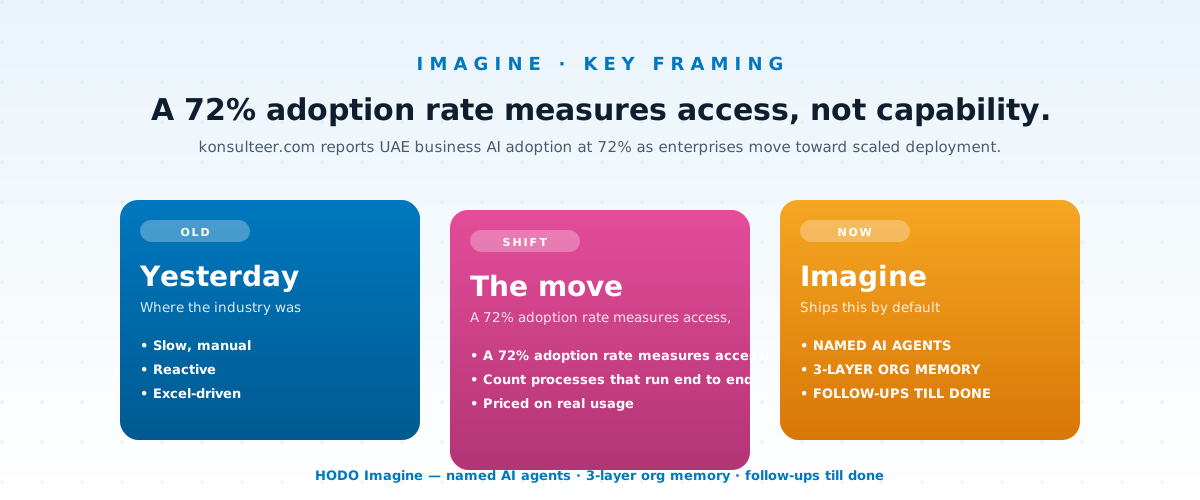
A 72% adoption rate measures access, not capability.
What breaks between a pilot and a department
Pilots work because the pilot owner supplies the missing context by hand. They know which price list is current, which consultant prefers which phrasing, which outstanding item from last week still needs chasing. Each prompt is quietly reconstructed from memory the tool does not have. That is sustainable for one motivated person and collapses at a dozen.
Three things break first. Context breaks: a new coordinator asks the same model the same question and gets a worse answer, because the model was never the source of the quality, the operator was. Accountability breaks: when output is wrong, nobody can say which instruction produced it or who owns the correction. Continuity breaks: a task started on Monday, paused for an insurer response, and forgotten by Thursday simply disappears, because a chat window has no concept of an open item.
Operators tend to respond by writing longer prompt documents and circulating them on internal drives. That treats a memory problem as a documentation problem. The prompt file goes stale within weeks, nobody updates it after a tariff revision, and the people who most need it are the newest joiners who do not know it exists. Scaled deployment requires the context to live where the work happens and to update itself as the work changes, not in a folder somebody has to remember to open.
Scale is a property of processes, not seats
A more useful question than "how many staff use AI" is "which recurring processes now run with AI inside them, end to end." Those are different claims. Seat counts grow by buying licences. Process coverage grows only when a specific job is assigned, its inputs are defined, and somebody reviews the output on a schedule.
For a Gulf healthcare operator, the candidate list is unglamorous and finite: insurer correspondence and resubmission follow-ups, patient communication in two or three languages with consistent phrasing, referral-partner updates, vendor and AMC renewals, monthly performance reporting across branches, onboarding material for each new clinical or front-desk hire. Each of these repeats, each has a predictable shape, and each currently depends on one person remembering the last cycle.
This is the design behind named AI agents with jobs, memory and reporting lines. An agent that owns insurer follow-up is not a better chat window; it is an accountable position in the organisation chart with a defined remit, a record of previous cycles, and an escalation path to a human when something falls outside its brief. The practical test is whether a process survives the departure of the person who set it up. If it does not, the deployment is still a pilot wearing a larger budget.
Regulated work needs a record, not a chat log
Healthcare operators in the UAE and wider GCC work under licensing and inspection regimes that assume traceability, who decided, on what basis, and when. AI use that lives in personal chat histories sits outside that assumption entirely. There is no reviewable trail, no version of the instruction that produced a given output, and no way to demonstrate consistency across branches during an audit.
The same gap shows up commercially. Groups running three or four branches routinely discover that each location communicates differently with patients and payers because each location improvised its own AI usage. Tone drifts, terminology drifts, and discount language drifts. That is a brand problem before it is a compliance problem, and it gets worse with every outlet added.
The fix is structural rather than motivational. Instructions, approved phrasing and historical decisions need to sit in one owned layer, with an audit trail attached, so that output is reproducible and reviewable. Brand voice consistency is the visible symptom of that layer working; the audit trail is the part that matters when a regulator or an insurer asks how a decision was reached six months ago.
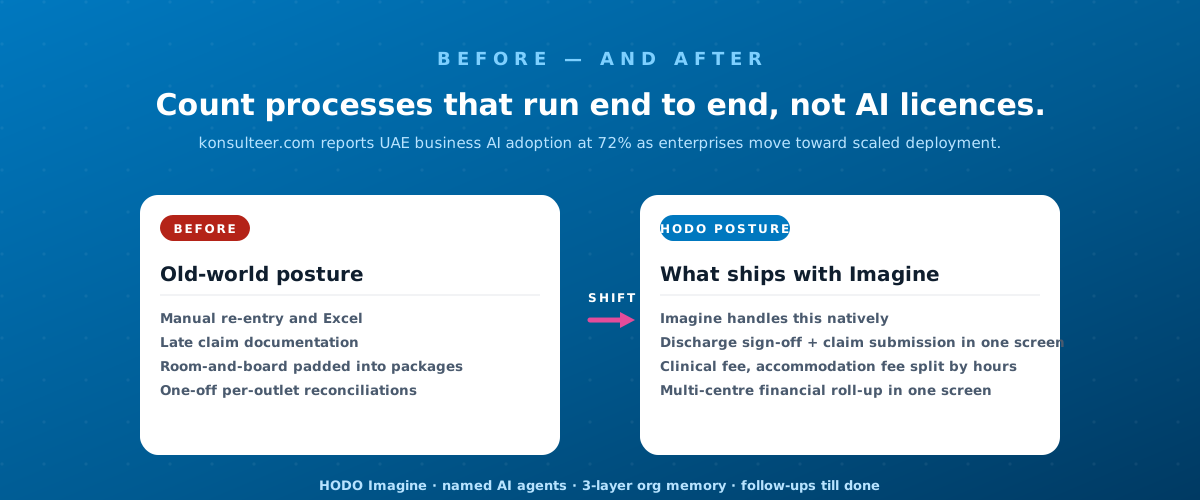
Count processes that run end to end, not AI licences.
A measurement set for the next two quarters
Four numbers separate scaled deployment from scattered adoption, and none of them is a licence count. First, process coverage: how many named recurring processes have an assigned owner, an agent and a review cadence. Second, closure rate on follow-ups, items that reached resolution, not items that were logged. Third, time to competence for a new joiner, measured from start date to working unsupervised on a defined task. Fourth, context retention: when a manager leaves, how much of what they knew is still queryable the following week.
Those four can be baselined in an afternoon and re-measured quarterly. They also expose the uncomfortable cases early, the process that looked automated but required daily manual repair, or the agent whose output nobody actually reviewed. For founders building homecare, lab-at-home or marketplace platforms in the region, the same set doubles as a diligence story: it shows an operating system rather than a stack of subscriptions.
What this means for digital transformation
Scaled deployment is an organisational memory problem presented as a technology problem. imagine exists for that layer: named AI agents with jobs, memory and reporting lines so each recurring process has an accountable owner rather than a shared chat window; 3-layer memory across today, this week and forever, so context compounds instead of resetting with each conversation; and follow-ups until tasks close, which turns open items into tracked work. Knowledge sits with the organisation and survives churn, and brand voice consistency keeps patient and payer communication uniform as branches multiply. It does not replace Microsoft 365, Copilot or ChatGPT, it connects them with memory, which is the part the 72% figure does not measure.
See how imagine turns AI into organisational intelligence, explore imagine.