Khaleej Times reports that UAE firms are racing to secure AI agents, with adoption running well ahead of oversight. The gap is not primarily a model problem, it is an organisational one: agents are being handed real work without a named owner, a written job, or any record of what they produced. For healthcare founders and clinic group operators across the Gulf, how that gap gets closed decides whether AI becomes a durable advantage or an untracked liability sitting inside patient workflows.
Adoption outpacing oversight is a structure gap, not a tooling gap
Securing an AI agent is usually framed as a security-tooling question: credentials, data boundaries, prompt injection. Those matter. But the oversight failures surfacing in Gulf businesses this year are more mundane than that. An operations manager writes a prompt that drafts insurance follow-up letters. It works. Three colleagues copy it, each with small edits. Six weeks later nobody can say which version is live, what data it was given, or who signs off when it misreads a payer rule. Nothing was breached. Oversight simply never existed, because the agent was never an entity in the organisation, it was a habit inside one person's browser tab.
That is the pattern underneath the Khaleej Times framing. Adoption is cheap: any staff member with a licence can put a model to work this week. Oversight is organisational work, naming the agent, defining its job, deciding who it reports to, and keeping a record of what it did. Companies that skip the second half accumulate dozens of ungoverned micro-automations, each individually useful, none accountable. For healthcare operators the exposure is sharper than in most sectors, because the output usually touches a patient, a payer claim, or a clinical record on its way out the door.
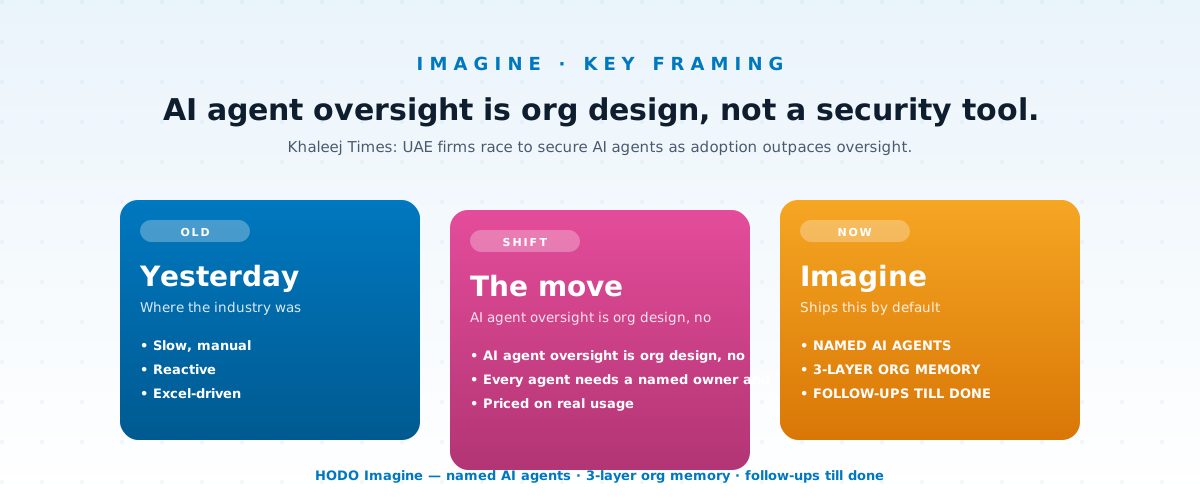
AI agent oversight is org design, not a security tool.
Where ungoverned agents break clinic and lab operations
The failure modes are specific enough to test for. A polyclinic in Dubai or Doha runs insurance pre-approval chasing through an informal agent; when the staff member who built it resigns, the task reverts to manual and the backlog is only noticed at month-end reconciliation. A lab group uses a model to draft patient-facing report explanations, and two outlets answer the same question in materially different language, one reassuring, one alarming. A home-collection operator automates appointment reminders, and nobody can show which patients were actually contacted when a complaint reaches the licensing authority.
Each case shares the same root cause: the agent had no job definition, no supervisor, and no durable record. Compare that with how the same organisation treats a receptionist or a phlebotomist. There is a role, a reporting line, a handover protocol, and a log. Nobody would let a new hire send patient communications on day one with no brief and no review, yet that is precisely the standard applied to most AI deployments. Agents sit in a governance blind spot because they look like software to the compliance team and like staff to the people using them.
The operational cost is not theoretical. Unclosed follow-ups show up as delayed payer settlements. Inconsistent patient messaging shows up as complaints. Lost agent knowledge shows up as the same automation being rebuilt three times in eighteen months.
What oversight looks like: a job, an owner, a reporting line
Workable oversight starts by treating an agent as an organisational unit rather than a prompt. That means four things, none of which require new regulation to adopt. First, the agent has a name and a written scope, what it handles, what it escalates, what it must never do unsupervised. Second, it has a human owner who is accountable for its output, the same way a department head owns a junior's work. Third, it has a reporting line, so output flows to a defined reviewer instead of straight to a patient or payer. Fourth, its work is recorded, so a dispute six weeks later can be reconstructed.
This structure also solves a commercial problem GCC operators raise constantly: proving the automation works. A named agent with an owner and a log can be measured, tasks assigned, tasks closed, escalations raised, rework required. An anonymous prompt cannot. Boards and investors asking what the AI budget bought get an answer grounded in closed tasks rather than enthusiasm. Licensing and accreditation reviewers asking who approved a patient communication get a name and a timestamp.
The sequencing matters. Operators who add structure after scaling to twenty informal automations face a cleanup project. Operators who define the structure first can add agents without adding governance debt, because every new agent inherits an existing pattern for ownership and review.
Memory is the control nobody budgets for
The least discussed oversight control is memory. Most AI usage in clinic groups and lab chains lives inside individual accounts, chat histories tied to a person, not the organisation. When that person leaves, the organisation loses the context: which payer rejects which code, how the Abu Dhabi outlet differs from the Sharjah one, what was tried last quarter and why it failed. The institution keeps paying for AI and keeps starting from zero.
Durable memory changes the economics. An agent that remembers today's open items, this week's commitments, and the organisation's permanent operating knowledge compounds in value instead of resetting. It also makes oversight possible in practice: a reviewer can ask why an agent took a decision and get an answer rooted in recorded context. Governance without memory is a policy document; governance with memory is an audit trail.
This is where the build-versus-connect decision lands for founders. The goal is not to replace Microsoft 365, Copilot or ChatGPT, those tools stay. The missing layer is the one that holds organisational knowledge, assigns it to named agents, and keeps it when staff churn. That layer is what turns scattered AI usage into something a healthcare business can defend to a regulator and sell to a corporate client as a genuine digital differentiator.
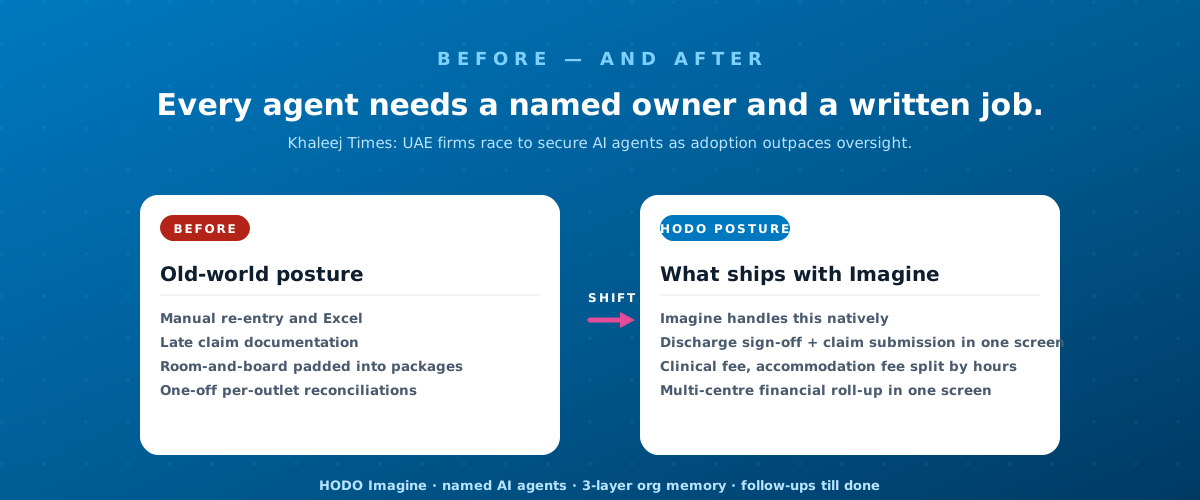
Every agent needs a named owner and a written job.
What this means for digital transformation
For healthcare founders and operators in the UAE and wider GCC, the oversight story in the Khaleej Times report is an invitation to get ahead of a problem that is still small. imagine is built for exactly this layer: named AI agents with jobs, memory and reporting lines so every automation has an owner and an escalation path; 3-layer memory covering today, this week and forever, so context compounds rather than evaporating with staff turnover; brand voice consistency so patient-facing output reads the same across outlets; and follow-ups until tasks close, which converts automation claims into a countable record of work finished. The point is not more agents. It is agents an operator can name, supervise and account for.
See how imagine turns AI into organisational intelligence, explore imagine.