GulfToday reports that a UAE-based technology firm has unveiled a new AI platform built for enterprises, the latest in a steady run of Gulf launches that treat AI as infrastructure rather than experiment. For healthcare founders and operators in the region, polyclinic groups, lab networks, home-collection fleets, the news matters less as a product announcement and more as a procurement moment. The decision has stopped being whether to buy an enterprise AI platform and become what the organisation is actually left holding once the licence is signed.
Platform launches are now frequent; capability is not
Any operator in Dubai, Abu Dhabi, Doha or Manama running a clinic group or a diagnostic chain has by now sat through several of these pitches. The architecture slide is familiar: a model layer, a connector layer, a dashboard, and a promise that staff productivity will rise. The pitches are not wrong, and the underlying technology is genuinely capable. What they rarely answer is the question a healthcare operator has to answer to a board or an investor: what did the organisation gain that a competitor with the same budget and the same vendor list cannot buy next quarter?
Model access is now effectively a commodity. Any clinic group in the GCC can license frontier models, and most already have some combination of Microsoft 365, Copilot and consumer chat tools in use by staff. That means the platform itself is no longer the differentiator. The differentiator is the accumulated, structured context the organisation feeds into whatever platform it chooses, tariff quirks per insurer, which referring doctor needs a call before a report lands, how the Arabic-language patient message is phrased, why a particular home-collection route is sequenced the way it is. That context either lives in a system the organisation owns, or it lives in individual heads and WhatsApp threads.
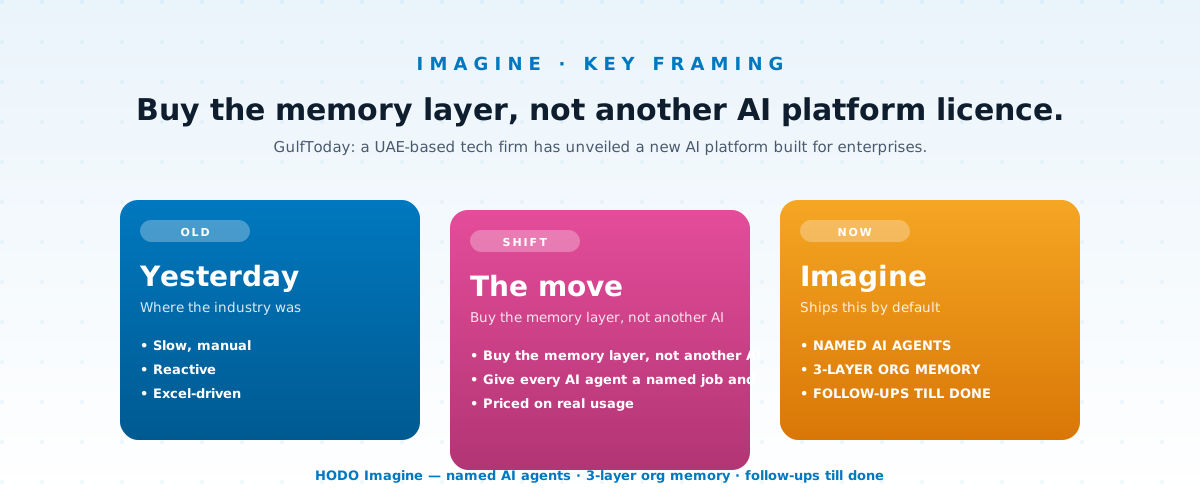
Buy the memory layer, not another AI platform licence.
The question most buyers skip: who owns the memory
Enterprise AI procurement conversations tend to centre on security, hosting location and integration scope. Those are necessary. But for a healthcare operator, the harder question is ownership of institutional memory. When a platform is swapped out, and in a market launching new platforms this often, it will be, does the operational knowledge accumulated over eighteen months leave with the vendor, or stay with the organisation?
The same question applies to staff. Healthcare operations in the GCC run on expatriate teams with real turnover. A strong operations manager at a three-branch polyclinic typically holds a large amount of undocumented judgement: which insurer rejects which code, which analyser needs recalibration before a Monday rush, which corporate client expects a call and not an email. When that person's visa cycle ends, most organisations rediscover all of it the hard way. An AI deployment that only answers questions and does not retain what it learns reproduces the same gap with better grammar.
This is the practical definition of organisational intelligence, and it is the test to put to any platform under evaluation: does usage make the system progressively more useful to the next person who joins, or does every new hire start from a blank context window? The first is an asset on the balance sheet. The second is a subscription.
Named agents with jobs, not a shared chat window
The most common failure pattern in enterprise AI rollouts is also the least discussed. A platform goes live, a few early adopters use it heavily, usage plateaus, and the renewal conversation becomes awkward. The cause is usually structural, not technical: the tool was deployed as a shared capability rather than assigned as a job.
The alternative is to treat AI the way an operator already treats staffing. Give each agent a name, a defined job, and a reporting line, a reporting coordinator that chases pending lab results, a billing reviewer that checks claim fields before submission, a patient-communication agent that handles report delivery follow-ups. Each has a scope, an owner who reviews its output, and an expectation about what it produces daily. This sounds like an organisational detail. In practice it is the whole difference between a platform that is used and one that is renewed out of hope.
It also makes delegation legible. A clinic manager can say which agent handles which queue, in the same way a roster says which nurse covers which shift. Anything less specific tends to collapse back into a single person being good at prompting.
Brand voice and audit trail are operational controls
Two things that look like polish are closer to compliance. The first is voice consistency. A polyclinic group or lab network in the Gulf communicates across English and Arabic, across WhatsApp, SMS and email, across appointment reminders, report delivery and corporate account updates. If every staff member generates their own AI-written message, the organisation ends up with a dozen tones, varying levels of clinical caution, and occasional language that a DHA or MOHAP-style reviewer would flag. Patient communication is a regulated surface, not a marketing one. Voice consistency enforced at the platform level is the cheapest control available.
The second is traceability. As health authorities across the UAE, Qatar and Saudi Arabia tighten expectations on digital records and patient communication, operators will be asked what their automated systems sent, to whom, and on whose authority. A platform that produces output without a retrievable trail creates a documentation problem that surfaces during inspection rather than before it. Any evaluation checklist for a healthcare buyer should include a plain requirement: show the log, show who approved it, show what changed.
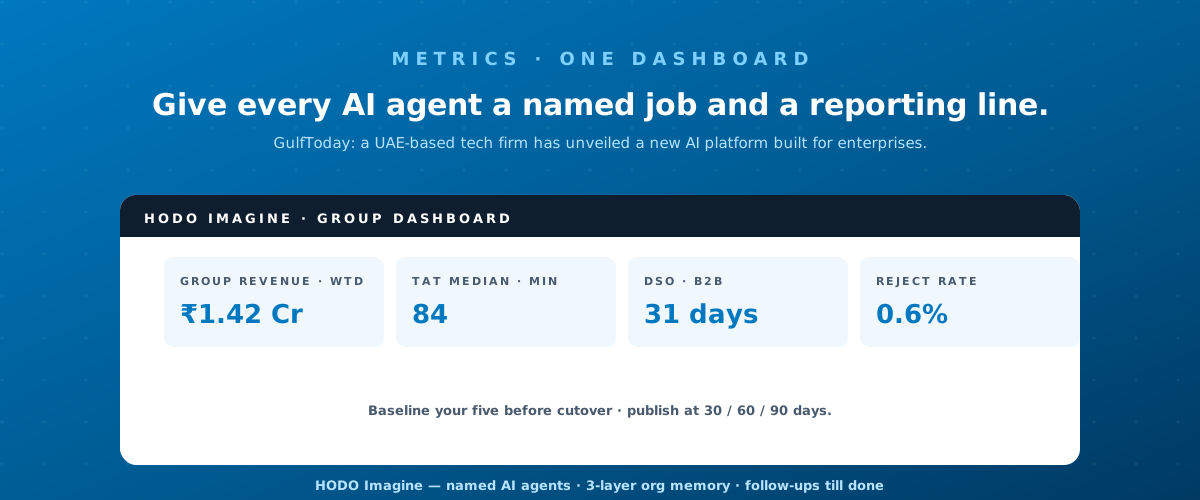
Give every AI agent a named job and a reporting line.
Measure adoption by tasks closed, not messages sent
Most enterprise AI reporting counts activity, queries, seats active, tokens consumed. None of those correlate with operational benefit. A more honest metric for a healthcare operator is closure: of the tasks handed to AI agents last month, how many actually reached a resolved state without a human re-opening them?
That reframing changes what to look for in a platform. Drafting is easy and now near-free. Following a task through, the third reminder to a patient who has not booked a follow-up scan, the pending insurer response, the corporate client whose monthly report has not been acknowledged, is where operational cost actually sits. Follow-ups that continue until a task closes are harder to build and considerably more valuable than another drafting interface. Founders evaluating platforms should ask for closure rates, not usage charts, and should expect the question to be uncomfortable.
What this means for digital transformation
Another UAE enterprise AI launch does not change a healthcare operator's position by itself. What changes the position is the layer above the platform: context the organisation owns and keeps. imagine is built as that layer, named AI agents with defined jobs, memory and reporting lines rather than a shared chat window; 3-layer memory spanning today, this week and forever, so operational knowledge compounds instead of resetting when a manager's contract ends; brand voice consistency across patient and partner communication in every channel; and follow-ups until tasks close, so delegation to AI shows up as finished work rather than activity counts. It does not replace Microsoft 365, Copilot or ChatGPT, it connects them with memory the organisation keeps.
See how imagine turns AI into organisational intelligence, explore imagine.