Gulf News reports that NADZ Healthcare has been named "Best Home Healthcare" at the Health Magazine Awards 2025, capping a year in which UAE regulators, insurers and residents have all pushed harder into at-home care. The award itself is one data point, but the trend it marks is louder: home visits are no longer an add-on channel for GCC clinics, they are becoming a primary care setting with their own economics, licensing rules and technology stack.
A UAE home-visit brand collects the trophy
NADZ's win, covered by Gulf News, sits alongside a broader shift in Dubai and Abu Dhabi over the last 24 months. DHA and DoH have been steadily formalising home healthcare provider licensing, insurers have expanded coverage for physio, nursing and phlebotomy at home, and pharmacy chains have moved into home sample collection. What used to be a service quietly offered by nurses moonlighting after hospital shifts is now an audited, licensed, insured care line with clinical governance requirements attached to it.
For operators watching from Sharjah, Ajman, Doha or Manama, the takeaway is not "copy NADZ." It is that the category is now visible enough to attract awards, capital and, inevitably, competition. The question stops being "should we offer home visits" and becomes "what does our operational spine need to look like when 40 percent of encounters happen outside a clinic room?" That is a very different software problem from running a polyclinic.
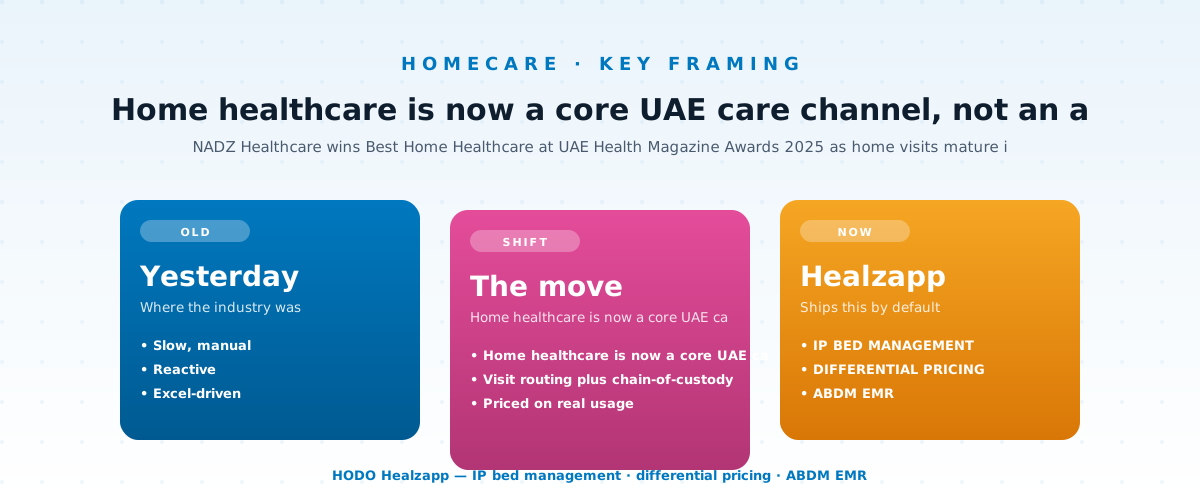
Home healthcare is now a core UAE care channel, not an add-on.
Home care is a distinct product line, not a courtesy
Polyclinics and standalone labs that dabble in home visits usually do it with the same booking form and the same billing counter as their walk-in service. That works for ten visits a week. It falls over at a hundred. The visit is not a mini OPD, it has different economics, different documentation and a different failure mode.
A home visit that is thirty minutes late is not a slightly delayed appointment; it is a broken promise the patient tells a WhatsApp group about. A home-drawn sample without a temperature log is a rejection at the analyser. A physio home session without a signed consent on the tablet is a rejected insurance claim. Operators who treat home care as its own product line, with its own SOPs, its own KPIs, and its own software surface, are the ones scaling past the founder's personal WhatsApp thread.
Routing, chain-of-custody, and the phlebotomist's day
The single biggest lever in home-visit unit economics is visits-per-staff-per-day. A phlebotomist doing four collections a day in a Jumeirah villa cluster is a very different business from one doing eleven in a Downtown tower. Routing that groups visits by area and time window, rather than by first-come booking order, often shifts the same headcount from five visits to eight without hiring anyone new.
Chain-of-custody is the other silent killer. A sample that leaves the patient's living room needs a barcode at draw, a temperature log during transit, a handoff timestamp at the lab receiving desk, and a report path back to the patient with the referring doctor copied. If any of those links break, the sample is either rerun (a cost hit) or reported late (a churn hit). LIMS designed for centre-based labs often skip the transit segment entirely, which is exactly where home-collection operators leak margin.
Doctor-at-home is a scheduling and consent problem
The doctor-at-home vertical has a different failure mode. The scarce resource is the doctor's time, not the sample. Overbooking a physician into three back-to-back home visits across two emirates guarantees at least one apology call. Under-booking wastes the highest-cost hour on the roster.
The pattern that works: publish doctor availability by area cluster, let the patient book from the app, auto-check insurance eligibility before dispatch, and open a teleconsult fallback if the doctor is stuck in Sheikh Zayed Road traffic. The visit also needs a proper EMR entry on-site, not a WhatsApp note the doctor writes up later that evening, because that on-site entry is what feeds the insurance claim and the follow-up nudge. Operators who nail this stop losing the follow-up visit to a competitor with a slicker patient app.
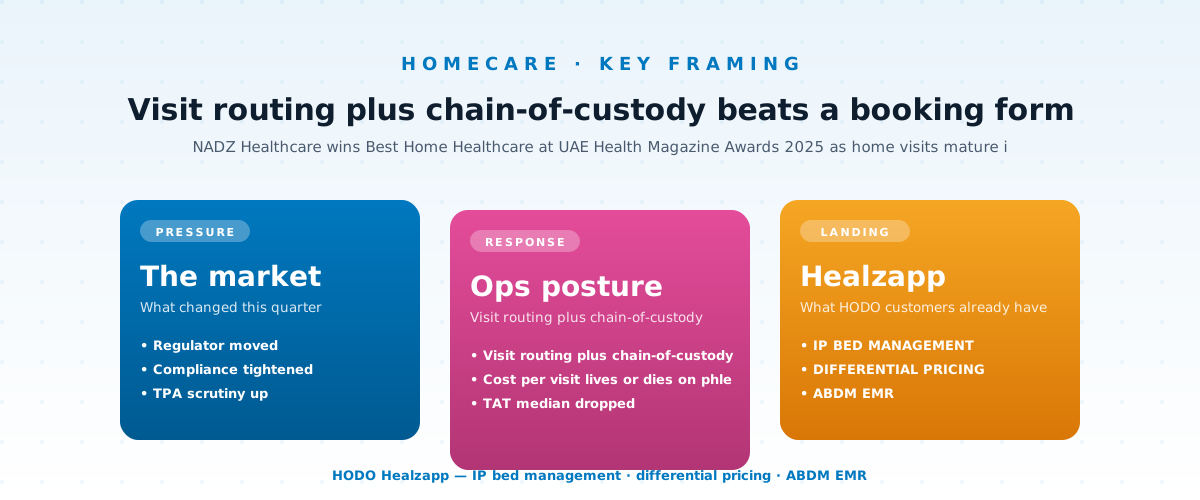
Visit routing plus chain-of-custody beats a booking form at scale.
Serious UAE home-care operators run into three complexities that most single-clinic HIS products quietly ignore. First, they operate across emirates, each with its own licensing body and its own insurer network. Second, corporate wellness contracts and TPAs each want their own pricing sheet and their own report format. Third, the operator often subcontracts to partner labs for specialised tests, which means anonymised sample tracking and a separate settlement flow at month end.
None of this is exotic. It is the daily reality of any home-care brand that has crossed five hundred visits a month. But it does mean the stack needs multi-outlet scale-up, differential pricing per partner, and partner-lab integration with anonymised sample tracking baked in, not bolted on after the fact when the finance team starts complaining.
What this means for HODO customers
Home-care operators on Healzapp already run Appointments, Teleconsultation and the Patient Health App as the doctor-at-home spine, the same three modules a NADZ-style operator needs to schedule visits by area cluster, drop into a teleconsult when a home visit slips, and give the patient a single place to see reports and rebook. For the lab-at-home side, Labzapp's barcoded samples plus machine interfacing, phlebotomy/home-collection workflows and automated WhatsApp report delivery close the chain from villa doorstep to the patient's phone, with the referring doctor copied automatically. Layer in multi-outlet scale-up and differential pricing per partner, and a home-care brand can add a new emirate or a new corporate contract without rewriting the operations manual. The NADZ trophy is a signal that UAE home healthcare has grown up as a category; the operators who keep pace will be the ones treating it as its own product line, with its own stack, from day one.