BD and Pharmatrade have launched what Menafn reports as the UAE's first robot-automated retail pharmacy, moving dispensing robotics out of hospital basements and into a mainstream community pharmacy. For polyclinic operators in Dubai, Abu Dhabi, Doha, Kuwait City and Manama, the headline is the robot. The operational story is the standard of data discipline a robot assumes already exists before anyone switches it on.
What a dispensing robot actually removes
Strip the announcement down and a dispensing robot takes three specific tasks off the counter: physically locating a pack on a shelf, matching that pack to the prescribed line item, and recording the movement out of stock at the moment it happens. Those three tasks are where most retail and clinic pharmacy time and most dispensing errors sit. Removing them is a genuine throughput gain, and in a high-footfall retail location with a narrow SKU range it can be a straightforward payback calculation.
What the robot does not touch is everything on either side of the pick. It does not decide whether the prescription was written correctly, whether the insurer will cover the molecule at that strength, whether a substitution is permitted under local rules, or whether the patient understood the dosing instruction. In a polyclinic, those surrounding steps are where the queue actually forms. A patient standing at a polyclinic pharmacy counter in Al Barsha or Salmiya is usually not waiting for someone to walk to a shelf. They are waiting for an insurance approval to come back, for a doctor to clarify a line, or for a cashier to work out the co-payment split. Automating the pick without addressing those steps shortens the smallest part of the wait.
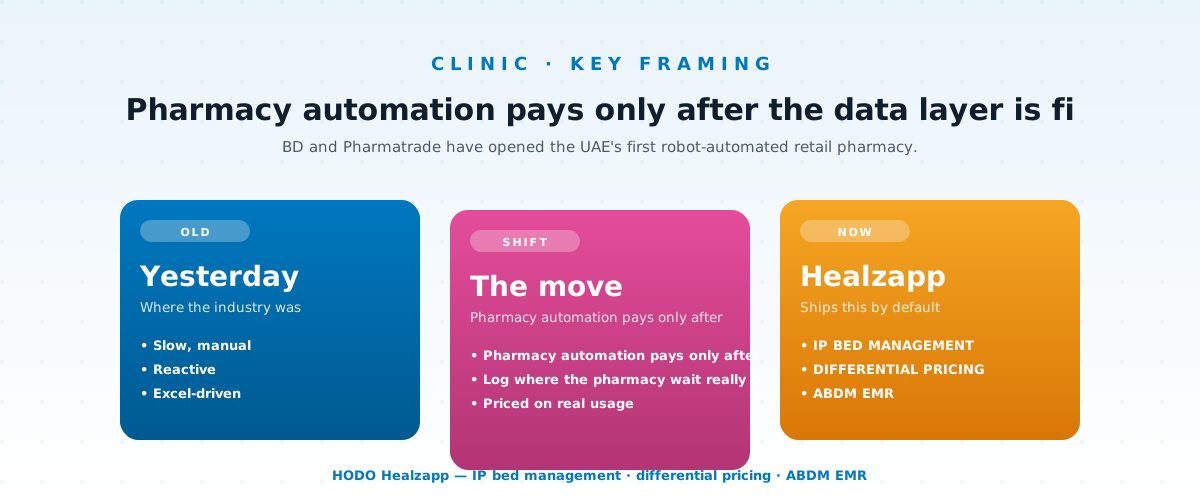
Pharmacy automation pays only after the data layer is fixed.
Polyclinic pharmacy is a different problem from retail
Retail pharmacy and polyclinic pharmacy look similar from the outside and behave very differently in the numbers. A standalone retail pharmacy has walk-in demand it does not control, a wide catalogue, and no clinical system upstream. A polyclinic pharmacy has captive demand generated a few metres away by its own consultants, a narrower formulary shaped by what those consultants actually prescribe, and a complete electronic record of every prescription before the patient ever reaches the counter.
That difference changes the first investment. In retail, the bottleneck is the pick, so robotics is a reasonable place to spend. In a polyclinic, the bottleneck is almost always the handover between consultation, insurance and billing. If a prescription arrives at the pharmacy as a printed sheet or a verbal instruction, the pharmacist re-keys it, and every downstream number — stock movement, revenue per visit, formulary analysis — is rebuilt from a copy rather than captured from the source. Fixing that handover costs a fraction of a robot and usually returns more minutes per patient.
The practical test is simple. For one week, log where each pharmacy wait actually goes: locating stock, clarifying the prescription, insurance approval, payment, counselling. Most GCC polyclinic operators who run that log are surprised by how little of the wait is the pick, and how much of it is approval and clarification.
The data layer decides whether automation pays
Dispensing automation is only as good as the catalogue behind it. A robot needs one canonical item master: one code per pack, one strength, one unit of issue, one barcode. Polyclinic groups that have grown outlet by outlet rarely have that. The same molecule exists three times under three spellings because three branches created it independently, and nobody can say with confidence how many packs the group holds.
This is why the item master, not the hardware, is the real project. Once there is a single catalogue and every dispense is captured electronically against a patient and a prescriber, several things become possible that have nothing to do with robotics: formulary rationalisation, honest stock transfers between branches, expiry forecasting, and a defensible cost per prescription. Those gains are available to a polyclinic group this quarter without buying a machine.
Machine integration follows the same logic. The reason to interface devices and automated equipment with the clinic system is not to eliminate staff; it is to eliminate transcription. Every number typed twice is a number that can disagree with itself, and in a multi-branch group those disagreements surface as inventory variance nobody can explain at the end of the quarter.
Stock, expiry and cost per prescription
Most polyclinic pharmacies are measured on gross margin, which hides the two costs that actually decide whether the pharmacy contributes to the clinic. The first is expiry write-off. The second is the stock-out that sends a patient to the pharmacy next door, taking the dispensing margin and some of the trust with it.
Both are forecasting problems, and a polyclinic has better forecasting inputs than any retail pharmacy, because it owns the prescribing data. If the system knows which consultants work which sessions, what they prescribe, and at what volume, reorder levels stop being a storekeeper's intuition and become a calculation. Branch-level differential pricing and insurer-specific pricing can then be applied without losing track of true landed cost per unit.
The metric worth adopting is cost per prescription dispensed, built from staff time, write-off, carrying cost and the share of rent the pharmacy occupies. Groups that track it tend to find that two or three slow-moving categories account for a large share of write-off, and that the fix is a formulary conversation with consultants rather than a capital purchase.
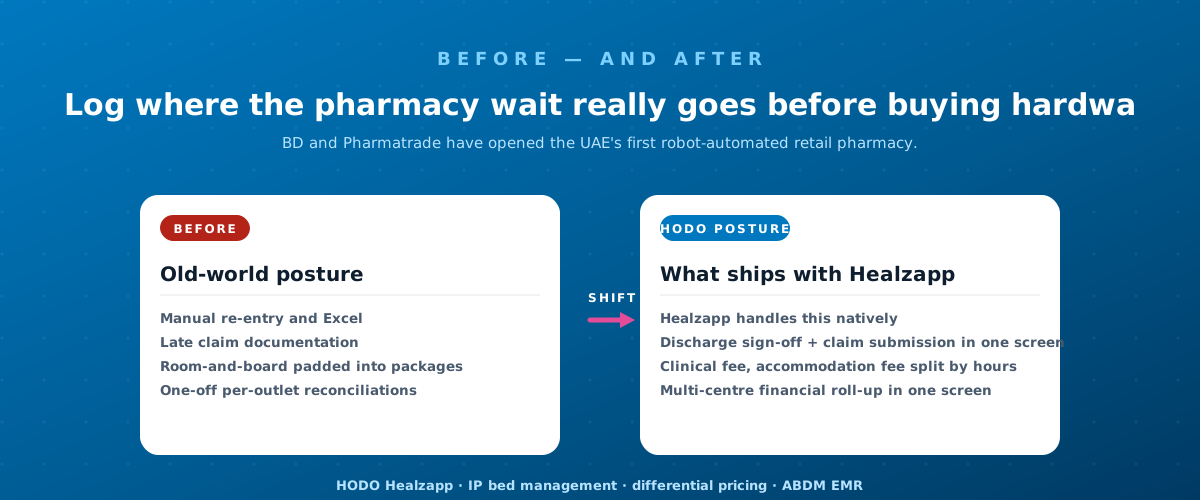
Log where the pharmacy wait really goes before buying hardware.
Licensing, insurance and the audit trail
Automation also raises the standard of record-keeping expected by regulators. DHA, MOHAP and the equivalent authorities in Qatar, Kuwait and Bahrain already expect traceability on controlled items, batch numbers and expiry handling. An automated dispensing point makes that trail electronic by default, which is an advantage during inspection — provided the system behind it holds the same data the regulator asks for, in a form that can be exported without a week of manual reconciliation.
Insurance adds a second audit layer. Claim rejections in GCC polyclinics frequently trace back to a mismatch between what was prescribed, what was dispensed and what was billed. When all three live in one record, the reconciliation is a report rather than an investigation. When they live in a clinical system, a pharmacy spreadsheet and a billing package, every rejected claim becomes a small forensic exercise, and claim leakage quietly becomes a fixed cost of doing business.
Asset-heavy automation introduces one more obligation: tracking warranty and maintenance contracts on the equipment itself. A robot under an expired service contract is a queue waiting to happen.
What this means for HODO customers
The sequence matters more than the technology. Before automating the pick, a polyclinic group should close the loop between prescription, dispense, stock and claim — and that loop is software, not hardware. HODO Healzapp handles it through the Pharmacy and Inventory modules working off a single item master, with Machine Interfacing removing transcription between equipment and the record, and Multi-outlet scale-up with one-click new-centre setup so a fourth or fifth branch inherits the same catalogue and pricing rules instead of inventing its own. Warranty+AMC asset tracking keeps service contracts on automated equipment visible before they lapse.