WAM (www.wam.ae) reports that the UAE AI Office has organised a specialised AI training programme in partnership with Emirates Health Services and Siemens, aimed at building applied AI capability inside the health workforce rather than buying it as a finished product. For private polyclinics in Dubai, Abu Dhabi, Doha and Manama, the signal matters more than the programme itself. Trained clinicians and administrators can only act on the data their systems actually record, and in most clinics the operationally important part is never recorded at all.
Why a capability programme is the interesting part
Most government AI announcements in the Gulf are procurement stories: a platform selected, a pilot funded, a partnership signed. This one is a capability story. The UAE AI Office, Emirates Health Services and Siemens are putting health sector staff through structured training, which implies a view that the binding constraint is not the availability of models but the ability of people inside health operations to apply them to real workflows. That view is sound, and it has a second-order effect private operators should read carefully. Emirates Health Services runs a large public network. When its administrators and clinical staff come out of a programme like this, practical expectations inside the UAE health system shift: shorter waits because scheduling is analysed rather than guessed, faster report turnaround because bottlenecks are measured, fewer repeat visits because history is available at the point of care. Patients notice those changes, then walk into a private polyclinic in Al Barsha or Khalifa City and compare. Insurers benchmark too. A polyclinic group that has spent five years running on a billing package plus spreadsheets plus WhatsApp threads will find that trained staff cannot close that gap on their own, because it is not a skills gap. It is a records gap.
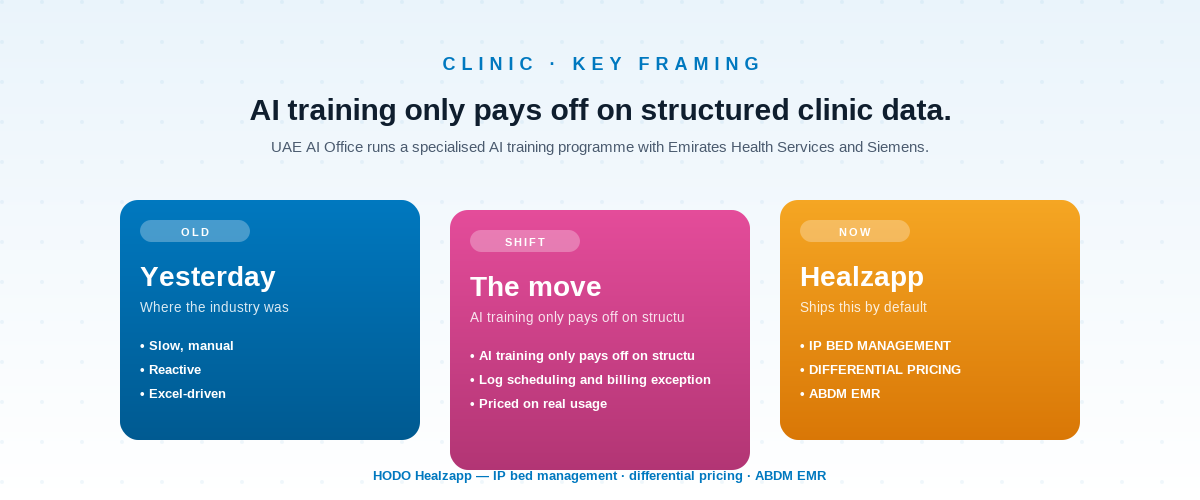
AI training only pays off on structured clinic data.
Trained people cannot query what was never written down
The pattern repeats across clinics in the region. A receptionist knows one insurer's pre-approval comes back within the hour while another takes two days, so she sequences her calls accordingly. A nurse knows which consultant runs late on Thursdays and quietly pads the slots. A branch manager knows the third-floor ultrasound has been throwing errors for months and has an informal workaround. None of this is in the system. It is operational intelligence held in heads, and it leaves when staff leave, which in GCC clinic operations, with visa cycles and real turnover, is often. Put an AI-trained administrator into that environment and the honest output is a request for data that does not exist. Any analysis of appointment utilisation requires that no-shows, walk-ins, late starts and doctor-initiated cancellations be distinguishable in the record, not collapsed into a single 'cancelled' status. Any analysis of claim rejections requires the reason code to be captured at the point of rejection rather than reconstructed at month end. Training without structured capture produces well-informed frustration. The fix is unglamorous: decide which operational events matter, make the system record them as a by-product of normal work, and stop relying on recall.
What an AI-ready polyclinic record actually contains
Four categories of record do most of the work. First, the appointment and queue layer: which doctor, which branch, booked when, arrived when, seen when, and what happened to the slot if it went unused. Multi-doctor scheduling in a polyclinic is where throughput is won or lost, and it is also the cleanest source of operational truth, because every entry is timestamped by someone doing their job. Second, the clinical record. An EMR that stores a visit as a scanned attachment is a filing system; an EMR that stores structured problems, medications and results is queryable. Healzapp's EMR (AI-condensed history) is built for the second case, so a consultant sees a compressed view of prior visits instead of scrolling a dozen files, and the same structure is what any later analysis depends on. Third, the diagnostic layer: Machine Interfacing, so analyser and imaging results land in the record directly without a transcription step that adds both delay and error. Fourth, the delivery layer, where WhatsApp/SMS report delivery turns report-ready into a timestamped event rather than a phone call nobody logged. None of these are AI features. They are the preconditions for any of it to work.
Billing and insurance: the part that breaks first
Gulf clinic billing is structurally harder than single-payer outpatient billing, and the difference is not currency. One polyclinic may handle direct-pay patients, several insurance networks with different co-pay and deductible rules, corporate accounts on negotiated rates, and walk-in packages, all inside the same session. Healzapp's Billing module covers multi-currency and GCC patterns for that reason, and Differential pricing lets a group hold distinct rate cards per payer or corporate partner instead of applying manual overrides at the counter. That matters for AI readiness in a specific way. If the rate on a line item is an override typed by a cashier, the price has no explanation attached. If the rate comes from a configured card tied to a payer, every bill carries its own reasoning. The first produces a dataset nobody can analyse. The second produces one where rejection patterns, payer mix and margin per consultation become answerable questions. The same holds for pre-approval status, submission dates and resubmissions. Clinics that hold these inside the HIS can say which payer costs them most in administrative time. Clinics that hold them in a shared spreadsheet can only say that collections feel slow. Trained staff do not change that. The recording method does.
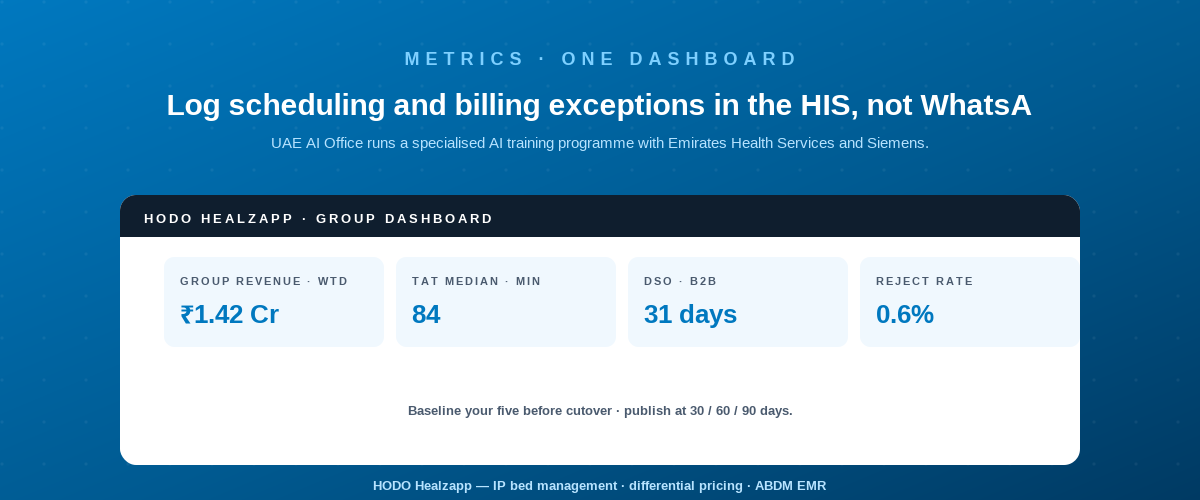
Log scheduling and billing exceptions in the HIS, not WhatsApp.
Groups scale configuration, not training
For a group running four or eight branches across two emirates, training has a scaling problem: every new branch brings new staff, new local habits and another round of knowledge transfer that is never quite complete. Configuration scales better. Multi-outlet scale-up with one-click new-centre setup exists for this, so a new centre inherits the service catalogue, rate cards, user roles and workflow rules of the group rather than being assembled from scratch by whoever opens it. The operational payoff is comparability. When every branch records a no-show the same way, cross-branch reporting means something and an underperforming location shows up in a week rather than a quarter. When each branch invents its own codes, group reporting becomes a reconciliation exercise that consumes the analysis time it was supposed to create. Licensing and inspection readiness follow the same logic: DHA and MOHAP-style requirements are easier to satisfy from a system already holding consistent records across sites than from branch-level compilation at short notice. Staff training then becomes an amplifier rather than a substitute. People who understand what the data can answer, working on data that is actually consistent, close the loop the UAE AI Office programme is pointing at.
What this means for HODO customers
The programme announced with Emirates Health Services and Siemens is a reasonable bet that capability has to be built inside health operations rather than bought around them. For a private polyclinic, the matching investment is not an AI purchase. It is making ordinary clinic work leave a structured trace. EMR (AI-condensed history) keeps the clinical record queryable instead of archived. Billing (incl. multi-currency / GCC patterns) with Differential pricing gives every line item an explanation that payer analysis can use. Multi-outlet scale-up with one-click new-centre setup keeps a growing group comparable across branches, which is the only condition under which group-level intelligence works at all. Clinics that get those three right will find AI-trained staff have something to work with. Clinics that do not will keep paying for training that lands on unstructured records.