Gulf Business reports that Aster Clinics plans to take its UAE network past 100 facilities by 2030. Coverage of the announcement puts the backing at AED 100 million, with the network at 85 UAE clinics today and annual footfall up 15% over the past year. For independent polyclinic owners in Dubai, Sharjah and Abu Dhabi, it is a preview of how UAE primary care will be competed for through 2030.
What the plan actually says
Going from 85 to 100+ facilities is a modest rise in site count. The more telling part is where the money goes. The plan, as reported, combines expanded existing clinics with new ones. It adds speciality centres, including diabetes care run as a ‘clinic within clinics’, orthopaedics and physiotherapy, and women's health. It also strengthens in-clinic diagnostics, grows homecare and personalised care, and pushes more of the patient relationship through the myAster digital platform.
Recent moves follow the same pattern: a new clinic in Jaddaf, an expanded orthopaedic clinic in Qusais, and wider women's health services at an existing Gardens site. New sites target high-density residential areas and emerging communities, in line with the UAE's aim of essential care within 10 to 15 minutes of home. Nearly as much of the growth is coming from making existing clinics deeper as from opening new ones.
That matters for the independent operator. A single polyclinic can't match a chain on real estate or marketing spend. It can match the operating model: more services per site, more revenue per patient, and a longer relationship after the consultation ends. Every one of those depends on operations and systems before it depends on capital.
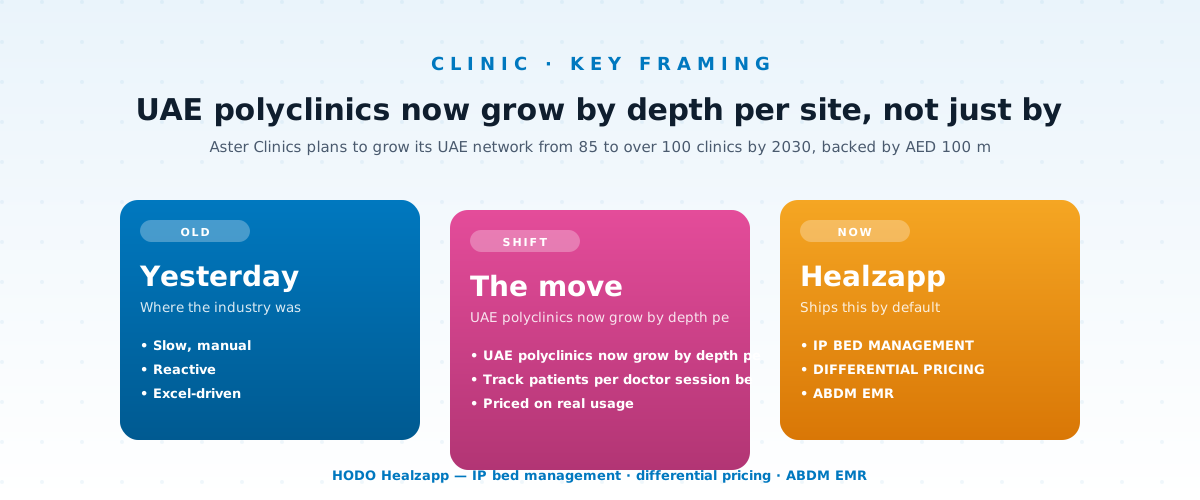
UAE polyclinics now grow by depth per site, not just by new sites.
Footfall growth is a throughput problem before it is a property problem
A 15% jump in footfall across the same floor area means about one extra patient for every seven already coming through the door. That load hits reception, the waiting area, nursing triage, billing and the insurance desk long before anyone feels the need for a new lease.
Most independent polyclinics run out of throughput before they run out of space. Common symptoms: doctors whose sessions overrun while the next clinician sits idle, walk-ins and booked patients sharing one queue, insurance eligibility checked at the counter while the line grows, and no-shows nobody tracks because the appointment book lives in several places.
Before committing to a second or third outlet, four numbers are worth tracking weekly for each doctor and each site:
Patients per doctor session, compared against the scheduled slot capacity.
Door-to-doctor time, from check-in to consultation.
No-show and late-cancellation rate by specialty and time slot.
Revenue per consultation-room hour, which shows which rooms and rosters actually earn.
If these numbers are poor at one site, a second site will copy the problem rather than fix it. Chains that scale well standardise the patient flow first and add locations after.
The clinic-within-a-clinic model is the one to copy
Aster's diabetes ‘clinic within clinics’ is the most transferable idea in the plan. A polyclinic that already sees a steady stream of general medicine, family medicine or internal medicine patients has a built-in referral base for a focused chronic-care service. The same logic applies to physiotherapy next to orthopaedics, or a women's health service next to general practice.
Setting one up usually involves regulatory work, such as adding specialties to the facility licence and credentialing clinicians with the relevant authority (DHA, DoH or MOHAP depending on the emirate). It does not require a new building. The operational work is where most attempts fail:
The sub-service needs its own roster and schedule, not a shared column in the general OP book.
Chronic-care programmes need package pricing and planned recall visits, not one consultation fee at a time.
Payer mix differs by service, so price lists by payer have to be managed deliberately.
The service needs its own P&L view. When its revenue disappears into general OP billing, nobody can tell whether the diabetes programme pays for itself.
An owner who can't answer ‘how many enrolled patients came back for their three-month review?’ is running a specialty signboard, not a specialty service.
Diagnostics and homecare extend revenue per patient
Aster's plan pairs new specialties with in-clinic diagnostics and expanded homecare. Together these lengthen the patient journey from a single visit into an episode of care.
With in-clinic diagnostics, the sample, the result and the revenue stay in-house, and the report returns to the same record the doctor opens at follow-up. For a polyclinic without its own laboratory, the practical sequence is to start with an outsource lab partnership, track how many consultations generate an investigation, and add in-house analysers once volumes justify the cost. The metric to watch is investigation capture rate: the share of ordered tests actually performed within the clinic's network.
Homecare does the same thing from the other side. Elderly patients, post-procedure follow-ups and chronic-care enrolees are the ones most likely to drop out when a visit means traffic, parking and a waiting room. A home visit or a teleconsultation keeps them in the programme. The operational condition is that home and remote encounters land in the same patient record and billing flow as clinic visits. Otherwise the service becomes a parallel business with its own spreadsheets.
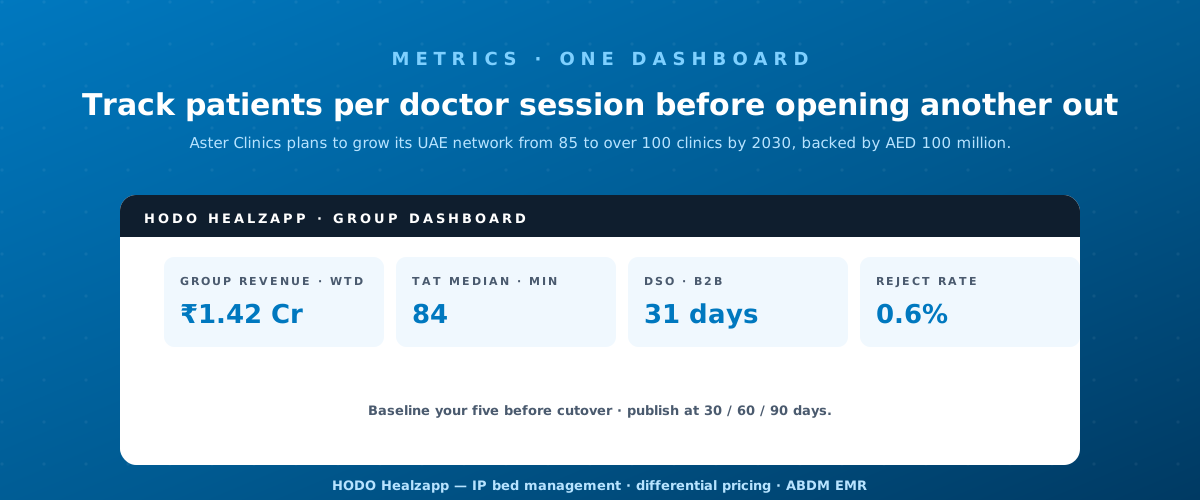
Track patients per doctor session before opening another outlet.
Scale exposes the systems gap
The point where an independent group moves from two clinics to four is where informal systems break. Price lists drift between branches. Doctor rosters get coordinated on WhatsApp groups. A patient seen in one branch shows up at another with no history on file. Month-end means stitching together exports from different tools.
Chains avoid this by treating each new site as a template: the same service master, price structures, user roles, report formats and patient communication rules, switched on for a new location instead of rebuilt by hand. Aster also runs clinics in Bahrain and Oman, and GCC groups expanding across borders face a further layer of currency and billing differences.
The patient-facing side needs the same discipline. myAster exists because patients now expect to book, see reports and speak to a doctor from their phone. An independent polyclinic doesn't need to build its own app, but it does need a patient app or dependable report delivery on the messaging channels its patients already use.
What this means for HODO customers
Healzapp is built for the operating model Aster's plan describes, at the size of an independent polyclinic or a growing group. Multi-outlet scale-up with one-click new-centre setup lets a second or fifth branch go live with the same service master and structures as the first, and Differential pricing keeps payer- and partner-specific price lists under control. Appointments, alongside TV Token Display, handles multi-doctor scheduling and waiting-room flow, so sub-specialty rosters don't compete for one queue. The Patient Health App, Teleconsultation and WhatsApp/SMS report delivery extend care beyond the visit, and Billing covers the multi-currency patterns GCC groups meet when they cross borders.
For a clinic-within-a-clinic, the gain is visibility: each specialty keeps its own schedule and price list while the patient record, reports and billing stay in one system. EMR (AI-condensed history) gives a doctor in a new branch or sub-service the patient's prior encounters at a glance. The four throughput numbers above become routine reports instead of a month-end exercise. That is the groundwork an independent polyclinic needs before its own next site, whether that is a second branch or a first specialty centre.