Docquity, the Asia-focused physician network and healthcare intelligence platform, has announced a strategic partnership with Growth Partner Holding to extend its operations into the Middle East, as reported by The Manila Times. The move brings another doctor-facing knowledge and insights layer into markets where clinic groups are already managing insurance pre-approvals, licensing inspections and multi-site expansion at the same time. For polyclinic owners in Dubai, Abu Dhabi, Doha, Kuwait City and Manama, the practical question is not whether such networks arrive. It is whether their own clinic data is in a state that can connect to anything at all.
What the partnership actually signals
Regional expansion deals of this kind follow a familiar shape. The platform brings a physician base and an analytics layer; the local holding company brings regulatory familiarity, licensing relationships and distribution across Gulf markets. The commercial logic is easy to read. The GCC has a dense private clinic sector, high insurance penetration, a large expatriate physician population that already consumes cross-border medical content, and health authorities pushing harder every year on digital record standards and e-claim discipline.
For a polyclinic operator, the useful takeaway is not that one more platform exists. It is that the number of parties asking for structured access to clinic data keeps rising. Physician-intelligence networks, insurer analytics teams, corporate wellness buyers, referral hospitals and AI vendors all arrive with the same implicit request: supply clean, exportable, coded records. Clinics running on a billing-only package, a shared drive of scanned consultation notes and a staff WhatsApp group for lab results cannot answer that request without weeks of manual reconstruction.
Treat the news as a deadline signal rather than a product to evaluate. Over the next two years, participation in regional networks, payer programmes and referral chains will quietly favour clinics whose records are machine-readable. The clinics that benefit will be the ones that fixed their record layer before the opportunity showed up, not the ones negotiating data extracts after signing a partnership.
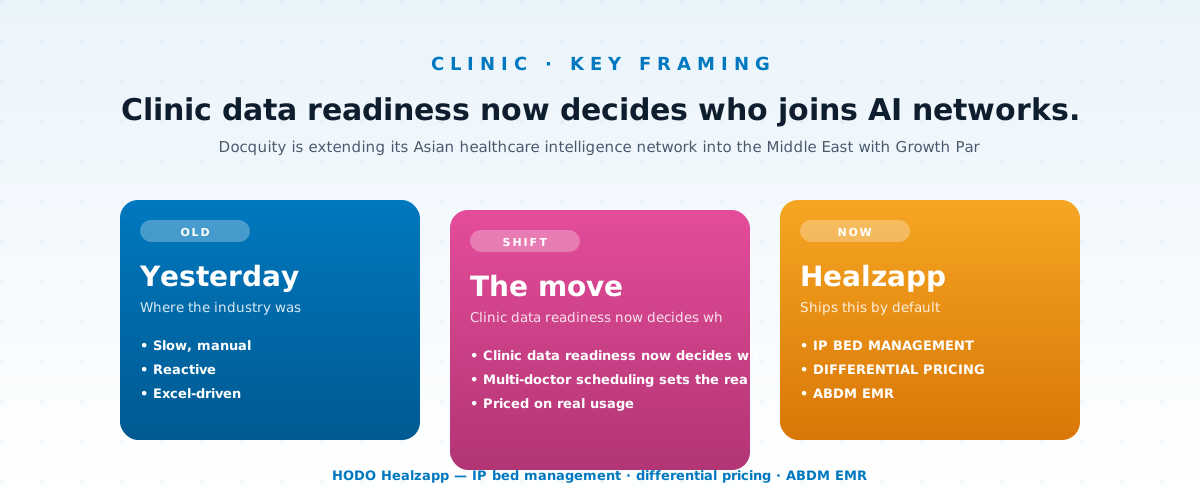
Clinic data readiness now decides who joins AI networks.
Data a clinic cannot export is data no network can use
The common failure in GCC polyclinics is not an absence of records. It is records stored in shapes nothing can read. Consultation notes live as free text in a word processor. Radiology findings arrive as a PDF attached to a visit. Analyser results are typed by hand into a comments field, with transcription errors nobody catches until an insurer queries the claim. Everything is technically present and operationally useless.
Fixing this is unglamorous work with measurable returns. Diagnoses and procedures captured against coded values instead of typed phrases. Lab and imaging results landing as discrete fields through machine interfacing, so a haematology analyser or a point-of-care device writes directly into the patient record rather than printing a slip someone re-keys. Allergies, chronic conditions and medications held in dedicated fields instead of buried in a paragraph.
The immediate payoff is consult-time retrieval. A doctor seeing twenty-eight patients in a shift cannot read eleven previous visits. A condensed, structured history that surfaces the last diagnosis, current medications and pending results in one view changes the first ninety seconds of every follow-up consultation. The secondary payoff is the one this news story points at: a clinic whose data is already structured can respond to a network, insurer or audit request in an afternoon instead of a quarter.
Multi-doctor scheduling is where throughput is won or lost
A typical Gulf polyclinic runs eight to twenty practitioners across general practice, dentistry, dermatology, physiotherapy, gynaecology and visiting specialists who hold two or three sessions a week. Shifts split around morning and evening sessions, hours shift during Ramadan, and the weekend pattern differs by country. Against that complexity, most clinics still schedule in a way that leaks capacity daily.
The leakage shows up in predictable places. Visiting-specialist sessions published late, so bookings arrive in the last forty-eight hours and half the slots go empty. Walk-ins absorbed into booked slots without any record of the displacement, so the schedule looks full while the waiting room looks chaotic. No-shows that nobody measures by doctor, day or slot type, which means nobody knows whether the 7 pm dermatology slot is worth keeping open. Patients queuing at reception to ask how long the wait is, which consumes front-desk attention that should be going to insurance verification.
Clinics that measure this find the fix is mostly structural. Publish specialist rosters far enough ahead that bookings can accumulate. Separate walk-in capacity from booked capacity instead of blending them. Show queue position on a screen so staff stop answering the same question. Convert routine result reviews and medication follow-ups to teleconsultation, which frees physical rooms for the visits that need a chair and an examination couch. None of this requires more doctors — it requires the schedule to reflect reality.
Insurance, cash and corporate contracts at the same front desk
Billing is where GCC clinic operations diverge most sharply from a single-payer model. One reception counter handles insured patients across several networks with different co-pay tiers, corporate contract patients with negotiated rates, self-paying residents, and visitors paying in another currency. Pre-approval thresholds differ by insurer and by service. A dental or physiotherapy package may need authorisation that a GP consultation does not.
Rejections rarely stem from clinical disagreement. They come from a diagnosis code that does not support the billed procedure, a missing authorisation reference, or documentation that cannot be produced in the form the payer wants. Each rejection costs staff time twice: once to resubmit, once to chase. A clinic doing four thousand claims a month with an eight per cent rejection rate is funding a part-time job out of avoidable rework.
The controls that reduce this are specific. Payer-specific rate cards applied automatically at billing rather than remembered by the cashier. Pre-approval status visible on the visit before the patient reaches the consultation room. Claim documentation assembled from the structured record instead of recompiled by hand. Reconciliation that ties collections, insurer receivables and corporate invoices back to accounts without a monthly spreadsheet exercise. Cashflow in a polyclinic is decided less by footfall than by how fast and how cleanly claims close.
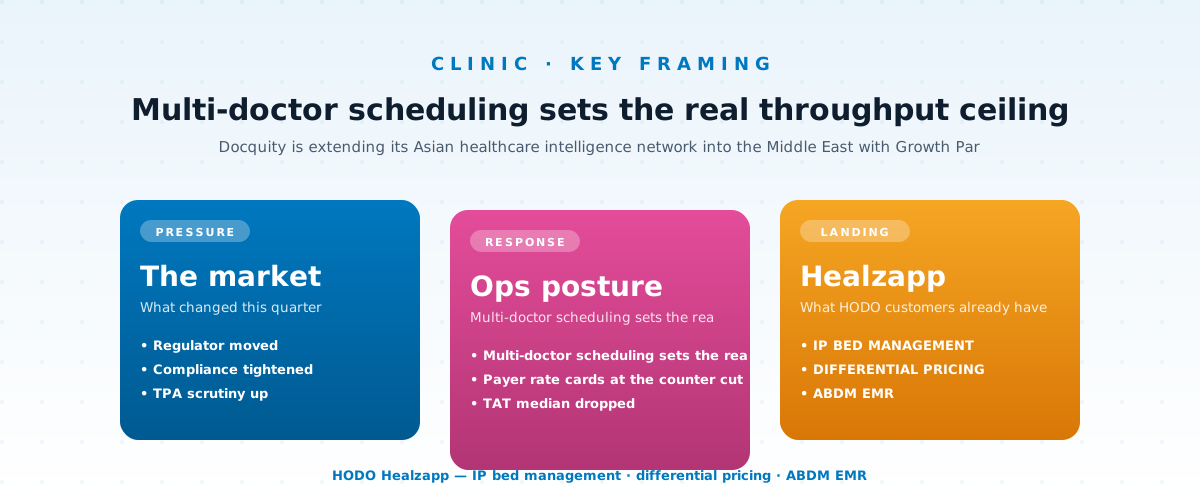
Multi-doctor scheduling sets the real throughput ceiling.
Licensing and audit readiness are a records problem
Gulf regulators inspect against local licensing frameworks that vary by emirate and by country, and the questions they ask are consistent even when the rules differ. Which licensed practitioner saw this patient. What credential covered that procedure. Where is the prescription trail. How long are records retained and who accessed them. What is the batch and expiry trail for dispensed medication and consumables.
A clinic that answers these from a structured system answers in minutes. A clinic that answers from scanned files and staff memory spends days preparing for an inspection and still exposes gaps. The same applies to pharmacy and consumable stock, where expiry control and dispensing records serve both compliance and margin. Audit readiness is not a separate project from daily operations — it is the by-product of capturing operations properly in the first place.
This is also the test that any future network, payer programme or AI partnership will apply. The ability to produce a complete, timestamped, attributable record on demand is the entry ticket. Clinics treating record quality as a compliance chore are solving the same problem as clinics treating it as a growth enabler; only one group gets both returns.
What this means for HODO customers
The Docquity and Growth Partner announcement is a reminder that regional healthcare intelligence is being assembled around clinic data, and clinics with unstructured records will watch it happen rather than take part. The groundwork is ordinary clinic software discipline, done properly.
In Healzapp, Appointments handles multi-doctor and visiting-specialist rosters with walk-in and booked capacity kept distinct, so throughput is measured rather than guessed. Billing (incl. multi-currency / GCC patterns) applies payer and corporate rate cards at the counter and keeps insurance, cash and foreign-currency collections reconcilable. EMR (AI-condensed history) gives the consulting doctor a usable summary of prior visits, medications and results instead of a stack of PDFs, and keeps the underlying record structured enough to satisfy an insurer query or a licensing inspection. For groups adding locations, Multi-outlet scale-up with one-click new-centre setup carries the same configuration into the next branch rather than rebuilding it.