Microsoft Source has published an update on the company's deepening commitment to the Middle East, covering investment in cloud and AI infrastructure, digital resilience and local skills development across the region. For a polyclinic group in Dubai, Abu Dhabi, Doha or Manama, the headline is about datacentres and training programmes, but the operational consequence lands much closer to the front desk. Regional AI capacity is only useful to a clinic whose own appointment, billing and clinical records are structured enough to feed it.
Regional infrastructure is moving faster than clinic data maturity
The announcement follows a pattern that has become familiar across the GCC: in-region cloud capacity, AI compute, cybersecurity commitments and workforce training, all aligned to national digital agendas in the UAE, Saudi Arabia, Qatar and Bahrain. One consequence matters directly to healthcare operators. The old objection to hosting clinical data on hyperscale cloud, that the nearest region sat in Europe, with latency and data-residency questions attached, has largely dissolved. Residency is now an architecture choice rather than a blocker.
What has not changed is the state of the data inside most mid-sized polyclinics. A typical four-to-eight doctor clinic runs appointments in one system, insurance eligibility checks in a payer portal, pharmacy stock in a spreadsheet, and consultation notes spread across templates and free text. Each of those is individually workable. Together they turn any AI initiative into a data-cleaning project first, and a clinical project a long way second.
The practical reading of a regional investment announcement is therefore not "start buying AI". It is narrower and more useful: the infrastructure constraint has been removed, so the binding constraint is now operational. Clinics that spend the coming year consolidating scheduling, billing and records into one system will be able to use regional AI services whenever they choose to. Clinics that do not will spend the same budget on integration consultants, and will still be reconciling two versions of the same patient record.
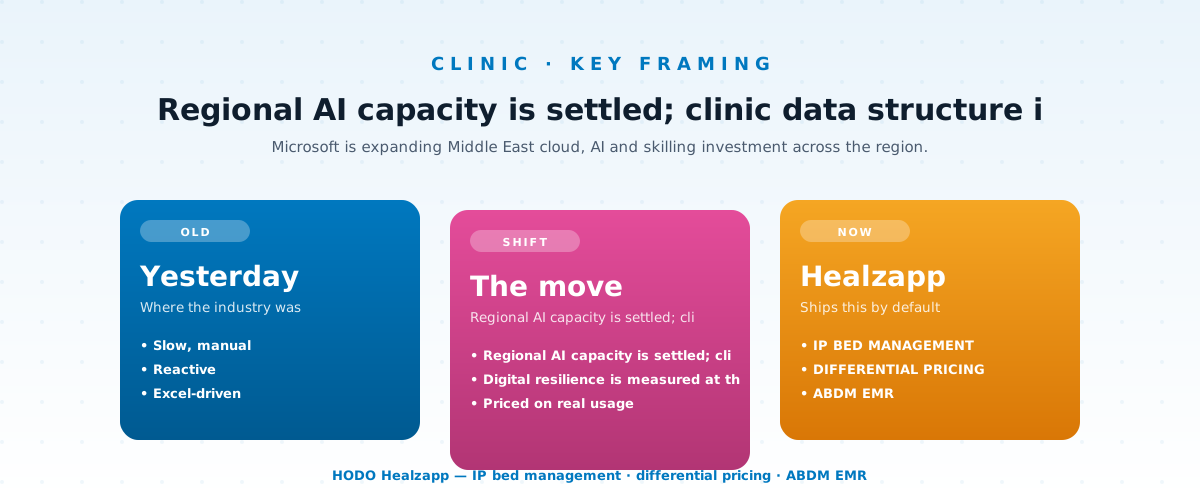
Regional AI capacity is settled; clinic data structure is not.
Digital resilience is measured at the reception counter
Digital resilience, in the Microsoft framing, covers cybersecurity, continuity and sovereign control. Translated to a polyclinic, it means something concrete: what happens to the clinic on the day the internet link drops, the licence renewal falls due, or the receptionist who knew all the workarounds resigns.
Most GCC polyclinic groups have grown by adding branches rather than by re-platforming. The second branch got a copy of the first branch's setup; the third got a slightly different copy. Patient master data diverges, price lists diverge, and consolidated reporting becomes a monthly export-and-merge exercise. That is a resilience problem long before it is an analytics problem, because it means no single source of truth exists to restore or to audit against.
DHA, DOH and MOHAP-style licensing regimes add a second dimension. Inspection readiness depends on being able to produce consistent records, consent, prescriptions, doctor licence validity, insurance claims, across every branch on request. Clinics that rely on per-branch local installations tend to discover the gaps during an inspection rather than before it. A single hosted system with one patient index and one pricing structure turns that from a scramble into a report. The regional cloud build-out makes that architecture easier to justify to a board that previously worried about where the data physically sat.
Multi-doctor scheduling is the dataset worth cleaning first
If a polyclinic wants one measurable win before touching AI at all, scheduling is the place to take it. Multi-doctor, multi-speciality clinics in the GCC run a harder scheduling problem than most Indian outpatient departments: visiting consultants who work two sessions a week, doctors split across two branches, licence-restricted scopes of practice, and walk-in traffic that peaks sharply around Friday and evening hours.
The costs of getting this wrong are not subtle. Empty consultant slots in a clinic paying a fixed monthly retainer are pure margin loss. Overbooked slots push waiting-room times past the point where insured patients start choosing a competitor two streets away. Neither shows up clearly in a monthly P&L; both show up immediately in a utilisation report that compares booked slots against available slots per doctor per session.
Getting that report requires appointments, doctor rosters and billing to live in the same system. Once they do, a set of ordinary operational questions become answerable: which sessions run under sixty per cent utilisation, which doctors carry the longest lead time to next available slot, how many bookings convert to a billed consultation, and what proportion of no-shows follow a missed reminder. None of that needs a large language model. All of it becomes considerably more valuable if a model is later pointed at it.
Billing and insurance decide whether the data is worth reading
GCC clinic billing looks nothing like Indian hospital billing, and treating it as a localisation afterthought is where several HIS deployments in the region have come apart. Multi-currency handling, VAT treatment, co-payment and deductible rules that vary by payer and plan, corporate and staff-scheme rates, cash versus insured pricing for the same test, these are structural requirements, not configuration flags.
The operational tell is the claim rejection rate. Rejections that trace back to eligibility not being checked at registration, or to a service being coded against the wrong plan, are billing-system problems wearing a clinical costume. They consume administrative hours, delay cash by weeks, and distort the utilisation numbers the clinic uses to make hiring decisions.
A clinic that fixes this gets two things. First, working capital behaves predictably, which matters when a branch lease and four doctor retainers are due on the same date each month. Second, and relevant to the AI question, the revenue data becomes trustworthy. Any forecast, any payer-mix analysis, any automated coding assistance built on top of unreliable billing records will produce confident nonsense. Regional AI capacity does not change that; it only makes the nonsense faster.
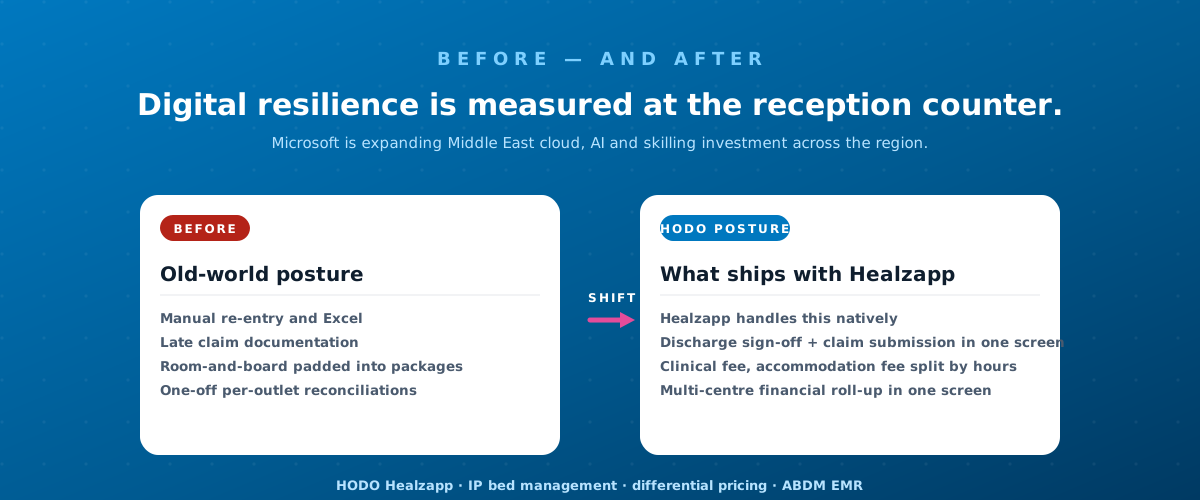
Digital resilience is measured at the reception counter.
The skilling gap shows up in operations, not IT
Workforce development is a recurring theme in these regional investment announcements, and it is usually read as a developer-training story. In a polyclinic the shortage is elsewhere. The people whose capability determines whether a system delivers value are receptionists, insurance coordinators, nurses and branch managers, not a two-person IT team.
That argues for a narrow definition of what good software looks like in this segment. Fewer screens per task. Defaults that match how the clinic actually runs. Report delivery that reaches the patient without a staff member re-typing a mobile number. Queue and token handling that reduces the number of times a receptionist is asked "how long more". Systems that require heavy training tend to be used partially, and partially-used systems generate exactly the patchy data that makes every later project harder.
What this means for HODO customers
The Microsoft investment story is a reminder that regional infrastructure is no longer the limiting factor for GCC healthcare operators, internal data structure is. Healzapp is built around that assumption for polyclinic groups. Appointments handles multi-doctor, multi-session and visiting-consultant scheduling with utilisation reporting per doctor and per branch, so slot economics stop being a monthly guess. Billing (incl. multi-currency / GCC patterns) covers payer-specific rules, co-payments and cash-versus-insured pricing as first-class structures rather than workarounds. Multi-outlet scale-up with one-click new-centre setup keeps the third and fourth branches on the same patient index, price list and reporting spine as the first, which is what makes consolidated reporting and licensing inspections routine instead of disruptive. EMR (AI-condensed history) and WhatsApp/SMS report delivery close the loop at the consultation and at the patient's phone.