Ceres is set to work with the UAE Medical Investment Group on "Smart Ward and Cardiac Diagnostic Center Development", according to a 머니투데이 report carried on Google News. The headline reads as a hospital infrastructure story, but much of the operational load lands one layer down — on the polyclinics that will refer cardiac cases in, read reports back, and bill insurers for the episode. Instrumented wards and specialist diagnostic centres only pay off when the clinics feeding them can move structured data rather than scans and phone calls.
What the Ceres-UAE MIG tie-up signals
The report carries little technical detail, but the shape is familiar across the Gulf. An investor group with hospital assets brings in an outside technology partner to build two things together: instrumented inpatient capacity, and a dedicated cardiac diagnostic centre. Cardiology is a logical place to start. Volumes are predictable, pathways are protocol-driven, insurer coverage is well established, and the modality mix — ECG, echocardiography, stress testing, Holter and ambulatory blood pressure — produces structured output that can be read centrally and reported out to referring clinicians.
For polyclinics in Dubai, Abu Dhabi, Doha, Kuwait City and Manama, this is not somebody else's capital project. Specialist diagnostic centres live on referral volume from general and multi-specialty clinics, and instrumented wards need somewhere for discharged patients to follow up. Every such opening changes three things for the clinic next door: a new place to send cases, a new commercial counterparty with a price list, and a new data obligation. The clinic that can receive a cardiac report into the patient record, put it in front of the consultant at the next appointment, and bill the insurer for the whole episode keeps the relationship. The clinic that cannot becomes a holding bay for paper.
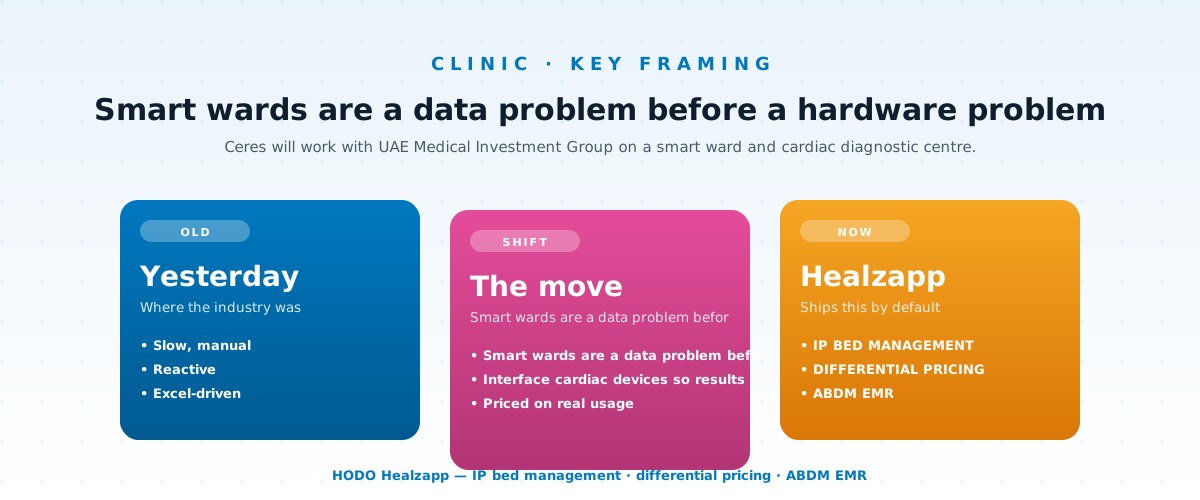
Smart wards are a data problem before a hardware problem.
A smart ward is a data-integration project
Most "smart ward" budgets get read as hardware budgets: monitors, central stations, bedside terminals, pumps that talk. Hardware is rarely the binding constraint. The constraint is whether the output of all that instrumentation reaches the record a clinician actually opens, and whether it gets there without a nurse retyping it.
This is the same problem a twelve-bed observation unit in a UAE polyclinic already has at smaller scale. Vitals go onto a paper chart, get transcribed into the system at the end of a shift, and lose their timestamps on the way. An analyser or an ECG machine prints to paper, the paper is scanned, and the scan is filed against the visit as an image nobody can trend. By the time a consultant reviews, the clinical picture is a stack of attachments rather than a timeline.
Device-level integration is what closes that gap: results posting from the machine into the patient record, with the patient identifier attached at acquisition rather than at filing. The operational test is straightforward. Count the minutes per shift that nursing staff spend moving numbers from one surface to another. In clinics that have not solved this, the figure is rarely small, and it scales linearly with bed count and with every new device added to the floor.
Cardiac diagnostics rewire the referral chain
When a cardiac centre opens nearby, surrounding clinics stop being pure end points and start acting as channel partners. That shift carries administrative weight. Each referral needs an order, a booked slot at the centre, a report returned against the correct patient, an agreed commercial split, and an audit trail that survives both a DHA or MOHAP-style licensing review and an insurer audit.
Most polyclinics run this on a messaging group and a spreadsheet. It works until volume arrives. Then reports get attached to the wrong file, the referring doctor chases status by phone, and month-end reconciliation with the partner centre turns into a two-day exercise because nobody logged which referral produced which invoice. The failure is not clinical; it is that the referral never existed as a record in the first place.
The alternative is to treat partner centres and referring doctors as system users with their own logins, each seeing only their own cases, their own turnaround, and their own rate card. Rates differ by counterparty — a corporate contract, a partner clinic and a walk-in patient should not price the same test identically — so pricing has to be configurable per partner rather than negotiated by email and applied manually at billing.
Insurance billing is where the pathway leaks
A cardiac episode in the GCC crosses several payers and several price books. Pre-approval thresholds, co-pay tiers, package versus itemised pricing, network versus out-of-network rates, and cash patients paying in a different currency all sit in the same day's work. The clinic that handles this in a general accounting package is effectively re-deriving the payer rules by hand on every claim.
Two failure modes dominate. The first is revenue quietly left behind: a procedure performed in the observation unit, documented in the notes, and never posted to the bill because the charge capture happened in a different place from the clinical record. The second is rejection churn — claims returned for a missing pre-approval reference or a service coded against the wrong plan, then resubmitted weeks later with the cash already forecast.
Neither is fixed by hiring another biller. Both are fixed by making the billing layer read the same record the clinician wrote in, carry payer-specific and partner-specific rates natively, and handle multi-currency settlement without a parallel ledger. That is also what makes a new branch viable: if the pricing and payer logic is configuration rather than custom work, opening a second or third centre is an administrative task, not a project.
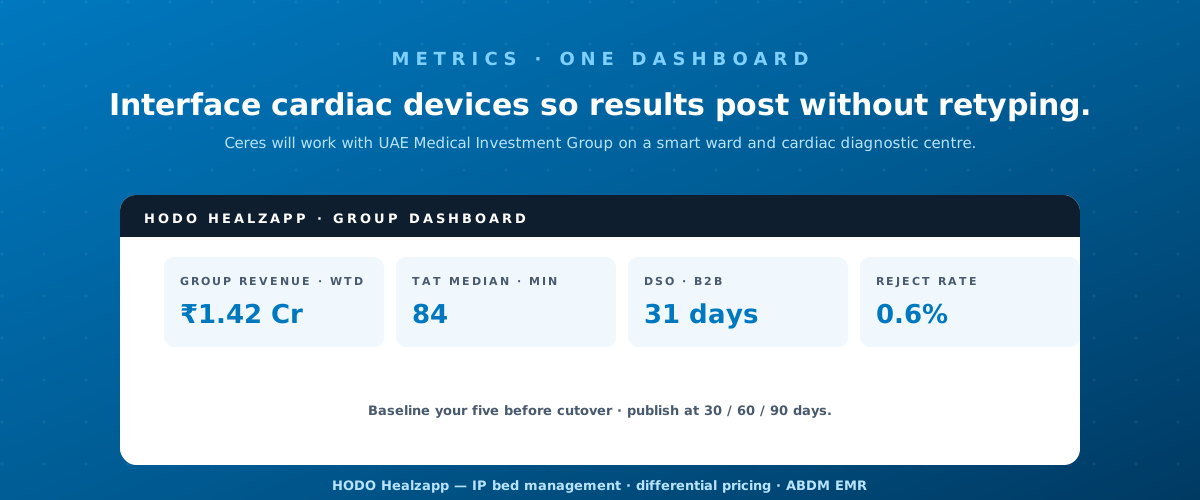
Interface cardiac devices so results post without retyping.
Scheduling and bed visibility decide realised capacity
Capacity on paper and capacity delivered are different numbers. A polyclinic with nine consultants across three specialities loses throughput to the same recurring causes: overlapping slot templates, no view of which observation beds are free right now, consultants held up waiting for a prior report, and patients in the waiting area with no idea where they stand in the queue.
Fixing this is unglamorous. Multi-doctor scheduling with per-consultant templates and room constraints. Live bed and chair occupancy visible to whoever is admitting, not reconstructed by walking the corridor. A nursing view that shows pending orders and vitals due by bed. A queue display in the waiting area so reception stops answering the same question forty times a day. And a condensed clinical history at the top of the consultation, so a returning cardiac follow-up does not cost eight minutes of scrolling before the consultation starts.
These are the measures that move the only numbers that matter commercially: patients seen per consultant hour, time from arrival to first contact, and staff hours spent on coordination rather than care. A smart ward built on top of weak scheduling discipline will simply produce instrumented idle time.
What this means for HODO customers
The Ceres-UAE MIG announcement is a useful prompt rather than a threat. Specialist capacity is being added across the GCC, and the clinics that connect to it cleanly will capture the referral economics. Three parts of HODO Healzapp carry most of that work. Machine Interfacing pulls analyser and device output into the patient record with identifiers attached at source, which is the same plumbing a smart ward needs and the same plumbing an observation unit needs today. B2B Referral / Outsource Lab / Corporate-partner logins turn referral relationships into tracked records with partner-level visibility and Differential pricing per counterparty, so reconciliation stops being a month-end reconstruction. Billing with multi-currency and GCC payer patterns keeps charge capture attached to the clinical record instead of a separate ledger, and makes a second or third centre a configuration exercise.
Clinics evaluating platforms this quarter should test these three things against their own referral volume before anything else on the feature list.