M42, the Abu Dhabi-based health group, and Siemens Healthineers have announced a partnership to advance healthcare transformation across the Global South, published through the Abu Dhabi Media Office and carried on Google News. The stated focus is imaging, AI-assisted diagnostics and capacity building in emerging markets. For a six-doctor polyclinic in Dubai, Sharjah, Doha or Manama, the operational reading is narrower and more useful: diagnostic scale is being industrialised by very large groups, so the mid-sized clinic has to locate its advantage somewhere other than hardware.
What the announcement actually describes
Partnerships of this shape move three things. They move installed diagnostic capacity into markets that were previously under-equipped. They move reporting workflows toward standardised, vendor-supported AI tooling rather than locally assembled scripts. And they move reference pricing, because once a large group runs high-volume imaging and laboratory operations in a region, the per-study and per-test cost that payers and corporate buyers consider reasonable is set by that group's unit economics, not by a single clinic's rate card.
None of that is a threat to a polyclinic in the conventional sense. A clinic in Al Barsha does not lose patients because Abu Dhabi commissions more scanners. What changes is the composition of margin. Diagnostics has historically subsidised consultation in small multi-speciality clinics across the GCC, a modest consultation fee, carried by the laboratory and imaging work that follows it. When regional diagnostic capacity rises and reference prices drift downward, that subsidy thins. The clinic that has not examined where else its margin comes from finds out late, usually during an insurance renewal cycle.
The planning question is therefore not whether to buy equipment. It is which parts of the patient journey a clinic genuinely owns, and whether its systems record those parts well enough to defend them.
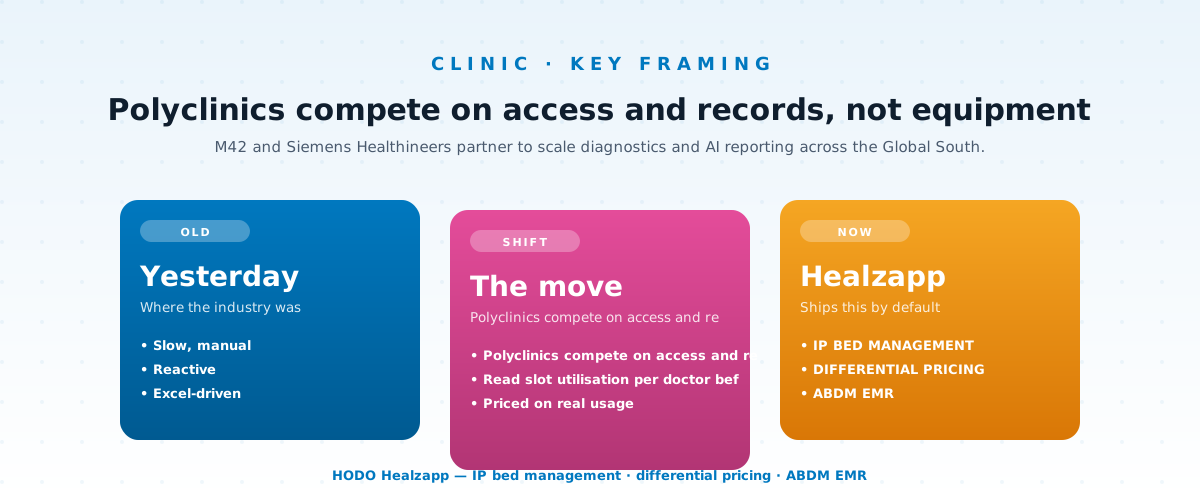
Polyclinics compete on access and records, not equipment.
A polyclinic does not win on installed equipment
What a neighbourhood polyclinic actually controls is access and continuity. A patient can be seen the same afternoon. The same general practitioner remembers the last visit. A dermatology or paediatric opinion is available within the same building without a new registration. A family of four is on one file. None of that is purchasable at scale, and none of it depends on owning a particular scanner.
The problem is that access and continuity are usually managed informally, which means they degrade quietly. Same-day access collapses when a single consultant's session is overbooked while another sits half-empty, because no one is reading slot utilisation by doctor and by hour. Continuity collapses when the previous visit's notes exist but take four minutes to locate, so the consultant re-takes the history and re-orders tests the patient already paid for last month.
Both failures are scheduling and records problems, not clinical ones. Multi-doctor scheduling that shows real utilisation per session lets a clinic manager move slots before the complaints start. A patient record that opens with a usable summary of prior visits lets the second consultation start where the first ended. Clinics that fix these two items typically find their consultation revenue per doctor-hour improves without any change in fees, and that improvement is durable in a way that a diagnostic margin is not.
Outsourced diagnostics is only cheap when the loop closes
Most GCC polyclinics already outsource a share of their laboratory and imaging work, and more will as regional capacity grows. Outsourcing is rational. It becomes expensive when the loop around it is manual. The common pattern: a test is ordered on paper, sent by courier or a driver, the result arrives by email as a PDF, someone downloads it, renames it, and attaches it to the file, if they remember. Each handoff adds delay, and the delays are invisible until a patient calls asking why a result promised on Tuesday has not arrived.
A tighter arrangement treats the partner laboratory as part of the clinic's own workflow rather than an external vendor. The order is raised once in the clinic system and visible to the partner. The result returns into the same patient record, against the same order, without re-keying. In-house analysers connect directly so the machine output becomes the recorded result instead of a value typed from a printout. Where the clinic also receives referred work from smaller practices nearby, those referrers get their own login rather than a shared mailbox.
The gain is measurable in two places: turnaround time to the patient, and the number of results that go missing between a partner and a file. A clinic that can promise a result window and meet it builds a referral reputation that no capacity announcement erodes.
Billing discipline decides whether volume actually pays
In the UAE, Qatar, Kuwait and Bahrain, insurance structure, not footfall, determines whether a busy clinic is a profitable one. A polyclinic typically carries several payers with different approved tariffs, different pre-authorisation thresholds and different documentation expectations, alongside cash and corporate patients. Add licensing requirements from DHA, MOHAP and their regional equivalents, and the administrative load per visit is substantial.
Three practices separate clinics that collect from clinics that chase. First, differential pricing configured per payer and per corporate contract, so the approved rate is applied at the counter rather than corrected after rejection. Second, reconciliation on a weekly rhythm, submitted, approved, rejected, resubmitted, reviewed by someone with authority to fix the cause, because a rejection pattern repeated for six weeks is a configuration error, not bad luck. Third, visible cash position: multi-currency and multi-payer billing that reports collection against service date, so the owner knows what is earned, not just what is invoiced.
This is unglamorous work, and it is where the thinning diagnostic subsidy is recovered. A clinic running a four per cent rejection rate against a peer at fourteen per cent is not better clinically. It has better configuration.
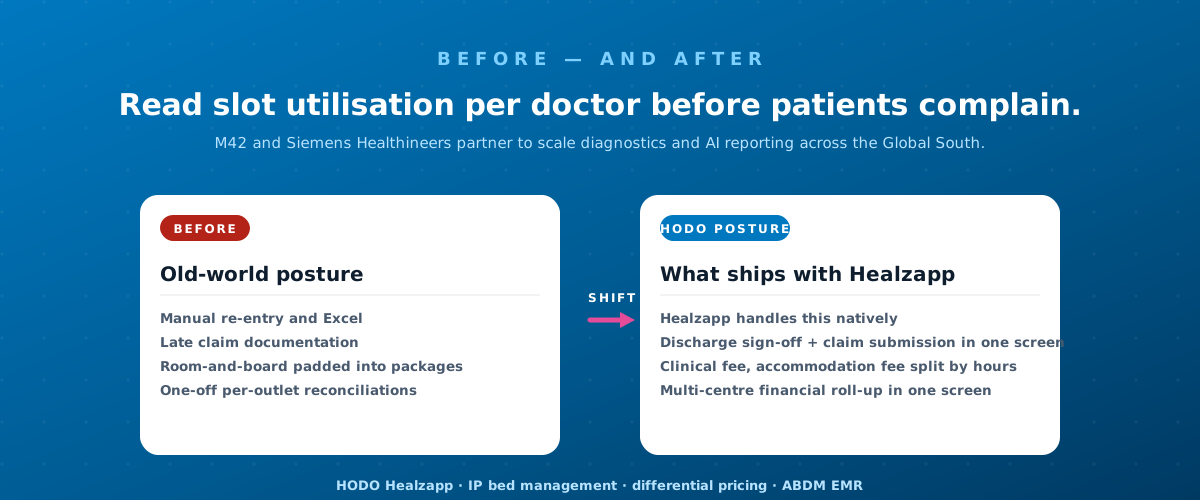
Read slot utilisation per doctor before patients complain.
Where AI reporting leaves the clinic's own work
If vendor-supported AI tooling increasingly handles image and test interpretation at the diagnostic layer, the clinic's contribution shifts to synthesis, reading a result against the patient's own history and deciding what happens next. That raises the value of a record that can be read quickly. A consultant who opens a file and sees a condensed view of prior visits, medications and past results makes a faster and safer decision than one scrolling through eighteen months of entries.
It also raises the value of delivery. A result that reaches the patient on WhatsApp with a clear next step, and a follow-up consultation that can happen by teleconsultation rather than a second trip across the emirate, converts a diagnostic event into continued care in the same clinic. For groups planning a second or third branch, the same logic applies to expansion: a new centre should inherit existing payer configuration, tariffs and templates rather than be rebuilt by hand over three weeks.
What this means for HODO customers
The M42 and Siemens Healthineers partnership signals cheaper, more standardised diagnostics across the region. Polyclinics that depended on diagnostic margin should expect it to compress, and should move their defensible value into access, records and collection discipline. HODO Healzapp is built for that work in UAE and GCC clinics. Appointments exposes real utilisation across multiple doctors so same-day access survives growth. B2B Referral / Outsource Lab / Corporate-partner logins and Machine Interfacing close the loop between partner laboratories, in-house analysers and the patient record without re-keying. Differential pricing with GCC billing patterns applies the right payer tariff at the counter, and Multi-outlet scale-up with one-click new-centre setup carries that configuration into the next branch instead of rebuilding it.