Uttar Pradesh has de-empanelled 648 hospitals and suspended 61 others from Ayushman Bharat–PMJAY after audits flagged violations and irregularities, Medical Buyer reported this week. For a ~100-bed hospital that runs 40–60% of its inpatient book on PMJAY receivables, losing empanelment is not a compliance ding — it is a cashflow event that can wipe out a quarter and force staff reshuffles inside a fortnight.
What actually happened in Uttar Pradesh
The state health authority’s action came after a phased audit of empanelled facilities under the National Health Authority’s fraud and abuse control framework. The 648 hospitals struck off the panel and the 61 placed under suspension covered a mix of small nursing homes, mid-sized private hospitals and a handful of larger chains. The specific triggers, per the reports, ranged from ghost admissions, upcoded procedures and duplicate claims to missing discharge summaries, thin OT notes and patient records that could not be produced on demand during on-site verification.
None of these are new offences. What has changseed is the tempo. State health agencies are now processing anti-fraud referrals in batches and publishing them, which turns a quiet notice into a public event. For a hospital operator, the reputational dent lands the same day the empanelment is pulled — and TPAs, corporates and PMJAY beneficiaries all recalibrate together.
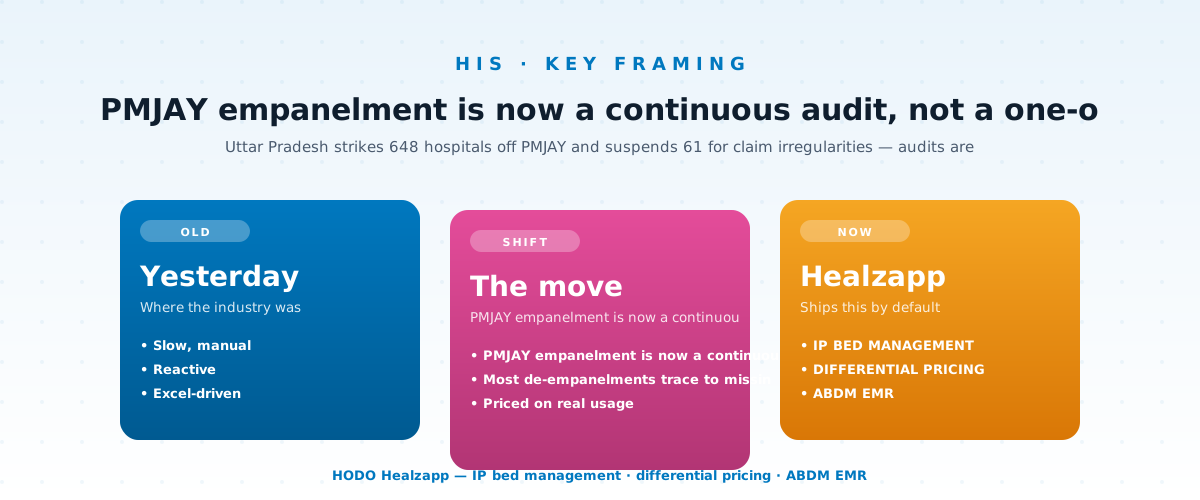
PMJAY empanelment is now a continuous audit, not a one-off.
Why PMJAY audits are tightening this year
NHA has been steadily hardening its claim-scrutiny stack. AI-based triangulation now cross-checks admission timestamps against bed occupancy filed by the same hospital, procedure claims against surgeon credentials on file, and diagnostic bills against machine-side logs where labs are integrated. The Uttar Pradesh batch is unlikely to be the last — Rajasthan, Madhya Pradesh and Karnataka have run similar audits in the last 12 months, and Kerala’s SHA has publicly said it is moving in the same direction.
The operational read is that empanelment is no longer a one-time credentialing exercise. It is a continuous evidence-production job. The hospitals that got de-empanelled were rarely doing outright fraud — most were losing the paper trail: nurse notes not written up before discharge, IP admission entries backdated in the HIS after the fact, or investigation reports uploaded as unstructured PDFs that could not be tied back to the specific PMJAY claim number.
The paperwork trail that keeps you on the panel
Every PMJAY claim that survives an audit has the same anatomy: a verifiable admission event, a bed assignment that matches the claimed length of stay, clinical notes stamped by the attending doctor within the shift, investigation reports linked to the visit, an OT note or procedure record if one is billed, and a discharge summary produced before the patient physically leaves.
The failure mode is almost always temporal. Notes get written days later. Bed occupancy filed to the state does not match the internal ward register. Discharge summaries are dictated by a junior resident and never counter-signed. Any one of these gaps is survivable; three of them on the same claim is what turns into a de-empanelment letter. A modern HIS forces the events into sequence — you cannot generate the discharge summary before the discharge is entered, you cannot bill a procedure without the OT note being signed off, and you cannot close a PMJAY claim without the linked EMR entries being present.
Where 100-bed hospitals typically leak evidence
Three patterns come up repeatedly in de-empanelment case files. First, split ledgers — the front office runs one billing system for cash and TPA, the PMJAY co-ordinator maintains a parallel Excel for state claims, and reconciliation happens weekly at best. When an audit lands, the two ledgers disagree on admission dates. Second, weak IP bed tracking — beds are marked occupied on the whiteboard but not in the HIS, so the claimed length of stay cannot be corroborated. Third, disconnected diagnostics — the in-house lab prints reports on its own stationery and hands them to the ward, with no digital link to the patient’s PMJAY case ID.
Each of these leaks is fixable, but only if the fix is architectural rather than procedural. Telling the PMJAY co-ordinator to be more careful survives one audit cycle. Making the HIS the single source of truth for admissions, bed occupancy, clinical notes, investigations and claims closes the gap permanently.
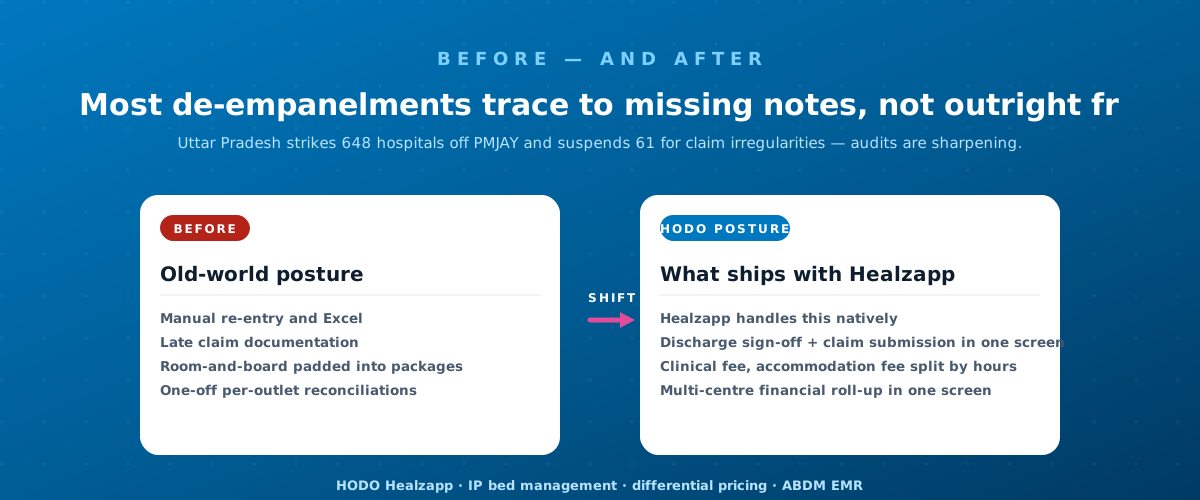
Most de-empanelments trace to missing notes, not outright fraud.
Rebuilding PMJAY discipline at the ward level
The operators who came out of the Uttar Pradesh audit clean shared a small set of habits. Nursing stations logged observations in the HIS at the point of care, not at end of shift. Bed management was updated at the moment of transfer, so the state-facing occupancy figure and the internal register never drifted. Investigation reports flowed from the lab analyser into the patient record automatically, carrying the correct patient ID and timestamp. And discharge summaries were auto-populated from the EMR — the doctor edited and signed rather than dictating from scratch, which cut the compliance window from days to minutes.
None of this is exotic. It is the standard operating shape of a well-configured HIS. The mistake most hospitals make is treating PMJAY as a billing workflow bolted onto the side, rather than as the default discipline for every admission — cash, TPA and state scheme included.
What this means for HODO customers
For hospitals running HODO Healzapp, the de-empanelment risk is largely an implementation-hygiene question. ABDM-compliant EMR gives each admission an auditable, timestamped clinical record that survives an on-site NHA verification without the paper hunt. IP bed management keeps ward occupancy consistent with what is filed to the state, so length-of-stay claims cannot be contradicted by the hospital’s own register. And Billing — with PMJAY, TPA, corporate and cash on one ledger — removes the split-book problem that most de-empanelled hospitals share. Operators still have to run the process, but the HIS stops rewarding the shortcuts that show up in audit reports.