ETV Bharat reports that Uttar Pradesh has directed hospital pharmacies to display their rate list where patients can see it, and that chemist associations have already raised concerns about how the order will be read and enforced. For a 100-bed hospital running its own dispensing counter, this is less a pricing decision than a data-discipline problem. A list on the wall is only defensible if the billing screen behind the counter produces exactly the same number, every shift, for every batch on the shelf.
What the order asks, and what the chemists are objecting to
The direction is narrow on its face: hospital pharmacies must publish what they charge, in public view, so a patient or an attender can check a price before the bill is raised. The objections being raised by chemist bodies are not really about transparency. They turn on three practical points. First, for scheduled and branded formulations the ceiling is already set by the manufacturer's printed MRP and by NPPA notifications, so a display board adds a compliance burden without changing the number. Second, the same molecule sits on a hospital shelf in several packs and several batches at different printed rates, so one static board cannot represent the counter accurately for long. Third, enforcement falls on whoever is standing at the counter during an inspection, not on whoever maintains the price master.
All three objections are reasonable, and all three are solvable inside the HIS rather than on the notice board. The hospitals that will struggle are not the ones charging aggressively. They are the ones that cannot produce, on demand, a single authoritative answer to the question "what does this hospital charge for this item today". Most 100-bed hospitals in Uttar Pradesh and elsewhere can answer that for consultation and room rent. Very few can answer it for 3,000-odd pharmacy line items without someone opening a spreadsheet.
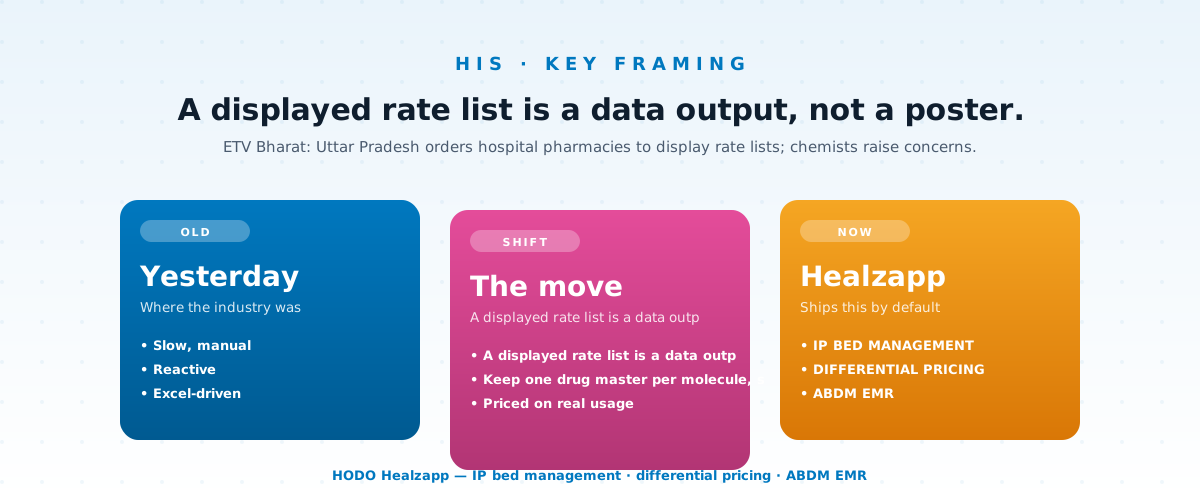
A displayed rate list is a data output, not a poster.
The display list is only as clean as the drug master
Pharmacy price disputes almost always trace back to master data, not to intent. The common failures are dull and repeatable: the same molecule entered three times with different spellings because three people did data entry on three different days; a strip of ten billed as a unit in casualty and as a strip in the IP pharmacy; pack size recorded as 1 when the purchase was in boxes of 15; an item retired at the main store but still live in the OT sub-store with a two-year-old rate.
Any of these turns a display board into a liability. A patient photographs the board, compares it to the bill, and the difference is a unit-of-measure error — but it reads as overcharging. Before publishing anything, the sensible sequence is a master clean-up: one item code per molecule, strength, form and pack size; generic name as the primary field with brand as a secondary attribute; a single owner for additions; and a hard rule that no new item can be billed before purchase and sale units are both defined. That clean-up is a week of work for a pharmacy in-charge with a competent HIS, and it is the entire foundation of everything that follows.
Two MRPs on one shelf: batch-wise rates and substitution
The chemists' sharpest point is the batch question. A hospital pharmacy routinely holds stock of the same item bought at different times, with revised MRPs printed on the newer packs. If the system carries a single flat rate per item, the counter either undercharges on new stock or overcharges on old stock, and the second case is the one that produces a complaint. Batch-wise stock with batch-wise MRP and expiry is therefore not an accounting nicety — it is the only way the dispensed price can be reconciled to the pack handed over.
Substitution is the second half of the problem. When the prescribed brand is unavailable, the counter substitutes a generic equivalent, often at a lower rate. If the substitution is handled verbally and the bill simply shows whatever was dispensed, there is no trail connecting the prescription, the indent and the issued batch. Audit teams and TPAs both read that gap the same way. The fix is to make substitution an explicit action in the system, captured against the original prescription line, so the record shows what was ordered, what was dispensed, which batch it came from and what the patient paid. Hospitals that do this also get a usable generic-substitution rate, which is a number worth tracking on its own for drug spend per occupied bed.
Where the bill drifts from the board: indents, OT and ward stock
A display board governs the retail counter. Most of a 100-bed hospital's drug consumption does not pass through that counter at all. It moves as ward indents, OT trays, emergency trolley stock and floor-level consumption that gets reconciled later, sometimes much later. That is where the gap between published rate and charged rate actually opens.
The operational test is simple: pick any inpatient bill from last week and try to walk every drug line back to a store issue, a batch and a rate. If ward consumption is posted as a lump-sum "pharmacy charges" line, or if the OT indent is settled the next morning from memory, the hospital cannot defend its own displayed list. Closing this means issuing to patient rather than to location wherever possible, posting unused returns on the same day, and treating ward and OT sub-stores as stocked locations with their own balances instead of a black box. It also removes a familiar discharge delay — bills held back while the ward reconciles drug consumption are a measurable contributor to late discharges and to the bed turnaround time that occupancy depends on.
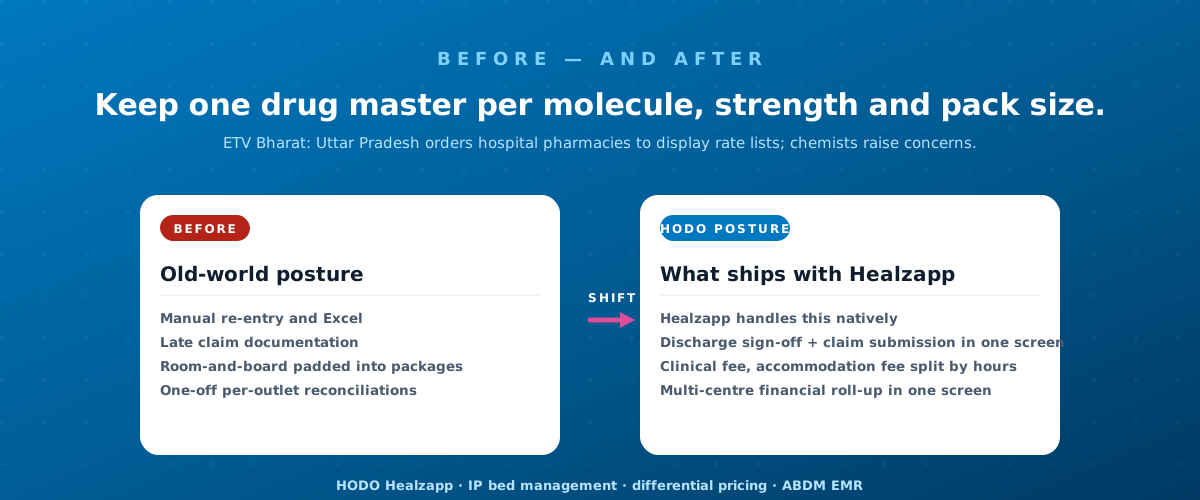
Keep one drug master per molecule, strength and pack size.
The ten-minute inspection test
A workable readiness standard is this: when an inspector or an aggrieved attender asks about a single drug, the pharmacy should be able to produce, within ten minutes, the current charged rate, the printed MRP of the batch in hand, the purchase rate and date, the date the rate was last revised and who revised it, and the last five bills on which the item was charged. None of that requires new infrastructure. It requires that rate revisions be dated and attributed rather than overwritten, that discounts be governed by payer-wise tariffs rather than counter-level overrides, and that the display list be generated from the live price master rather than typed up separately and reprinted when someone remembers.
Hospitals running multiple centres should also decide, before the next rate revision, whether the pharmacy price master is central or local. Both are defensible. What is not defensible is a chain where each centre edits its own rates and nobody can say which version is on which wall.
What this means for HODO customers
A public rate list is a reporting output, and it needs the stock and billing layers underneath it to be accurate. Healzapp Pharmacy carries batch-wise stock with MRP and expiry at batch level, so the price charged follows the pack actually dispensed instead of an item average. Inventory extends the same discipline to ward, OT and sub-store locations, so indents, issues and returns reconcile against the patient bill rather than sitting in a lump-sum charge. Differential pricing keeps one master with payer-wise tariffs for cash, TPA, PMJAY and corporate patients, which keeps the displayed rate honest without blocking contracted rates. Tally integration closes the loop to the books, so purchase, consumption and sale agree across the pharmacy and finance views.