The Economic Times reports that the GST Council has moved life and health insurance premiums to 0% GST, ending the 18% levy that sat on retail policies for years. For the buyer that is straightforward relief. For the hospital that receives the insured patient, the second-order effects hit billing, TPA workflow, pricing masters, and outlet capacity, and they arrive faster than most admins expect.
What the GST change actually says
The reform zero-rates GST on individual and family health insurance premiums, along with life cover. IRDAI-registered insurers will drop the 18% tax component from their retail products; group and corporate policies are expected to see the pass-through as well. The immediate arithmetic is simple: a ₹25,000 family floater that carried ₹4,500 in GST now lands at ₹25,000. Premium affordability climbs across every segment where price sensitivity is real, Tier-2 and Tier-3 buyers, first-time policyholders, and the retiree segment that had been priced out of the market.
The distributional effect for hospitals is where things get interesting. Insurance penetration in India has been stuck near 3.7% of GDP, and health cover specifically has been the laggard. A tax cut of this size is the largest single-shot demand stimulus for retail health insurance in a decade. Insurer sales cycles compress, TPA volumes rise, and hospitals that see insured patients today will see more of them within two to three quarters.
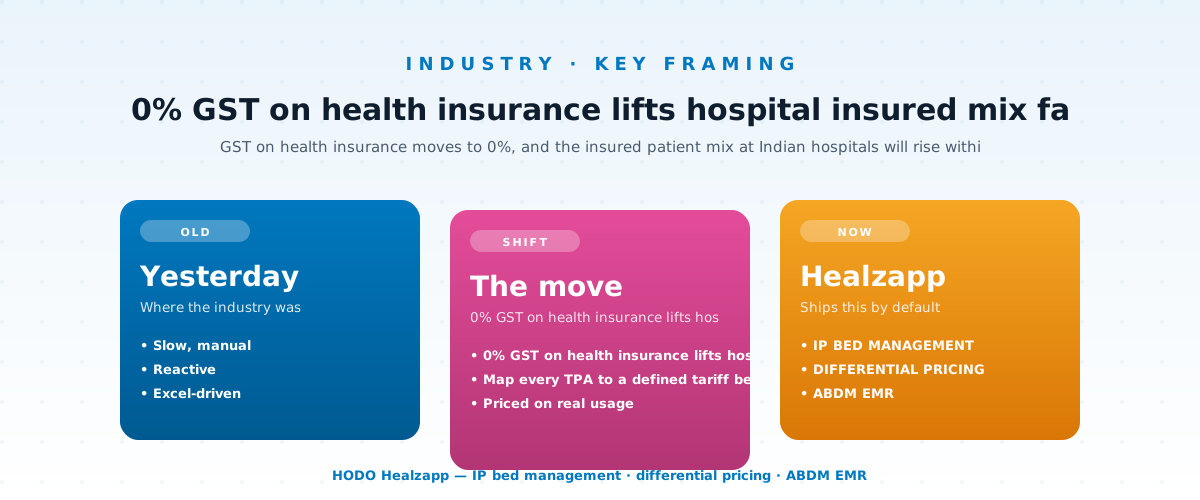
0% GST on health insurance lifts hospital insured mix fast.
Why the insured-patient mix matters more now
An insured patient is not the same operational unit as a cash patient. The billing cycle is longer, the documentation load is heavier, pre-authorisation and query resolution eat into consultant and admin hours, and TPA discounts squeeze the realised rate. When the insured share rises from, say, 32% of IP admissions to 45%, three costs jump at once: pre-auth handling time, denial-management effort, and days-in-AR on the cashflow side.
Hospitals that treat this shift casually end up with two visible symptoms, collections teams that grow faster than revenue, and consultants complaining about paperwork instead of throughput. The clinics that plan ahead re-map their billing masters, tighten cashless workflows, and put TPA-specific price lists in place before the surge, not after it. The window to do that is now, before the second-quarter numbers land.
TPA and cashless flow will strain first
Cashless is where the operational bottleneck shows up first. Each TPA carries its own tariff, its own pre-auth format, its own turnaround expectation, and its own set of exclusions. When volumes double, the manual approach, spreadsheet tariffs, email pre-auths, WhatsApp queries to a floor manager, collapses. Query cycles stretch from 24 hours to 72, and the AR ageing bucket shifts sharply to the right.
The fix is structural, not heroic. Every TPA relationship needs a defined tariff in the HIS, a named single point of contact, and a service-level target on pre-auth submission, the industry benchmark is under two hours from admission for planned procedures. Denial reasons should be logged as structured data rather than free text, so the top three denial reasons in any quarter can be addressed at policy level with the TPA rather than fought case by case. Hospitals that build this discipline hold their days-in-AR below 45; those that don't drift past 75 within a year.
Pricing masters and differential rate cards
The pricing problem gets sharper as insurance volume rises. Corporate tie-ups, TPA agreements, government schemes such as CGHS, ECHS and state schemes, and self-pay walk-ins all sit on different rate cards, and every one of those cards is being renegotiated as insurance penetration climbs. A hospital that runs one master price list and applies discounts manually at billing is one clerical error away from either revenue leakage or a TPA audit dispute.
The clean approach is a rate-card-per-payer architecture, every corporate, every TPA, every scheme gets its own tariff object, versioned by effective date, applied automatically at the billing counter based on the payer flag on the patient record. This is not exotic engineering; it is the operational baseline for any 100-bed-plus hospital that plans to run cashless volume without margin erosion. Chains that skip it end up with finance teams reconciling manually every month-end and audit findings on tariff mismatches at year-end.
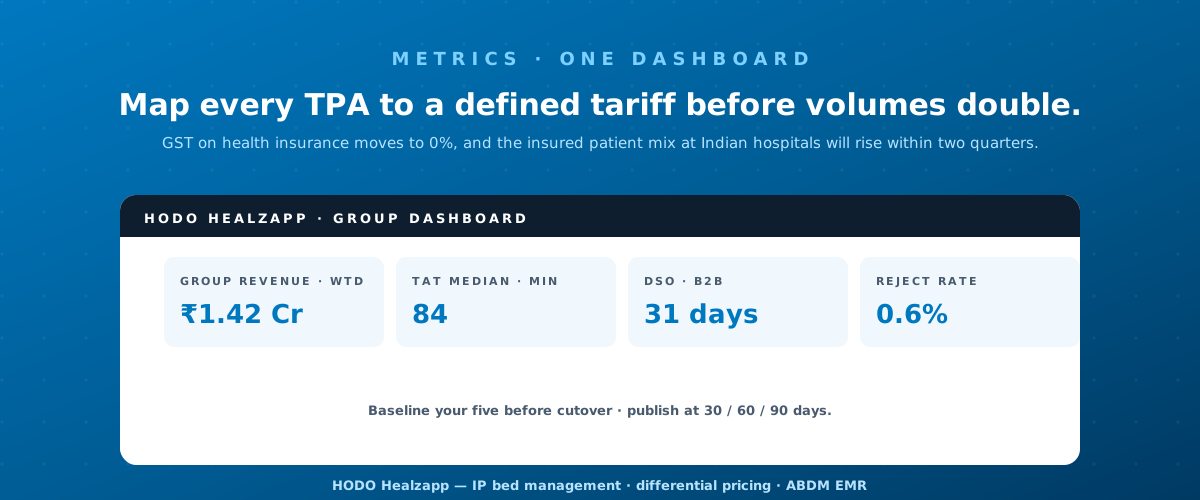
Map every TPA to a defined tariff before volumes double.
The multi-outlet angle
For clinic chains and diagnostic groups, the reform shifts the unit economics on new-outlet decisions. When retail health insurance gets cheaper, the addressable market for OP consultations, planned diagnostics, and elective day-care procedures expands in every catchment. Cities that were marginal on volume become viable. Suburbs that were considered saturated open up on the insured side of the ledger.
But new outlets only capture the upside if the setup cost is low enough to justify the bet. HIS deployment, doctor rosters, billing masters, TPA links, and MIS reporting all have to be reproducible from a template rather than built bespoke per site. Chains that have standardised setup on templates open a new outlet in weeks. Those that haven't spend six months per site and miss the demand window entirely.
What this means for HODO customers
The GST change is a billing and TPA readiness question first. Billing in Healzapp holds payer-flagged patient records, so cashless, corporate, and self-pay flows separate at the billing counter without manual routing. Differential pricing lets each TPA, corporate tie-up, and government scheme run on its own tariff, versioned and applied automatically, the rate-card-per-payer model without the spreadsheet risk. Multi-outlet scale-up with one-click new-centre setup means the surge in insured demand can be captured across catchments without the six-month site-by-site rebuild that stalls most chain expansions.